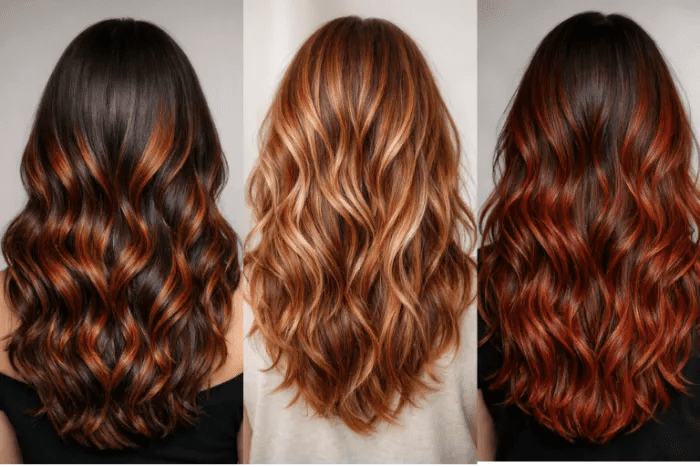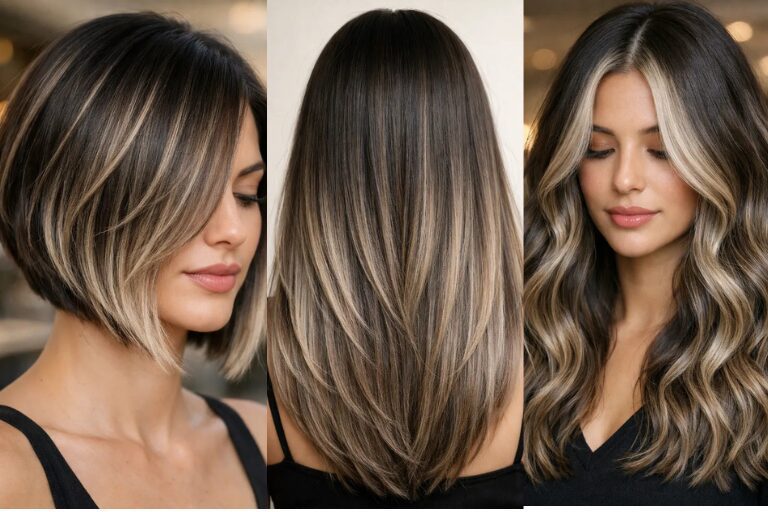
30 Golden Blonde Balayage Ideas: Glowing Styles That Brighten Your Whole Look
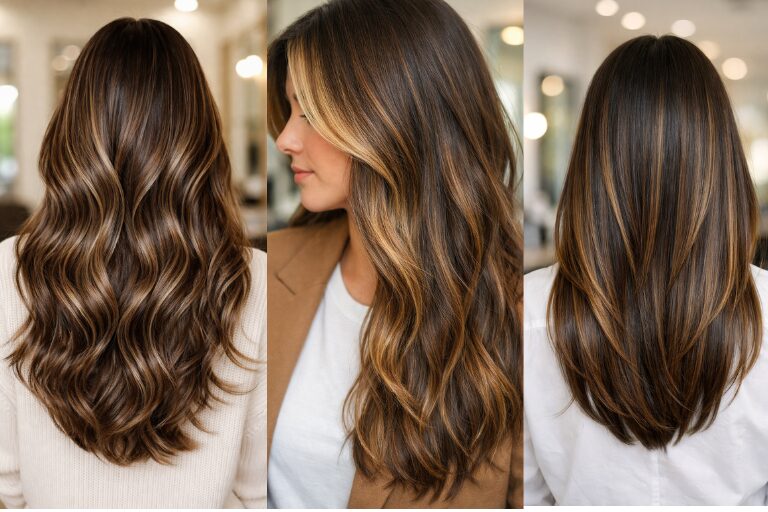
Golden blonde balayage occupies a specific, valuable space in hair color — it’s the technique that makes dark hair look lighter, fine hair look fuller, and dull hair look genuinely luminous without the commitment, the harsh grow-out, or the high maintenance schedule that traditional highlights demand.
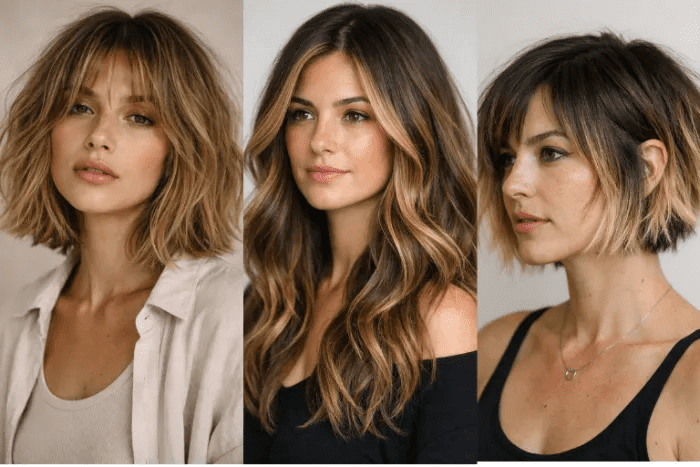
The reason it works so broadly across hair types, textures, and base colors comes down to how the technique interacts with light. Balayage places color where light naturally hits — the outer layers, the surface, the face-framing sections, the ends — and leaves the interior and root sections in their natural state. That distribution mimics exactly what sun exposure does to hair, which is why a well-executed golden blonde balayage reads as healthy and natural rather than obviously colored.
Golden specifically is the right tone choice for women who want warmth and luminosity rather than the cool, modern quality of ash or the understated depth of neutral tones. Golden highlights add a warmth to the base that reads as a genuine glow — in natural light, in photographs, in the mirror on a low-effort morning when you’ve done nothing to your hair.
This guide covers 30 golden blonde balayage directions across every hair length, texture, and base color. Every style includes what to request at the salon, how the technique works for that specific combination, and how to maintain the result so it stays glowing rather than fading flat or going brassy.
One note before you choose: the quality of a golden blonde balayage depends enormously on the toner applied at the end of the appointment. The lightening process is what creates the canvas; the toner is what creates the color. Ask your colorist specifically for a golden or warm-toned toner finish — without it, lightened sections default to whichever underlying tone your hair reveals during lifting, which is rarely the warm, rich gold you’re after.
1. Soft Bob With Golden Blonde Balayage
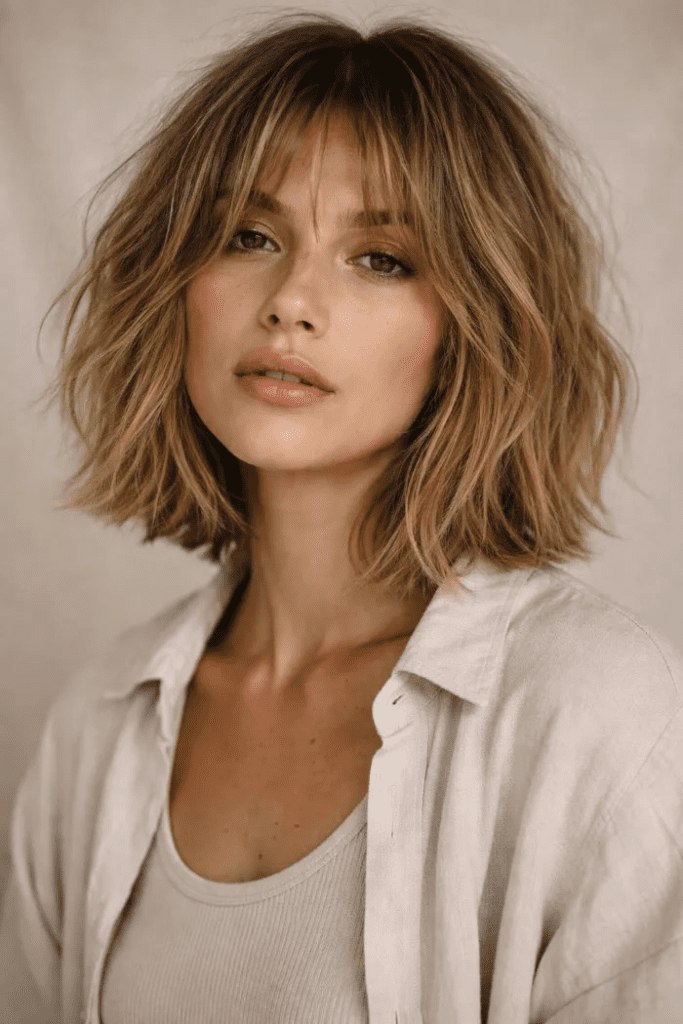
A softly layered bob at jaw length is one of the most flattering pairings for golden blonde balayage because the shorter length concentrates all the color dimension within the section of the hair closest to the face — which is where the brightening effect has the most visible impact on skin tone and overall appearance.
The golden balayage blended through the mid-lengths and ends adds warmth and movement to a bob that would otherwise risk looking flat or boxy. On a jaw-length cut specifically, highlights through the ends lift the perimeter visually, making the bob look fuller and more dimensional rather than sitting heavily against the cheek.
What to ask your colorist: Ask for golden balayage concentrated through the top layer and front sections rather than distributed evenly throughout — on a bob, interior highlights are largely invisible, so surface and face-framing placement delivers the most visible result for the same amount of work. Request a warm golden toner to finish.
Maintenance tip: Blow dry with a slight inward or outward bend at the ends to keep the highlighted perimeter visible. Straight-styled bobs on golden balayage can look flat — a small bend in the ends catches the light and shows the color dimension at its most flattering angle.
Best for: Women with jaw-length bobs who want a color update that makes the cut look fuller, warmer, and more dimensional without adding length or changing the shape.
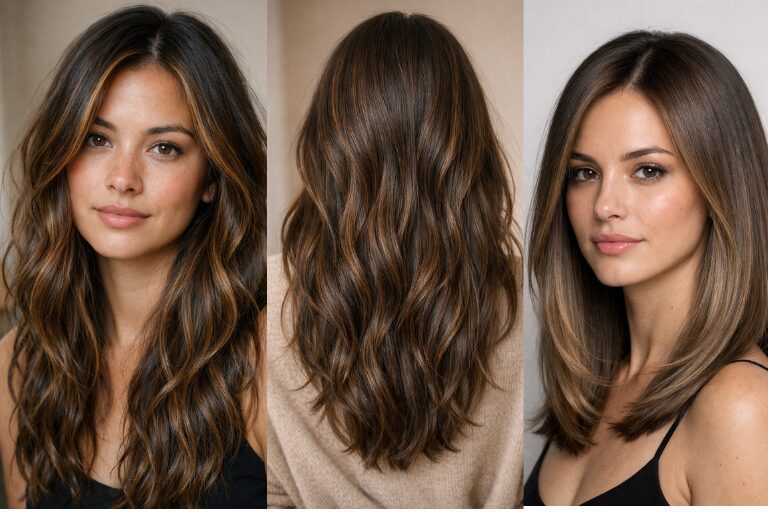
2. Brunette Hair With Golden Blonde Balayage
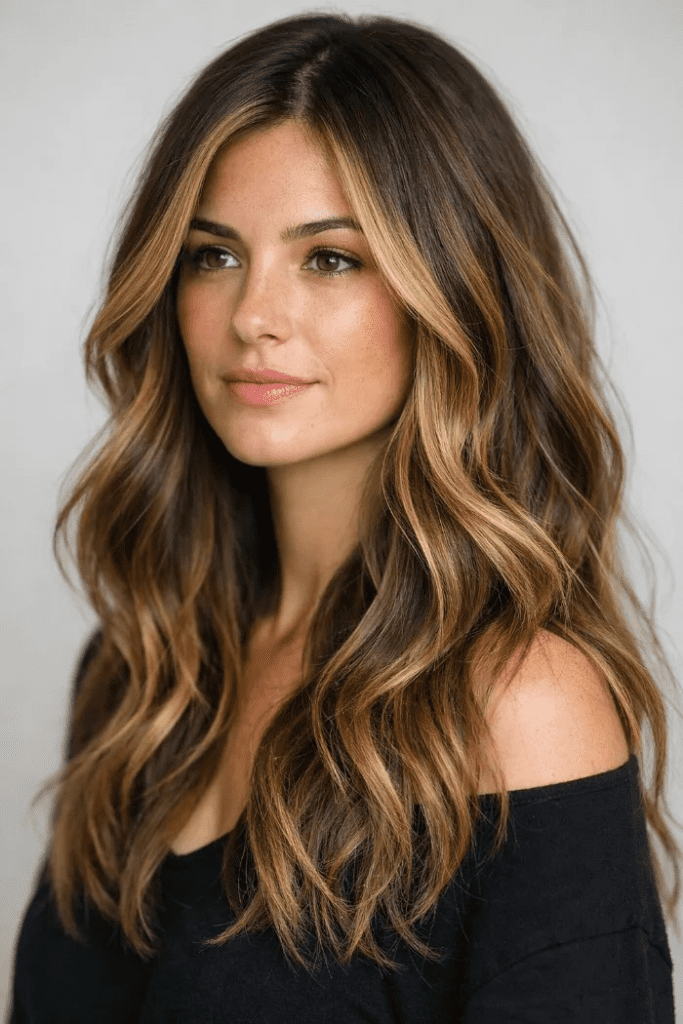
Golden blonde balayage on a brunette base is one of the most universally requested color combinations — and for good reason. The contrast between a rich brunette base and warm golden highlights creates a natural-looking dimension that both tones reinforce rather than compete against. The brunette reads deeper and richer next to the gold; the gold reads warmer and more luminous next to the brunette.
The placement of the gold is what determines whether the result looks natural or obvious. Highlights concentrated exclusively at the surface layers, face-framing sections, and ends replicate the way sun naturally lightens brunette hair. An even distribution of golden highlights throughout the full section of every foil produces a result that reads as colored rather than sun-kissed.
What to ask your colorist: Ask for surface-layer and face-framing balayage placement with golden sections that start at least two inches below the root. A root shadow or root smudge at the connection point between the natural brunette root and the golden mid-length is the technical step that makes the result look seamless rather than highlighted.
Maintenance tip: A warm golden or caramel-tinted gloss applied every six to eight weeks maintains the richness of both the brunette base and the golden highlights simultaneously. Without a periodic gloss, the golden sections fade toward a cooler, brassier tone while the brunette base can look flat.
Best for: Women with medium to dark brunette bases who want visible golden warmth that still reads as a natural variation of their own brunette rather than an obvious color treatment.
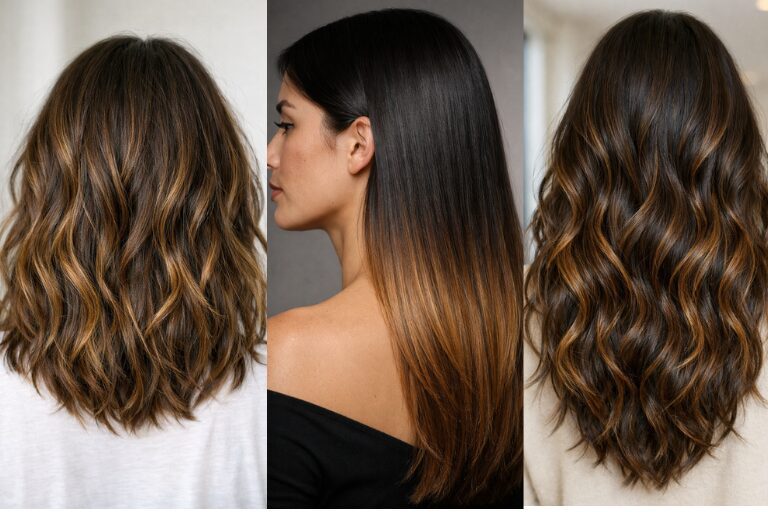
3. Chocolate Brown With Golden Balayage
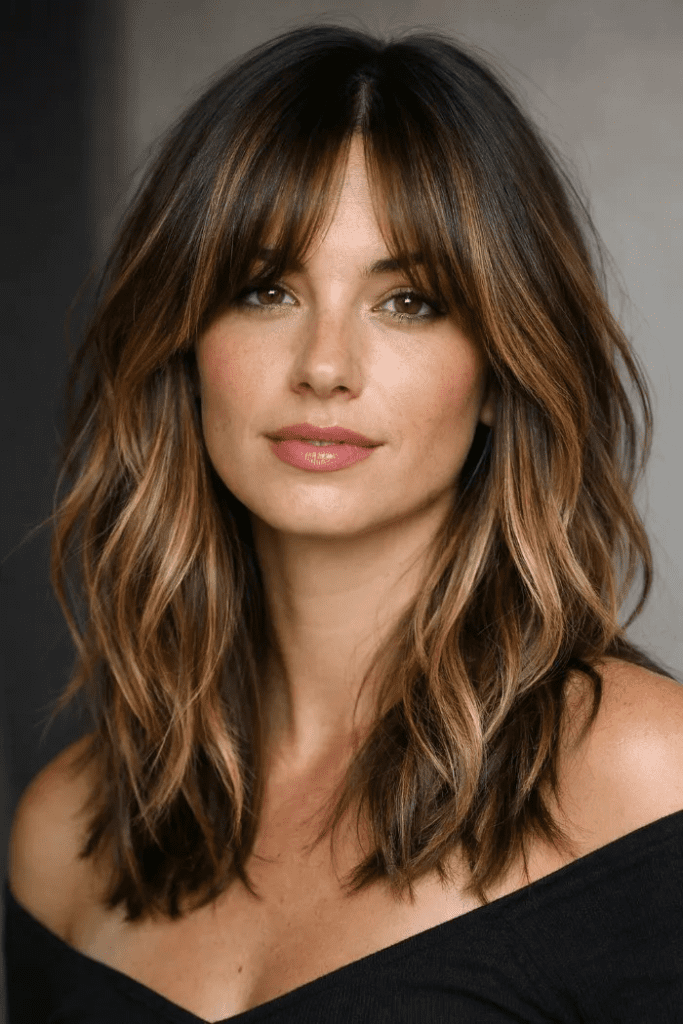
The chocolate brown and golden balayage combination is specifically effective because of the tonal relationship between the two colors. Chocolate brown has warm, red-brown undertones that sit in the same color family as golden blonde — which means the highlights look like they belong in the hair rather than being placed on top of a base they don’t relate to.
Concentrating the golden pieces toward the ends is the right placement strategy for this combination because it creates a natural ombre gradient from the deep chocolate root to the lighter golden ends. That graduation is the most forgiving placement option — there’s no visible lightening near the root that grows out, just a gradual shift in tone that becomes more subtle as time passes.
What to ask your colorist: Ask for balayage placed specifically toward the lower half of the hair length — mid-length to ends — with nothing lighter than the natural chocolate base in the upper sections. A golden or warm honey toner on the lightened sections ensures the gold reads as a warm extension of the chocolate rather than a disconnected lighter color.
Maintenance tip: The chocolate base benefits from a weekly deep conditioning mask to maintain the richness and shine that makes the golden highlights look their most dramatic. A glossy, well-conditioned brunette base is the best backdrop for golden highlights — a dry or faded brunette base makes even excellent highlights look dull.
Best for: Women with chocolate brown hair who want warm dimension that feels natural and grows out beautifully without requiring frequent root touch-up appointments.
4. Curly Hair With Golden Blonde Balayage
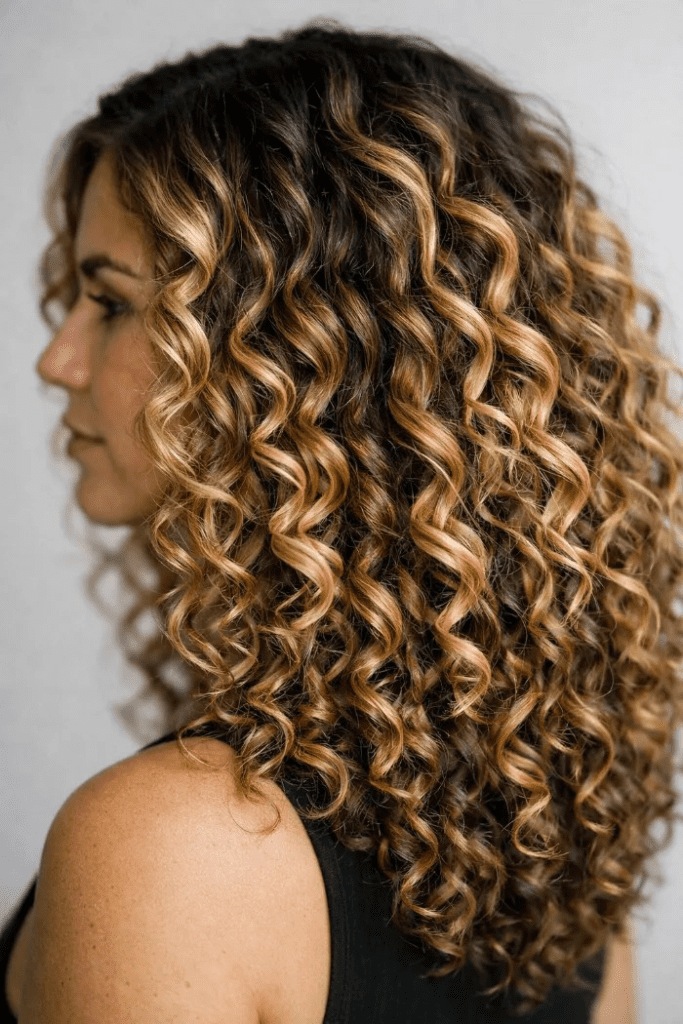
Curly hair and golden blonde balayage have an exceptional relationship — because the spiral structure of curly hair catches and reflects light differently at every bend, making balayage look dramatically more dimensional on curly textures than on straight ones. Where straight hair shows highlights as individual ribbons, curly hair shows them as a continuous shimmer that appears and disappears through the curl pattern.
The color placement on curly hair needs to follow the natural curl sections rather than fighting them. Highlights placed systematically in foils from root to end look unnatural on curly hair because the foil lines don’t align with the curl groupings. Freehand balayage applied following the natural curl sections looks organic because the color falls exactly where the curl naturally catches light.
What to ask your colorist: Ask for freehand balayage applied following the natural curl groupings rather than systematic foil placement. The golden pieces should sit on the outer sections of the curls where light hits most directly — interior sections of the curl won’t be visible and don’t need to be highlighted.
Maintenance tip: Defined, moisturized curls show golden balayage at its most luminous. Apply a leave-in conditioner to soaking wet hair before any styling product to maintain the moisture level that keeps curls defined and the highlights visible. Dry, frizzy curls close in on themselves and hide the balayage dimension entirely.
Best for: Women with naturally curly or wavy hair who want their texture to work with the color rather than against it — golden dimension that moves and glows through the curl pattern.
5. Dark Ash Roots With Golden Blonde Balayage
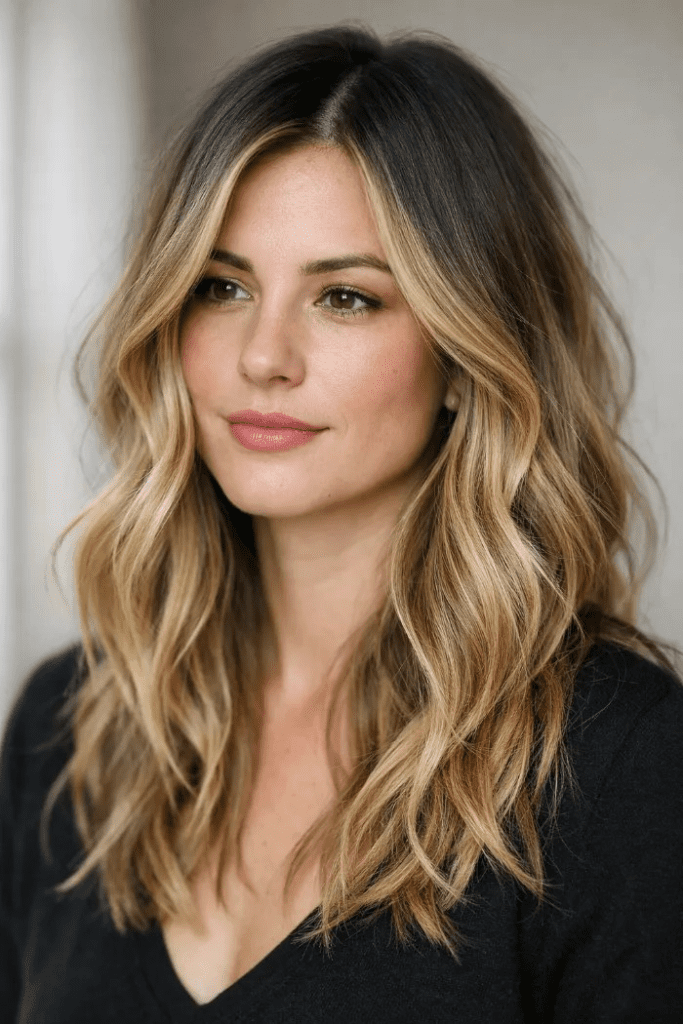
The combination of cool, dark ash roots and warm golden blonde lengths is one of the most intentional-looking color contrasts on this list — because the tonal opposition between cool and warm creates a graphic, deliberate quality that standard root-to-end balayage doesn’t have.
The cool ash root is doing specific work: by cooling the root area, it makes the warm golden lengths look even warmer and more luminous by contrast. The temperature difference between the two tones creates a visual pop that makes the golden sections appear brighter than they would against a neutral or warm root.
What to ask your colorist: Ask specifically for a cool-toned root shadow or root smudge in an ash or cool brunette formula — this is the step that gives the roots their distinctive cool quality rather than the natural warm undertone most brunette roots have. The golden balayage through the mid-lengths and ends should be applied with a warm toner to maximize the contrast with the cool root.
Maintenance tip: A cool or ash-toned gloss applied periodically to the root area maintains the contrast as the hair grows. Without maintenance of the root tone, the natural warmth of the hair grows back in and the deliberate cool-warm contrast gradually disappears into a standard dark-root-to-golden-ends result.
Best for: Women who want a high-contrast, intentional-looking color result where the root-to-end contrast is part of the aesthetic rather than something to minimize.
6. Darker Roots With Golden Blonde Balayage
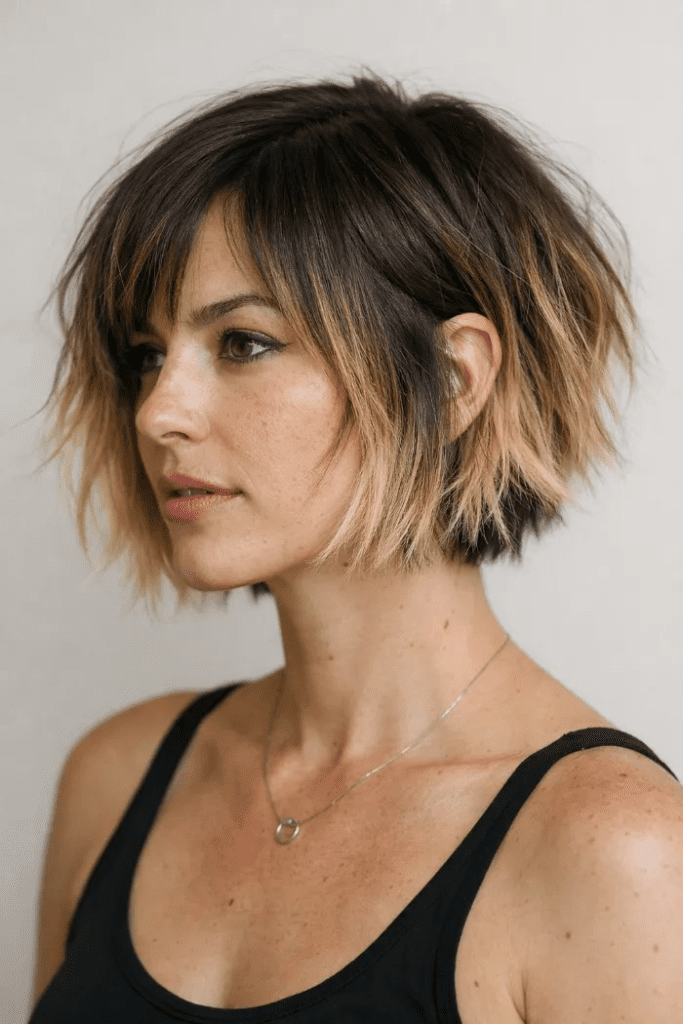
Keeping the roots naturally deeper while the golden blonde develops through the mid-lengths and ends is the most fundamentally low-maintenance approach to balayage — and it’s also the most flattering for women who want their color to look like a natural extension of their base rather than an applied treatment.
The deeper root naturally mimics the way hair grows in sun-exposed environments — dark and unexposed near the scalp, progressively lighter toward the ends where sunlight and environmental factors have had the most opportunity to lift the color. That natural-looking gradient is exactly what gives this style its lived-in, effortless quality.
What to ask your colorist: Ask for the balayage to start at least three to four inches below the root — the longer the natural section near the scalp, the more gradual and forgiving the grow-out. A root melt at the transition point keeps the connection between the dark root and the lighter mid-length completely seamless.
Maintenance tip: This is genuinely the lowest-maintenance option on the list — the deep root means there’s nothing to grow out that looks inconsistent with the rest of the style. A gloss refresh every eight to ten weeks and a sulfate-free shampoo routine are the only ongoing requirements.
Best for: Women who want the longest possible time between appointments and a color that never looks obviously grown out regardless of how many weeks have passed since the last salon visit.
7. Dark-Rooted Golden Blonde Balayage
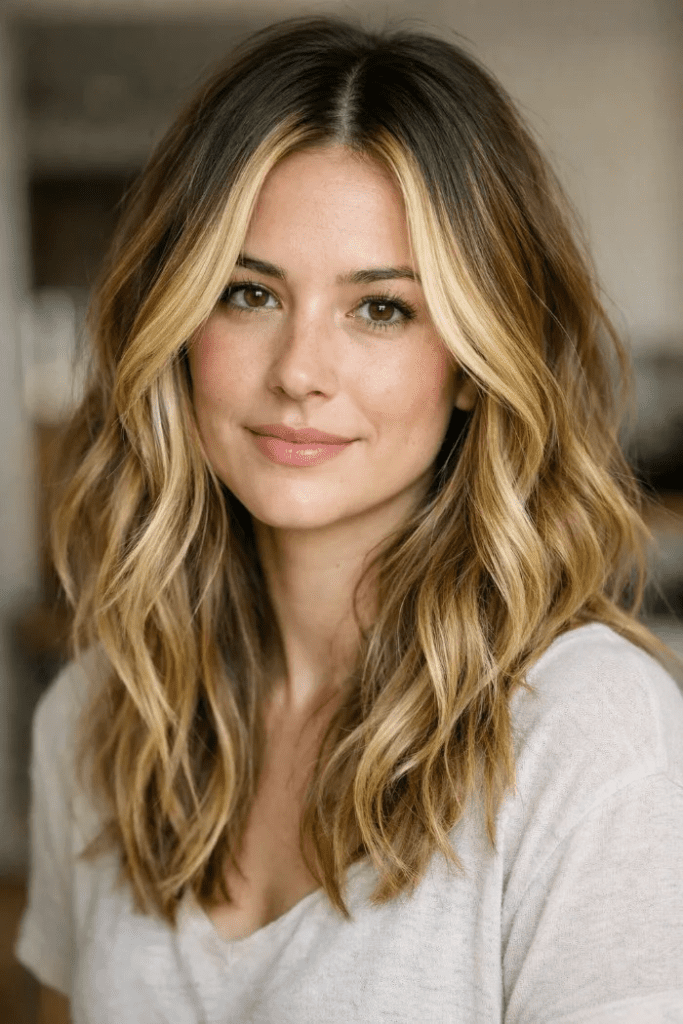
The dark root melt into golden blonde lengths is one of the most technically beautiful balayage results when executed correctly — because a seamless transition from dark to golden has an almost watercolor quality where the two tones genuinely blend into each other rather than sitting in visible separate sections.
The face-framing pieces in this style are doing specific work: by lifting the sections immediately around the face slightly lighter than the rest of the mid-lengths, they create a concentrated brightening effect near the skin without requiring a fully blonde money piece.
What to ask your colorist: Ask for a root shadow or root melt technique at the connection between the dark root and the golden mid-lengths — specifically request that your colorist blend the two tones rather than leaving a visible transition. Tell them you want the golden to feel like it’s growing out of the darker root, not sitting on top of it.
Maintenance tip: The dark root is self-maintaining as long as the hair is growing — the natural root growth always matches the intentional root color, which is exactly why this style works so well for low-maintenance color. Focus maintenance effort on the golden sections rather than the root.
Best for: Women who want depth at the root combined with visible warmth through the lengths — a color that looks grounded and natural rather than fully lightened.
8. Feathered Bangs With Golden Blonde Balayage
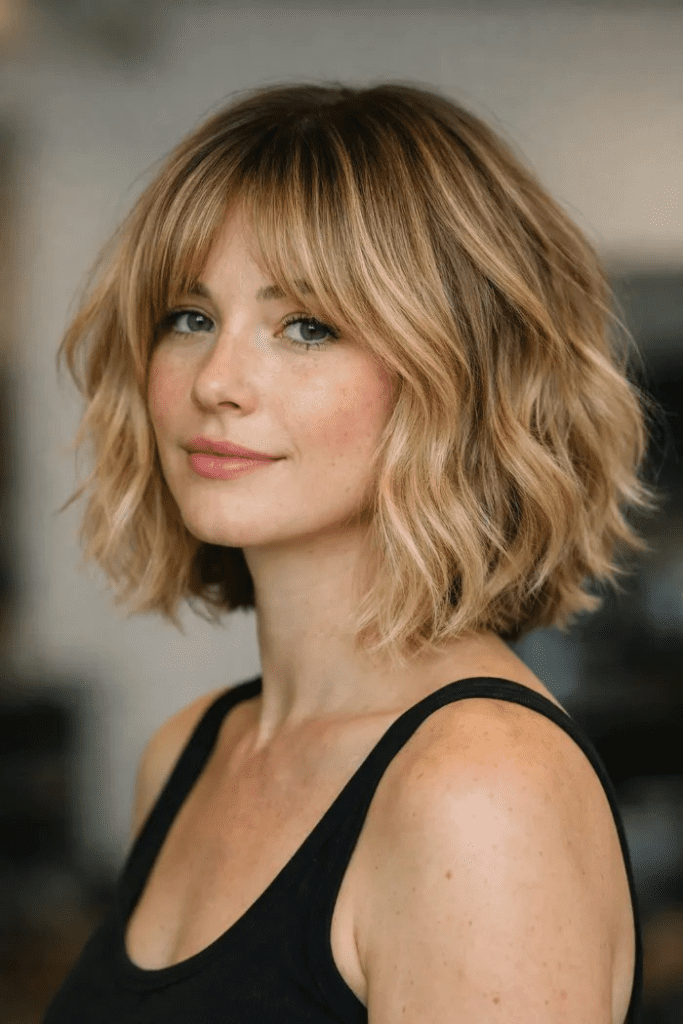
Feathered bangs paired with golden blonde balayage create one of the most face-brightening combinations on this list — because the feathered fringe concentrates golden tone in the section closest to the eyes and forehead, where the warmth has the maximum effect on skin luminosity and overall appearance.
The feathered quality of the bangs is specifically important for this pairing. A blunt, heavy fringe on golden balayage looks disconnected — the fringe sits as a separate dark section in front of an otherwise lighter style. Feathered bangs blend into the balayage naturally, allowing the golden tone to appear through the fringe rather than stopping abruptly at its edge.
What to ask your colorist: Ask for the golden balayage to be carried through the fringe sections as well as the lengths — feathered bangs with balayage need color through the fringe itself, not just behind it. Request fine highlight sections through the fringe using a micro-highlight or babylight technique rather than standard foils, which can create visible striping in shorter bang sections.
Maintenance tip: Feathered bangs need trimming more frequently than the rest of the style — every four to six weeks — to maintain the feathered quality that makes them work with the balayage. A straight-edged or grown-out fringe disrupts the connection between the bangs and the balayage and makes the two elements look disconnected.
Best for: Women who wear bangs and want their fringe to be part of the overall color story rather than an obviously darker section sitting in front of lighter lengths.
9. Textured Blonde Bob With Golden Balayage
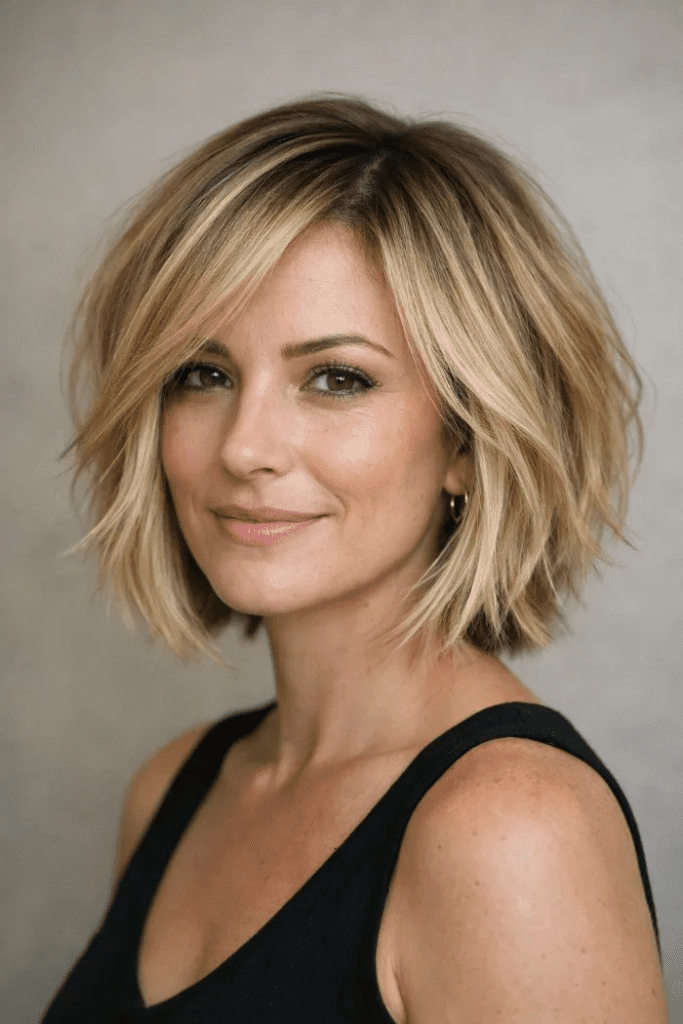
A textured bob with golden balayage is a combination where the cut and the color genuinely enhance each other — the texture creates the movement that makes the golden highlights visible from multiple angles simultaneously, while the golden highlights create the dimension that makes the textured layers look individually defined rather than blending into a uniform mass.
The slightly undone, piecey finish of a textured bob specifically benefits from golden balayage because the color adds a visual reason for each section to look distinct — the lighter pieces appear slightly brighter than the darker sections, giving the textured layers a dimensional quality that wouldn’t exist with a single all-over color.
What to ask your colorist: Ask for golden balayage placed through the individual layers of the textured bob rather than concentrated at the surface only — texture cuts benefit from some interior dimension as well as surface dimension, because the layers themselves create the interior visibility that a uniform bob doesn’t have.
Maintenance tip: Minimal styling is the right approach — a light texturizing spray or sea salt spray on damp hair and air drying preserves the dimensional quality of the cut and color. Heavy products flatten the texture and reduce the visibility of the golden highlights.
Best for: Women who prefer effortless, low-styling looks and want a cut-and-color combination that looks intentional and polished with minimal morning effort.
10. Golden Balayage With Curtain Bangs
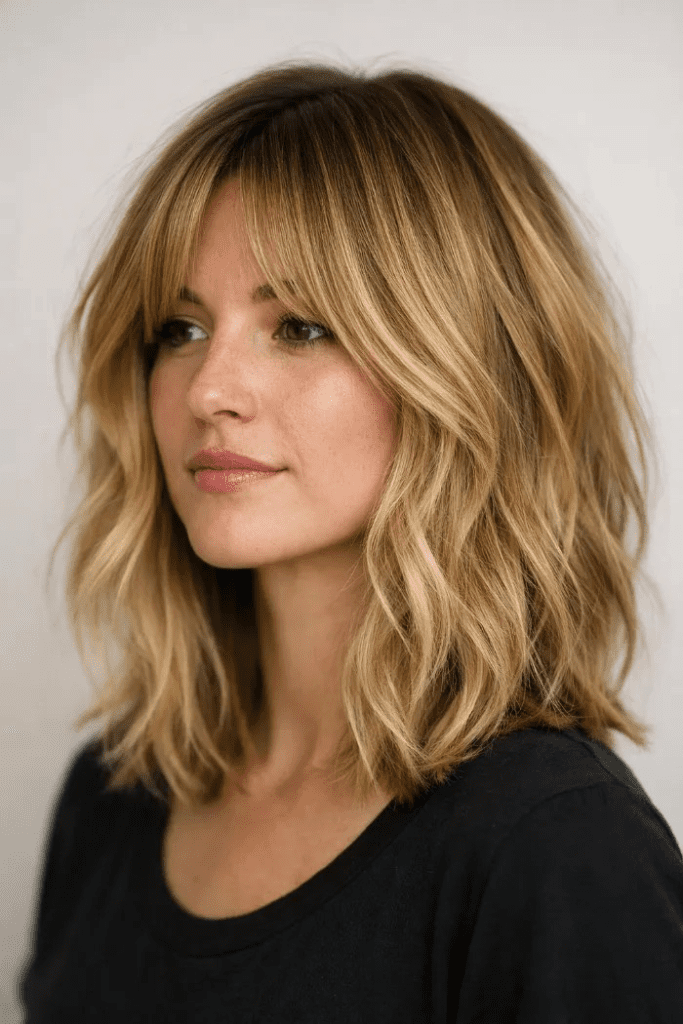
Curtain bangs and golden blonde balayage are a combination that’s become genuinely popular for a practical reason — the split, face-framing fall of curtain bangs creates a natural window around the face where the golden balayage is most visible and most flattering.
Because curtain bangs are parted in the center and swept outward, they direct the eye toward the cheekbones and temples — exactly where golden balayage face-framing pieces are placed. The two elements work in the same direction, maximizing the face-brightening effect of the color through the framing effect of the bangs.
What to ask your colorist: Ask for golden highlights carried through the curtain bang sections from root to end — curtain bangs that are left dark while the rest of the hair is golden look disconnected and heavy against the lighter lengths. The fringe should feel like part of the overall golden story, not a separate darker element.
Maintenance tip: Blow dry the curtain bangs with a round brush, sweeping each side away from the center part and directing the ends outward. This styling technique shows the golden pieces through the fringe most clearly and creates the face-framing effect the style is built on.
Best for: Women who wear curtain bangs or are considering them and want a color treatment that works harmoniously with the fringe rather than creating a tonal disconnect between fringe and lengths.
11. Short Bob With Golden Balayage
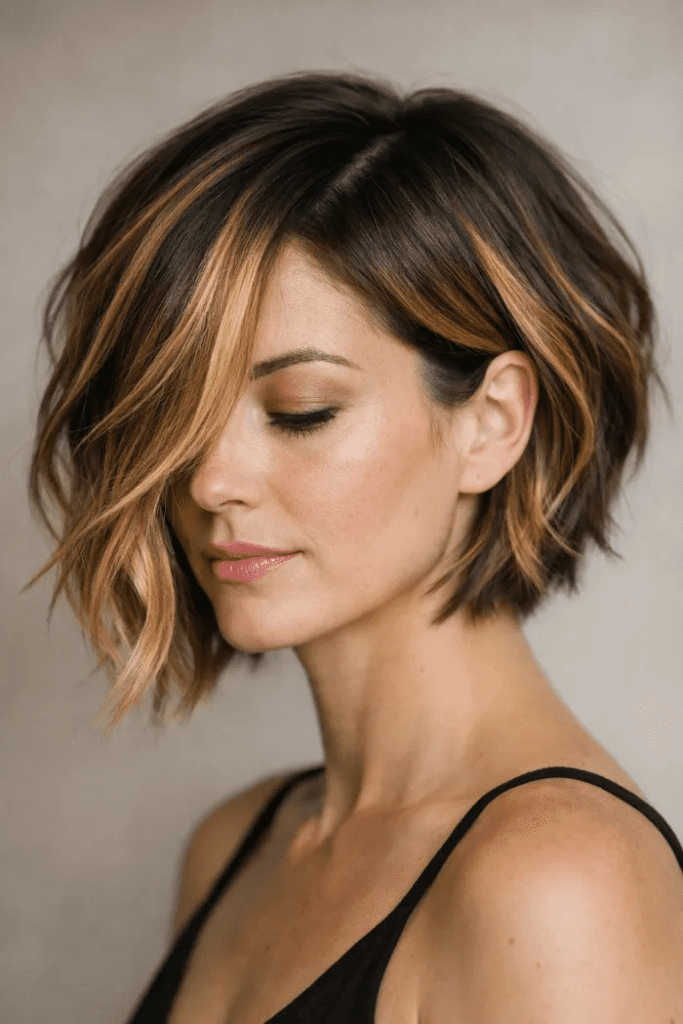
A short bob — sitting above the jaw or at chin level — is one of the most challenging lengths for balayage because the reduced length limits how much transition can occur from root to end. A standard balayage that starts mid-shaft on long hair starts too close to the root on a short bob, which risks making the highlights look like traditional highlights rather than a soft, blended balayage.
The right approach on a short bob is concentrating the golden pieces through the top layers and front sections rather than trying to create a root-to-end gradient. This placement delivers the face-brightening and dimension benefits of balayage without the technical limitations of working with reduced length.
What to ask your colorist: Ask for surface-layer balayage specifically — the top quarter-inch layer of the hair — plus face-framing pieces through the sections closest to the hairline. Tell your colorist you want the color to add dimension and fullness rather than a visible root-to-end transition.
Maintenance tip: Short bobs show grow-out faster than longer styles because there’s less overall length to absorb the new growth gradually. Budget for appointments every eight to ten weeks rather than the twelve to sixteen weeks that longer balayage styles can accommodate.
Best for: Women with short bobs who want color that adds dimension, lift, and fullness to a cut that would otherwise risk looking flat or one-dimensional.
12. Golden Blonde Balayage With Curtain Bangs on Long Hair
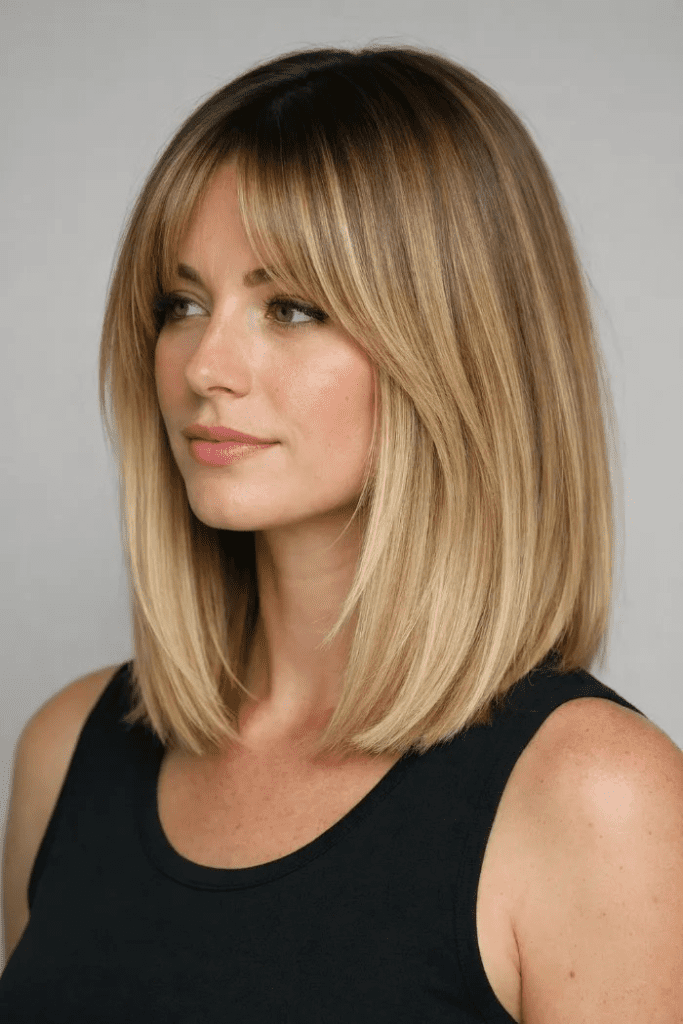
Long hair with curtain bangs and golden blonde balayage creates one of the most consistently photogenic combinations on this list — the length gives the balayage maximum surface area to develop a gradual, beautiful gradient while the curtain bangs frame the face with the golden tone where it’s most visible and most flattering.
The key distinction between this and the previous curtain bang style is the role the length plays in the overall color story. On long hair, the golden balayage has room to develop a full tonal journey from dark root through warm mid-lengths to lighter ends — the curtain bangs at the front serve as the brightest, most face-framing point of a color that genuinely transitions across the full length.
What to ask your colorist: Ask for a root shadow to keep the root area subtle, a warm golden transition through the mid-lengths, and a slightly brighter golden at the ends for a natural sun-lightened gradient. The curtain bangs should be highlighted from root to end to match the brightness of the face-framing balayage sections.
Maintenance tip: Long golden balayage on curtain bangs is genuinely one of the easiest color combinations to maintain — the root shadow means no visible grow-out, the long length absorbs new growth gradually, and the curtain bangs only need a toner refresh every eight to ten weeks to maintain their golden quality.
Best for: Women with long hair who want a complete, multi-element color look that’s as flattering in real life as it is in photographs.
13. Golden Blonde Balayage on Long Layered Hair
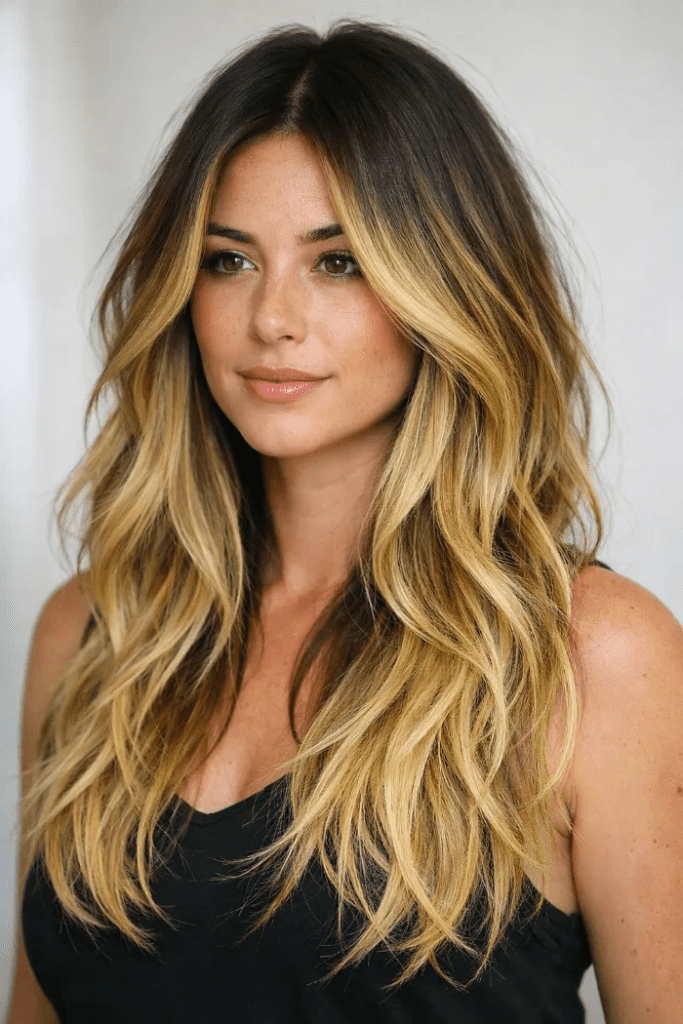
Long layers and golden blonde balayage are made for each other — layers create the movement and dimension that makes balayage most visible, while golden balayage creates the tonal variation that makes layers look individually defined rather than blending together into a uniform mass.
The interaction between the two is specifically beautiful on long layered hair because the layers create multiple levels of surface, each catching light at slightly different angles. Golden highlights placed through those layers appear differently at each level — brighter on the outermost layer, slightly deeper on the layer below, creating a multi-dimensional result that a single-layer haircut can’t replicate.
What to ask your colorist: Ask for golden balayage applied through each layer section rather than only the topmost surface — multi-layered hair needs color through multiple levels to take full advantage of the dimensional opportunity the layers create. A single surface application on long layered hair leaves the majority of the layered structure without color dimension.
Maintenance tip: A large-barrel curling iron or wand on low heat brings the layered sections forward and shows the balayage at its most dimensional. Straight-styled long layers compress the golden highlights against each other and reduce the visible dimensional effect. Even two minutes of loose curl or wave adds significant visible color impact.
Best for: Women with long layered haircuts who want a color treatment that enhances the dimensional quality of the layers and makes the cut look as intentional as it did the day it was shaped.
14. Golden Blonde Balayage With Face-Framing Layers
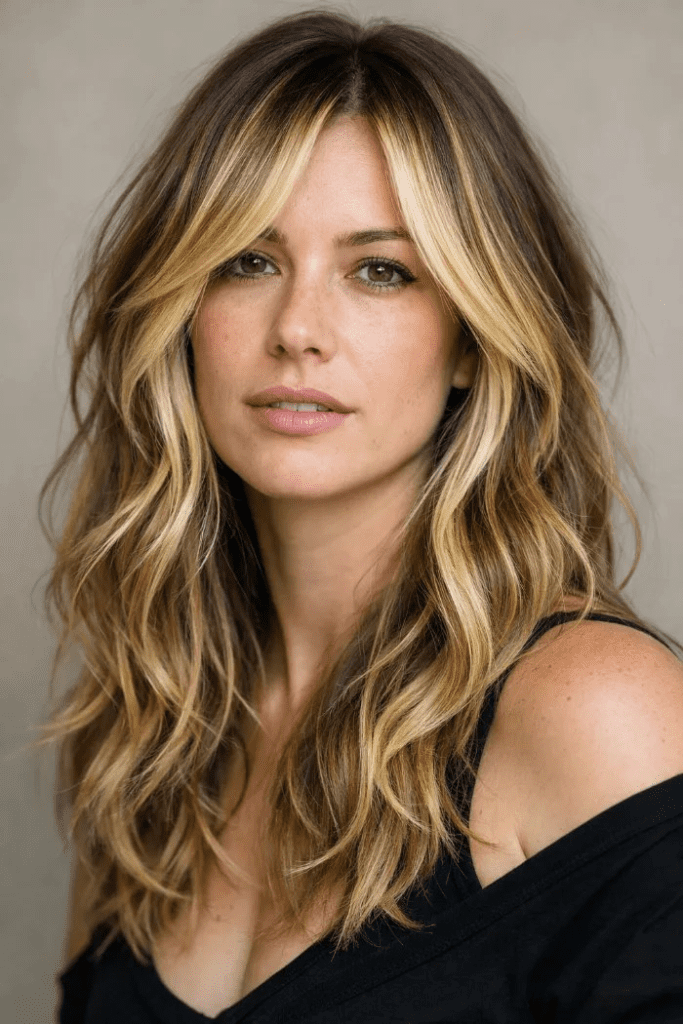
Face-framing layers and golden blonde balayage targeting the same sections creates a compounded brightening effect — the layers draw the eye toward the face while the golden color in those same sections adds warmth and light to the facial area simultaneously.
This approach is specifically effective for women who want a subtle overall color but visible brightness near the face — the technique concentrates the most visible color work in the most face-brightening location while leaving the rest of the hair with just enough golden dimension to create continuity.
What to ask your colorist: Ask for the brightest golden pieces to be placed specifically in the face-framing layer sections — these should be the lightest point of the entire color application. The rest of the hair can have softer, more blended golden balayage for context, but the face-framing sections should be noticeably brighter.
Maintenance tip: Face-framing sections fade faster than the rest of the balayage because they’re washed, heat-styled, and environmentally exposed most frequently. A toner refresh on the face-framing sections specifically every six to eight weeks keeps the brightness concentrated exactly where you want it.
Best for: Women who want to concentrate their color investment in the sections that have the most visible impact on their appearance — the most efficient, targeted approach to golden balayage.
15. Golden Blonde Balayage With Soft Wispy Bangs
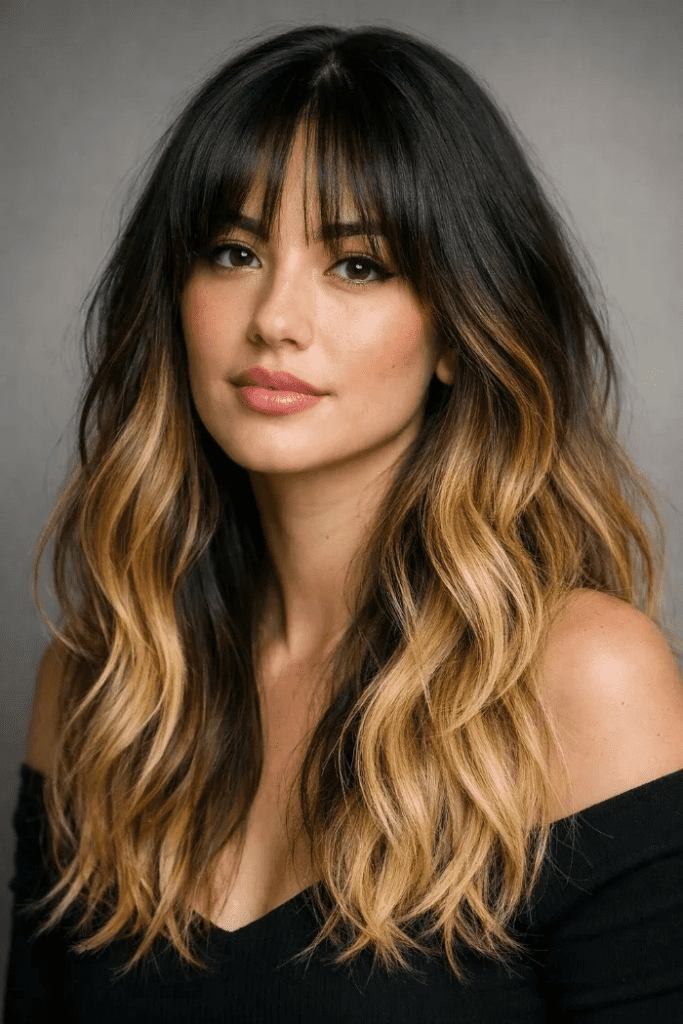
Soft wispy bangs with golden blonde balayage create a relaxed, airy aesthetic that’s distinctly different from the polished, structured look of curtain bangs with balayage or feathered bangs with balayage. The wispiness of the bangs creates a diffused, soft framing effect rather than a defined face frame — it’s the styling equivalent of a soft focus.
The airy quality of wispy bangs specifically suits lighter, more blended golden balayage rather than high-contrast or bold ribbon placements. Too much color contrast against very fine, wispy bangs looks heavy — the visual weight of the color overwhelms the lightness of the fringe.
What to ask your colorist: Ask for golden balayage through the wispy bang sections using the lightest possible application — a micro-highlight or babylight technique rather than standard foils, which can leave visible color lines in the thin sections of a wispy fringe.
Maintenance tip: Wispy bangs need almost no product — a light finishing spray to prevent flyaways and a quick pass with a flat brush to set the direction is the complete styling routine. Over-styling wispy bangs with heavy products collapses them into stringy sections that look sparse rather than wispy.
Best for: Women who prefer a gentle, soft aesthetic over a polished or structured look and want fringe that frames the face with lightness rather than definition.
16. Classic Golden Blonde Balayage
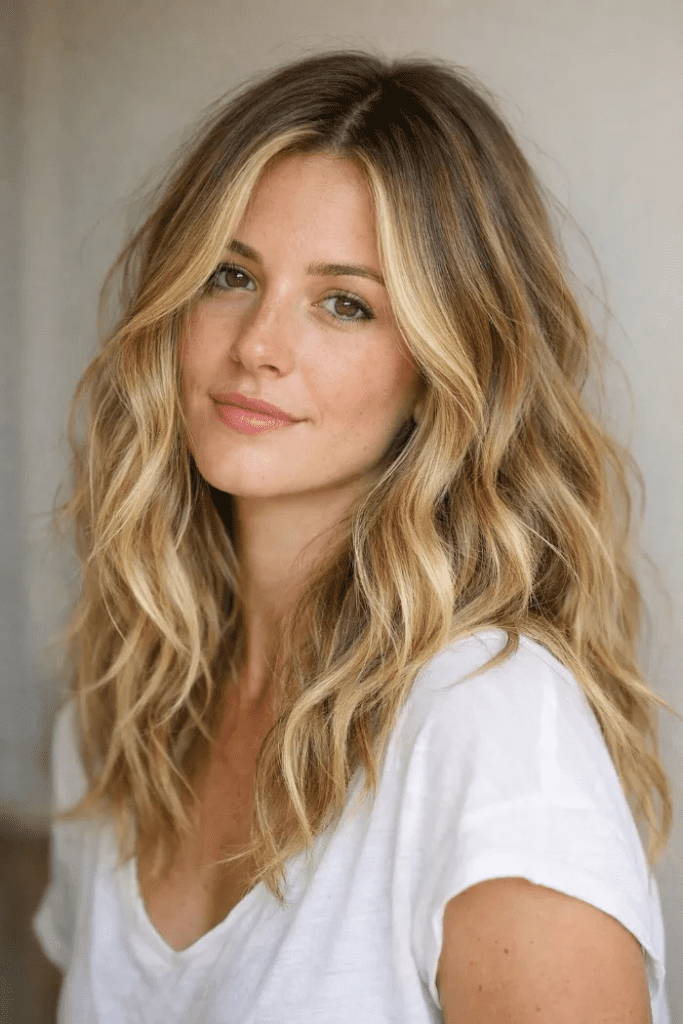
The classic golden blonde balayage is the foundational version of the technique — the result that established golden balayage as a consistently recommended color treatment and continues to be one of the most requested looks in salons.
The classic version prioritizes smooth, even blending over bold contrast. The transition from root to end is gradual and seamless, the golden tone is warm but not saturated, and the overall result reads as timeless rather than trend-driven. It’s the most universally flattering version of golden balayage because it works across the widest range of base colors, hair types, and styling approaches.
What to ask your colorist: Ask for smooth, even blending through the mid-lengths and ends with a gradual root shadow. Tell your colorist you want the result to look timeless and natural rather than bold or high-contrast. A warm golden toner in a neutral-warm formula is the right finish for the classic version.
Maintenance tip: A clear gloss applied every eight weeks maintains the smooth, unified quality of the classic balayage result — it seals the cuticle of both the highlighted and natural sections together, giving the whole color a seamless, polished appearance. The clear gloss is the technical step that maintains the “classic” quality over time.
Best for: Women who want a proven, reliable golden balayage result that looks consistently beautiful regardless of styling approach and grows out as gracefully as it was applied.
17. Golden Blonde Highlights in Twists
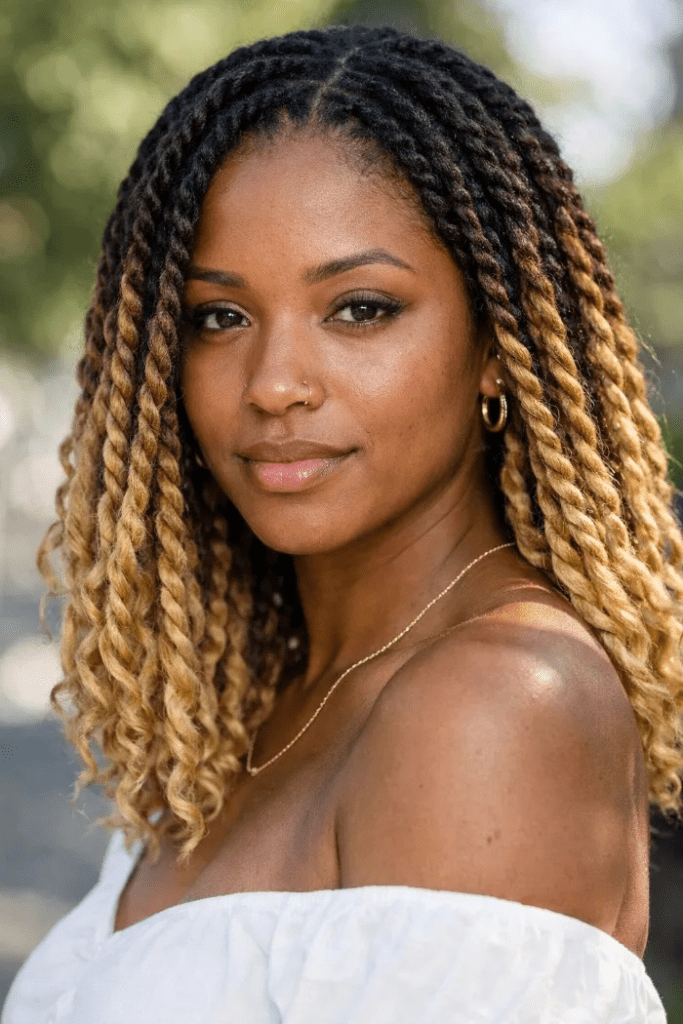
Golden blonde tones woven through twists — whether two-strand twists, flat twists, or rope twists — create a beautiful interaction between the color and the protective style. The lighter ends of each twist catch light differently from the darker mid-lengths, creating visible dimension and warmth within the structure of the style itself.
Balayage-inspired color applied before installing twists means the golden tone is visible at every point where the twist opens and closes — at the roots where the twist starts, through the length as it turns, and at the ends where the color is lightest. The result is dimension that travels the full length of each twist rather than sitting only at the surface.
What to ask your colorist: Ask for golden highlights applied before installing the protective style, concentrated through the mid-lengths and ends of the sections that will be twisted. Tell your colorist you want the color to be visible within the twist structure rather than only on the surface — this requires color through each section rather than only the outermost strands.
Maintenance tip: A light hair oil applied to the twists maintains the shine that makes the golden highlights most visible. Dry, matte twists reduce the reflective quality that makes the color dimensional — moisture and shine are the maintenance priorities for this look.
Best for: Women who wear protective styles and want their color to be visible and beautiful within the twist structure rather than hidden by the style itself.
18. Long Shag With Golden Balayage
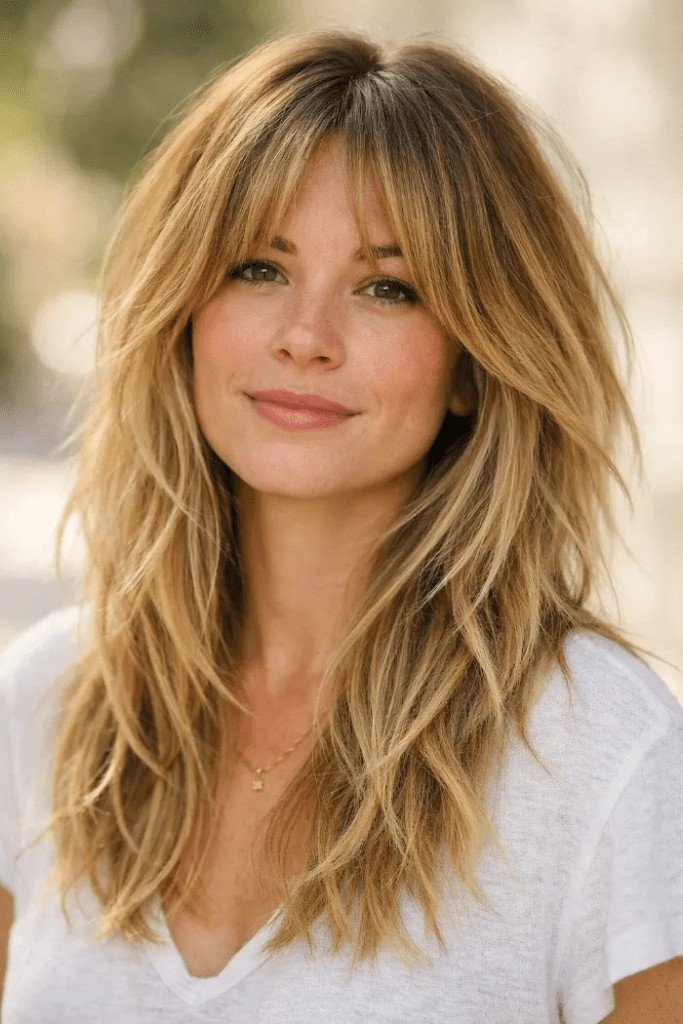
A long shag cut and golden blonde balayage are a combination specifically suited to women who want maximum texture, movement, and personality from their style — because the shag’s internal layering structure creates constant, varied movement that shows the golden highlights from every angle simultaneously.
The shag’s layers break up the hair into sections that catch light independently of each other, which means the golden balayage appears and disappears differently at each layer level as the hair moves. On straight or minimally textured hair, golden balayage shows as ribbons on a flat surface; on a long shag, it shows as a dimensional warmth woven through a constantly shifting structure.
What to ask your colorist: Ask for golden balayage applied through every layer section of the shag rather than only the surface — a shag’s internal layers are visible due to the cut’s structure, which means interior color placement actually shows on a shag in a way it doesn’t on a uniform-length cut.
Maintenance tip: Minimal product is the styling approach that shows golden balayage on a shag at its best — a light texturizing spray or a curl cream on damp hair, then air dry. The shag’s structure creates all the texture needed; heavy products flatten the layers and reduce the visible movement that makes golden highlights look dimensional.
Best for: Women who love texture-forward, personality-rich cuts and want a color that enhances the natural movement of a shag rather than sitting quietly in a uniform style.
19. Modern Golden Blonde Balayage
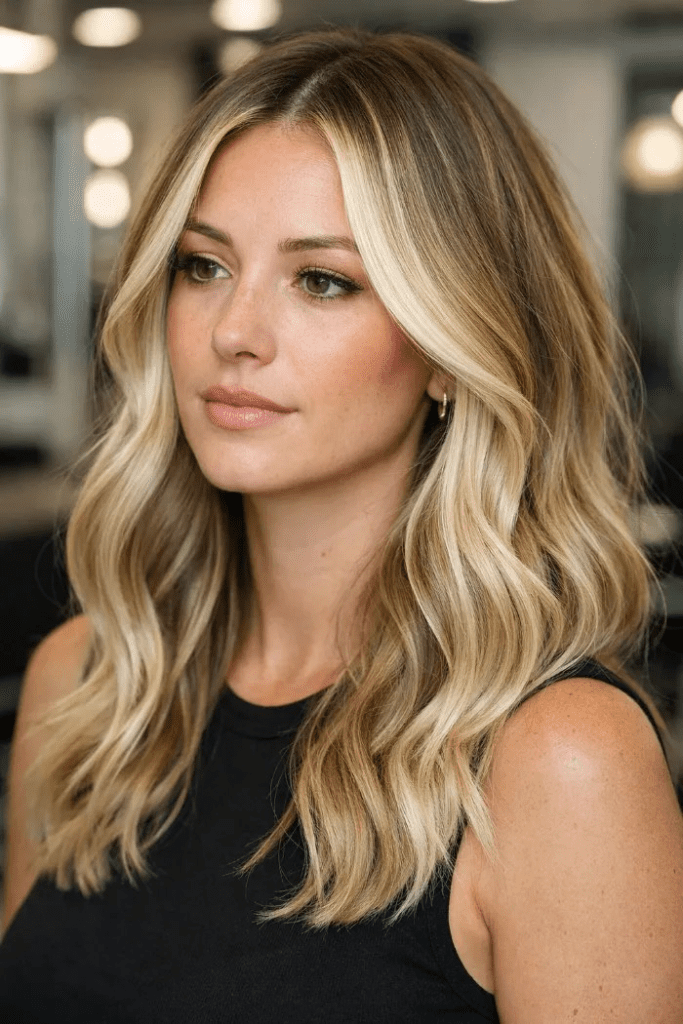
The modern version of golden blonde balayage distinguishes itself from the classic version through contrast — the roots are kept noticeably deeper and the ends are taken slightly lighter, creating a more graphic, intentional-looking result that reads as a contemporary color choice rather than a timeless one.
The deliberate contrast is what makes this modern. A classic balayage softens and blends; a modern balayage keeps the contrast present enough to be clearly visible while still blending the transition rather than creating a hard line. The distinction is a question of how much contrast you want to be visible at any given point.
What to ask your colorist: Ask for a deeper root shadow and a lighter golden end than the classic version — tell your colorist you want the contrast to be visible rather than seamless. The transition should still be blended rather than abrupt, but the difference between the darkest and lightest points of the color should be noticeably greater than in a classic application.
Maintenance tip: The higher contrast means grow-out is slightly more visible than on a classic or low-contrast balayage. Budget for an appointment every ten to twelve weeks rather than the longer intervals a classic balayage can accommodate.
Best for: Women who want a golden balayage that reads as a deliberate contemporary color choice rather than a natural-looking sun-kissed result — visible dimension and contrast as a style statement.
20. Platinum-Tipped Golden Balayage
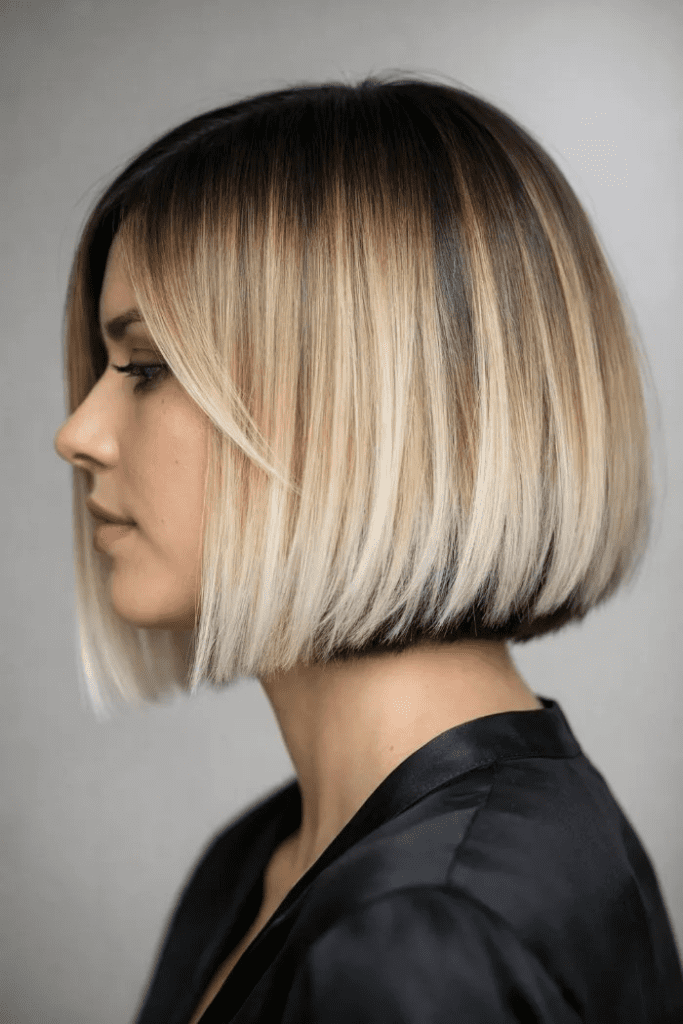
The platinum-tipped golden balayage is the highest-contrast version of golden highlights on this list — the ends lift to a near-platinum blonde while the root and mid-length stay in the golden-to-brunette range. The result is a dramatic, luminous finish at the ends that creates a visible glow effect as the hair moves.
The darker root is what makes platinum tips wearable rather than harsh — the graduation from deep root through golden mid-length to platinum ends creates a complete tonal journey that looks intentional rather than like overly processed ends sitting against uncolored roots.
What to ask your colorist: Ask for the platinum application to be concentrated only in the bottom third of the hair length — platinum through the mid-lengths on a dark base will look disconnected and harsh rather than gradual and luminous. The golden mid-length section is the bridge between the two extremes, and it needs enough length and color to function as a genuine transition rather than a thin blending zone.
Maintenance tip: Platinum tips require the highest maintenance of any style on this list — they need a purple or cool-toned toner refresh every four to six weeks to prevent going brassy or yellow. Bond-building treatments used monthly are essential for maintaining the structural integrity of the highly lightened ends.
Best for: Women who want the most visible, high-impact golden balayage result and are willing to invest in the maintenance schedule needed to keep platinum ends looking clean and intentional.
21. Shadow Root With Golden Blonde Balayage
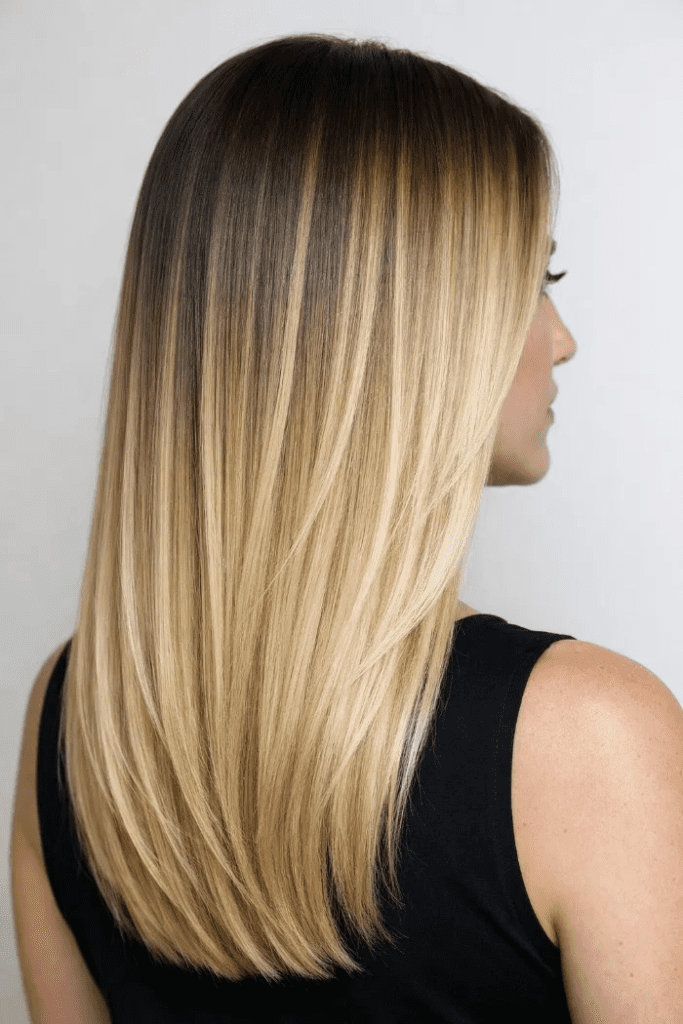
The shadow root technique involves deliberately darkening the root area — either by applying a darker formula to the root zone or by using a root shadow gloss — to create a soft, blurred connection between the natural root and the golden balayage through the mid-lengths.
The effect is specifically valuable for women who want their balayage to look freshly done regardless of how many weeks have passed since their last appointment. Because the shadow root intentionally mirrors what grown-in roots look like, natural root growth simply deepens and extends the shadow — making the style look like part of the design rather than a grow-out.
What to ask your colorist: Ask specifically for a shadow root application using a formula that sits two to three shades darker than the mid-length golden balayage. The shadow should melt into the golden section rather than creating a visible line — the blend between the shadow and the balayage is what determines whether the result looks intentional or simply grown out.
Maintenance tip: The shadow root is the most low-maintenance element of this style — it actively absorbs natural root growth rather than revealing it. Maintain focus on the golden mid-lengths and ends with periodic gloss refreshes rather than spending appointment time and money on root maintenance.
Best for: Women who love the look of golden balayage but dislike the visible root line that develops between appointments — the shadow root eliminates that concern entirely.
22. Short Bob Featuring Golden Blonde Balayage on Fine Hair
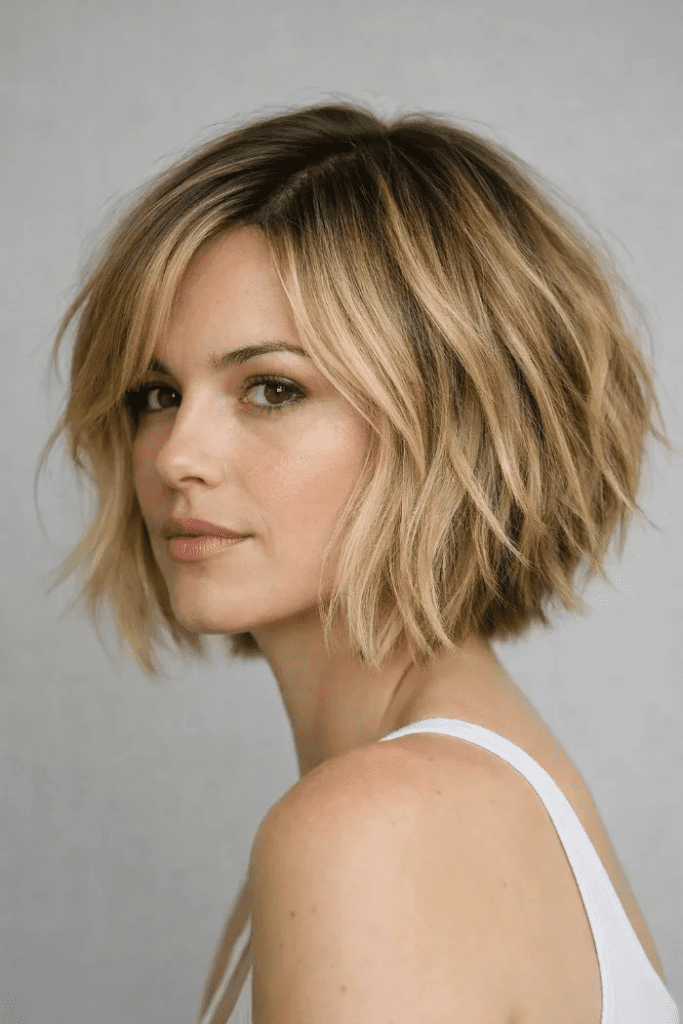
Fine hair in a short bob benefits from golden balayage more than almost any other hair type and length combination — because the color creates the illusion of thickness and dimension that fine hair naturally lacks, without adding any physical weight to strands that are already struggling to hold volume.
By placing golden highlights through the top layers and front sections of a short bob, the color adds visual separation between sections — the highlighted sections read as slightly distinct from the non-highlighted sections, creating a perception of multiple layers and density rather than a flat, uniformly colored surface.
What to ask your colorist: Ask for fine, widely-spaced highlights rather than dense balayage — too many highlights on fine hair in a short bob can create a washed-out result that looks lighter overall rather than dimensionally highlighted. The golden pieces should be visible but not dominant.
Maintenance tip: Volume-building products at the root before blow drying are the most important styling step for this look — a lightweight mousse at the scalp sets the stage for the golden highlights to look as dimensional as possible. Flat, root-less fine hair makes even excellent highlights look underwhelming.
Best for: Women with fine hair in short bobs who want a color treatment that creates the illusion of more hair and more dimension than they actually have.
23. Soft Golden Blonde Balayage
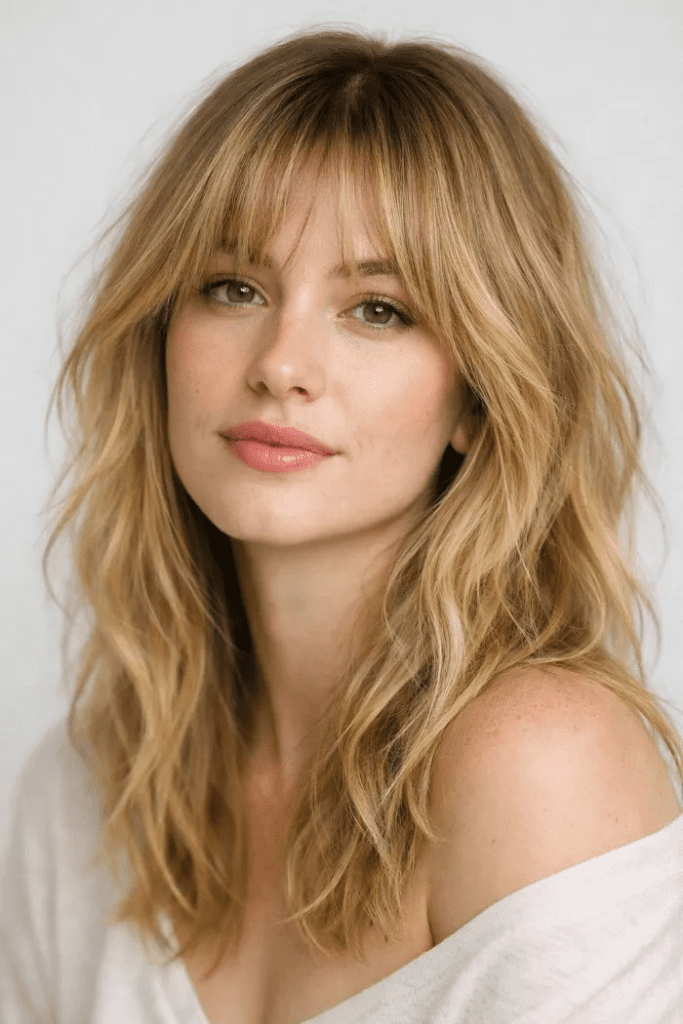
The soft golden blonde balayage is the most natural-looking, universally flattering version of golden highlights available — the tone is warm enough to add visible dimension but not so saturated or bright that it looks obviously colored.
What distinguishes soft golden from classic golden is the toner formulation — soft golden uses a slightly more muted, slightly less saturated version of the golden tone that reads as a natural variation within the brunette family rather than a separate, lighter color. The result is hair that looks healthier and more luminous rather than hair that looks highlighted.
What to ask your colorist: Ask for a soft or muted golden toner rather than a vivid or saturated golden formula. Tell your colorist you want the result to look like the warmest, shiniest version of your natural color rather than an obvious brightening treatment.
Maintenance tip: A clear gloss every eight to ten weeks maintains the soft quality — the clear formula adds shine and seals the cuticle without adding any additional tonal warmth, which keeps the soft golden result from shifting toward a more saturated tone over time.
Best for: Women who want the most natural, understated golden balayage result — highlights that make the hair look healthier and more dimensional without anyone being able to identify a specific color treatment.
24. Sun-Kissed Golden Blonde Balayage
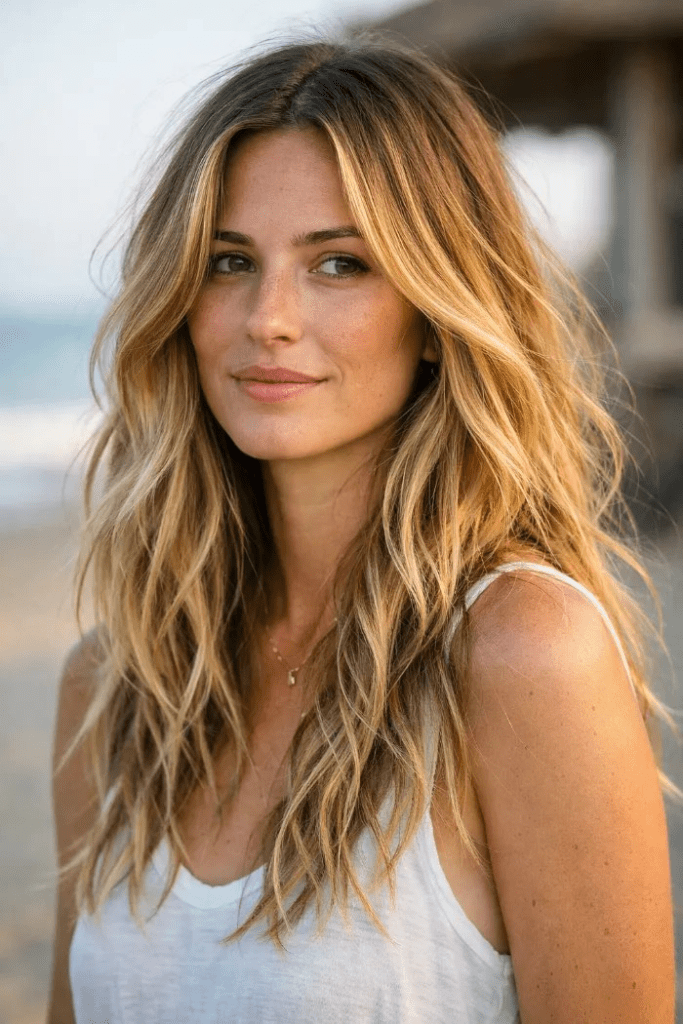
The sun-kissed version is the warmest, most luminous golden blonde balayage direction — it leans bright, warm, and saturated in a way that reads as genuinely sun-touched rather than subtly dimensional. Where soft golden is about understated warmth, sun-kissed is about visible glow.
The golden pieces in a sun-kissed application are concentrated through the outer layers and ends where they catch light most directly as the hair moves. The result is a hair color that creates a genuine glow effect in natural light — the kind that makes the hair look brighter and warmer regardless of the lighting context.
What to ask your colorist: Ask for a bright, warm golden toner rather than a muted or soft formula — the vibrancy of the toner is what creates the sun-kissed luminosity rather than an understated warmth. Request placement through the outer layers specifically for maximum light-catching effect.
Maintenance tip: Loose waves applied with a large-barrel wand show sun-kissed golden balayage at its most flattering — the wave pattern creates constant movement that catches the golden sections from multiple angles simultaneously. Minimal additional product lets the natural shine of the color come through.
Best for: Women who want the most visibly warm, luminous golden result on this list — hair that looks genuinely sun-touched and glowing rather than subtly dimensional.
25. Textured Lob With Subtle Golden Blonde Balayage
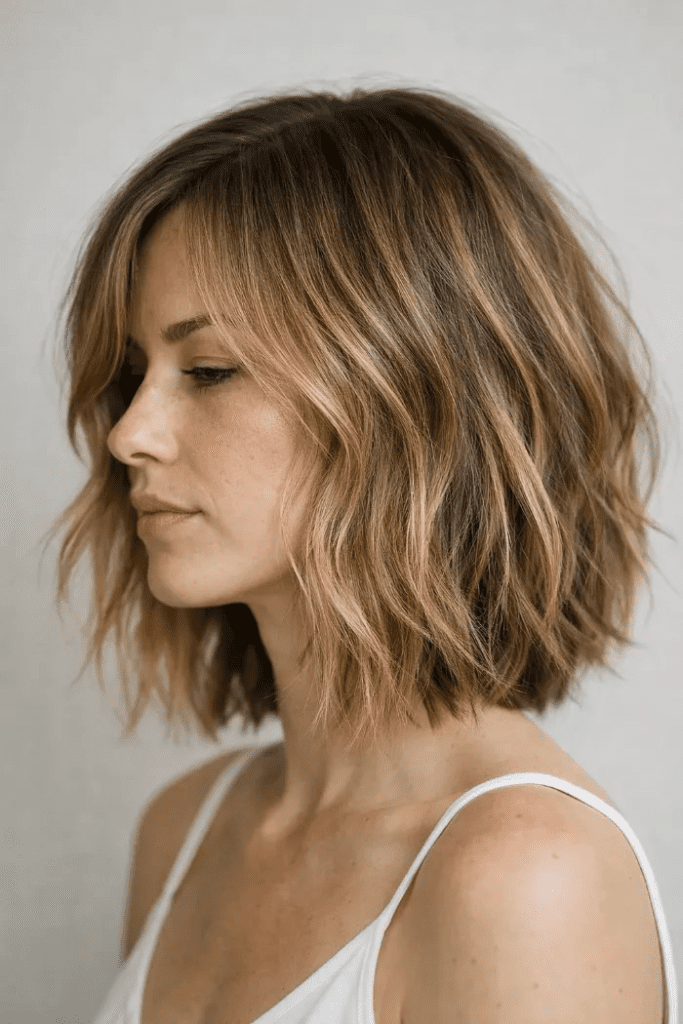
The textured lob sits at one of the most versatile hair lengths available — long enough to wear up, short enough to style down in under five minutes — and subtle golden balayage is the ideal color treatment for it because it adds dimension without competing with the textured styling that makes the lob interesting.
Subtle means the golden pieces are fine and spaced rather than wide and dense. Woven through the surface of a textured lob, fine golden highlights add a quiet dimensional quality that reads as expensive and intentional without anyone being able to identify what specifically makes the hair look so good.
What to ask your colorist: Ask for babylights or fine balayage rather than standard foil highlights — the finer the highlight section, the more seamlessly it integrates with the textured surface of the lob. Tell your colorist you want the result to look like quiet dimension rather than obvious highlighting.
Maintenance tip: A texture spray or light mousse on damp hair and air drying is the styling routine that shows subtle golden balayage on a lob at its best. The texture creates the movement and separation that makes fine highlights visible — without it, subtle highlights on a smooth, straight-styled lob can be nearly invisible.
Best for: Women who want a color treatment that makes their lob look expensive and well-maintained without looking obviously highlighted or requiring a complex maintenance schedule.
26. Tousled Blonde Bob With Darker Roots
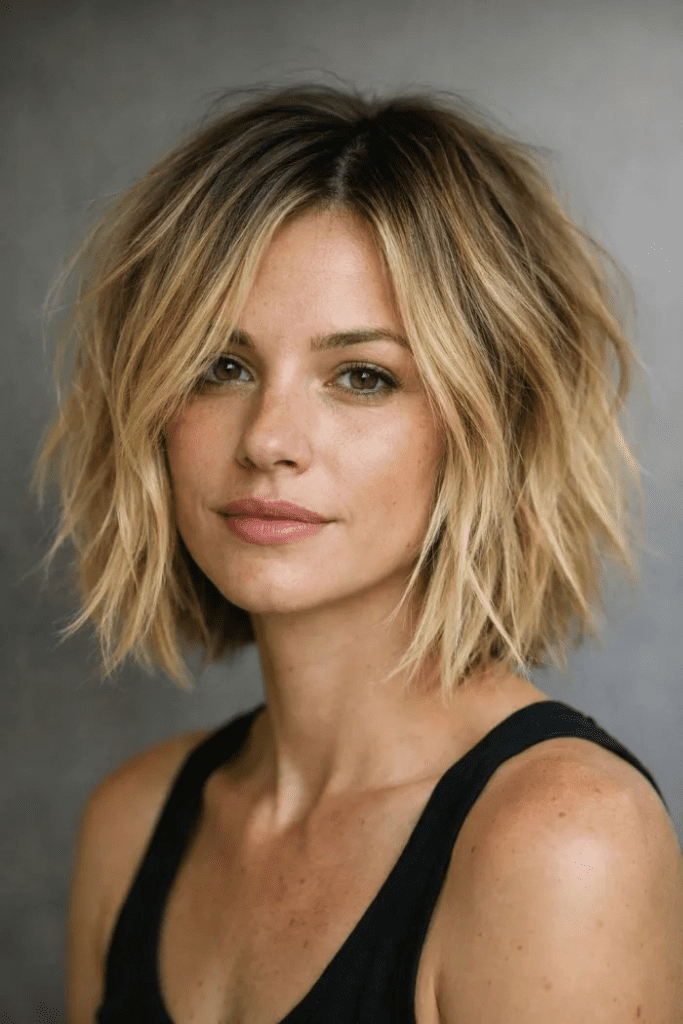
The tousled blonde bob with darker roots is a deliberately modern aesthetic — the undone, slightly disheveled finish of the tousled styling combined with the visible dark root creates a fashion-forward look that’s specifically designed to look effortless rather than polished.
The darker root is doing two things: it adds depth and dimension at the crown that prevents the overall look from reading as flat blonde, and it creates the visible contrast that makes the blonde through the mid-lengths and ends look intentionally lighter rather than simply grown out.
What to ask your colorist: Ask for a root shadow formula that matches your natural base color — the root should look natural rather than artificially darkened. The blonde through the mid-lengths and ends should use a warm golden formula rather than a cool or ash blonde, which would create a cooler, edgier result than the warm, tousled aesthetic this style is built on.
Maintenance tip: Air-dried texture is the styling approach that shows this look at its most authentic — scrunch a light mousse through damp hair and let it dry naturally. The tousled quality reads as effortless specifically because it isn’t precisely styled, and product-heavy or heat-intensive styling undermines the relaxed character of the look.
Best for: Women who want a modern, relaxed blonde bob aesthetic that looks genuinely effortless and doesn’t require daily styling effort to maintain its character.
27. Voluminous Curly Hair With Golden Balayage
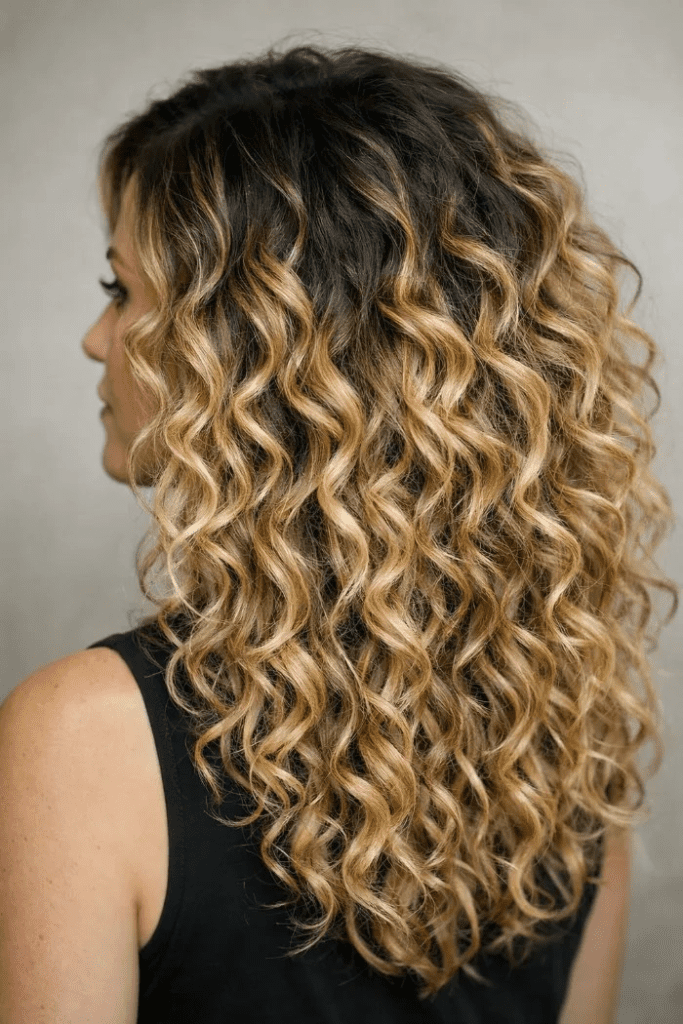
Voluminous curly hair and golden balayage is one of the most spectacular combinations on this list — because the volume of the curl creates a three-dimensional structure that shows balayage from every angle simultaneously. Where straight hair shows balayage as a flat plane of ribbons, voluminous curly hair shows balayage as a sphere of warmth that glows from every direction.
The outer curls and mid-lengths are the placement zones that matter most for curly balayage — outer curl placement maximizes visibility because those sections are the most exposed to light, while mid-length placement creates dimension visible as the curls spring and separate during wear.
What to ask your colorist: Ask for golden balayage applied through a freehand technique following the natural curl groupings — never in systematic foils, which create unnatural, geometric color placement that looks obvious against the organic spiral of curly hair. Request a golden toner with some warmth to ensure the highlights read as warm and luminous rather than ashy or cool against the dark curl base.
Maintenance tip: The number one maintenance priority for curly golden balayage is moisture. Dry curls close in on themselves and hide the color entirely; well-moisturized, defined curls open up and show the golden highlights at every bend. A leave-in conditioner every wash day and a deep conditioning mask every two weeks are the minimum for maintaining the curl definition that makes this color look its best.
Best for: Women with naturally voluminous curly or coily hair who want golden dimension that works with their texture’s natural drama rather than being minimized by it.
28. Wavy Blonde Lob With Golden Balayage
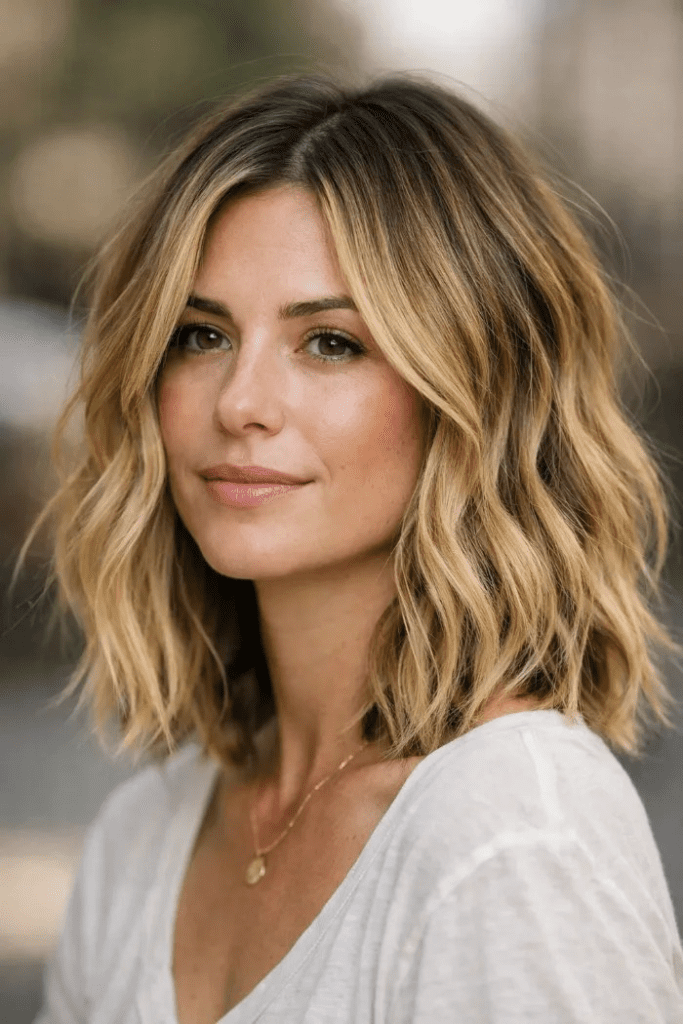
A wavy lob with golden balayage is consistently one of the most popular hair looks on social media — not because it’s complicated, but because it’s the result that most reliably looks good on the most people with the least effort.
The collarbone-length lob gives the balayage enough room to develop a visible gradient while keeping the bright ends close enough to the face to create a genuine brightening effect. The natural wave movement shows the golden highlights differently at every angle as the hair shifts — the style looks dimensional and alive in a way that straight styling on the same color can’t replicate.
What to ask your colorist: Ask for golden balayage that gets progressively lighter toward the ends — slightly darker through the upper mid-lengths, brighter through the lower mid-lengths, lightest at the ends. That gradual brightening creates the natural-looking gradient that makes this style look sun-kissed rather than highlighted.
Maintenance tip: A large-barrel wand and a light flexible spray is the complete styling routine for this look. Wrap sections loosely around the barrel, let cool, then run fingers through rather than brushing — brushing separates the waves into a smoother finish that reduces the dimensional wave quality that shows the balayage best.
Best for: Women who want a reliably flattering, versatile look that photographs beautifully and works as well for a casual day as it does for a special occasion.
29. Wavy Hair With Golden Blonde Ombre Balayage
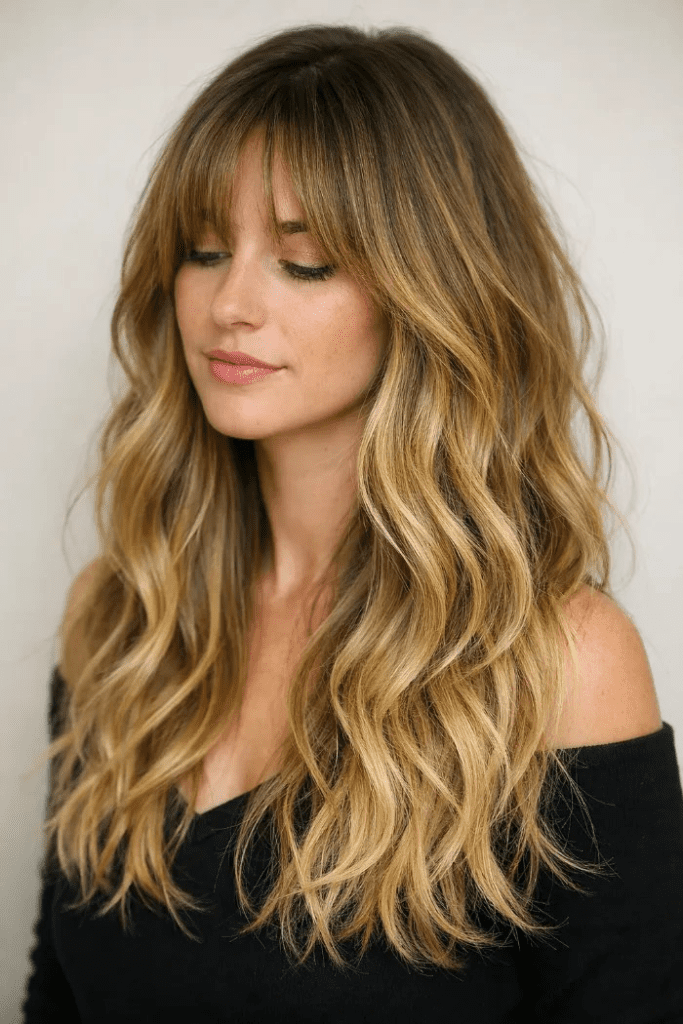
The ombre balayage is the most visible, high-contrast gradient on this list — it keeps the root area in the natural dark base and transitions the lower half of the hair to a noticeably lighter golden blonde, creating a clear, visible two-tone effect that’s more dramatic than standard balayage but softer than a traditional ombre.
The balayage technique applied to the ombre graduation is what softens it — rather than a sharp line where dark ends and golden begins, the balayage creates a diffused, feathered transition that looks gradual and intentional rather than abrupt.
What to ask your colorist: Ask for an ombre balayage technique specifically — tell your colorist you want the lower half of the hair to be noticeably lighter than the upper half, with a blended rather than hard transition between the two. Request a golden toner on the lightened lower section and a root shadow on the upper section to maximize the visual contrast.
Maintenance tip: On wavy hair, the ombre transition is naturally softened by the wave pattern, which means the gradient looks more blended in real life than it does in the salon immediately after the service. Embrace this — let the waves do the blending work and avoid straightening, which reveals the ombre contrast most starkly.
Best for: Women who want the most visibly dramatic, color-forward look on this list — a golden blonde gradient that reads as a deliberate, high-impact color choice rather than a subtle dimension treatment.
30. Wispy Bangs and Golden Blonde Balayage
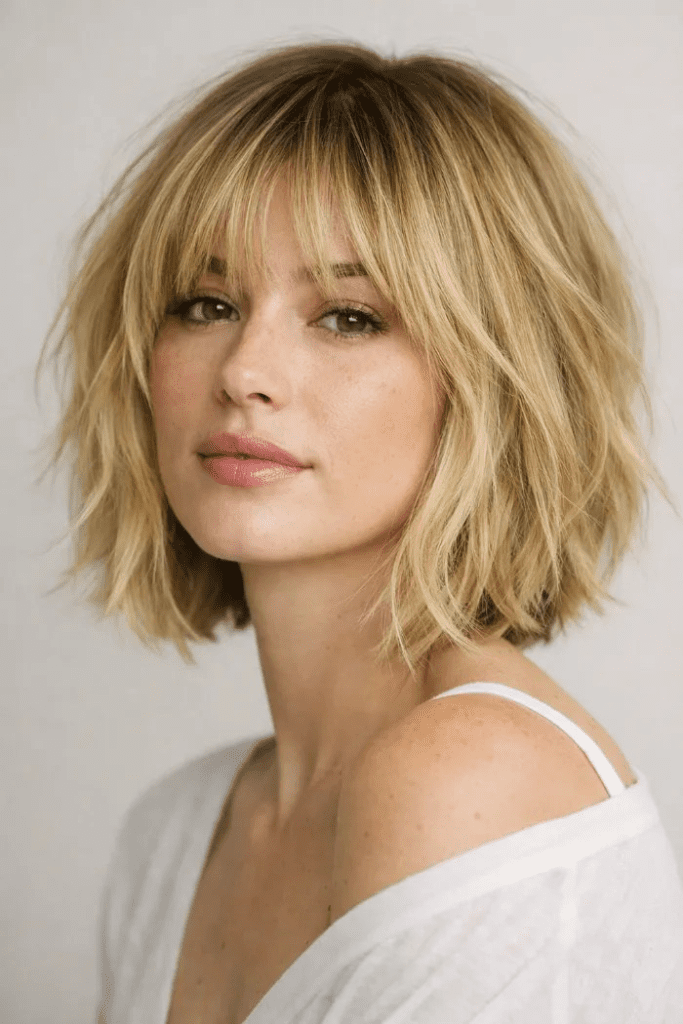
Wispy bangs paired with golden blonde balayage through the lengths create a soft, romantic aesthetic that’s distinctly different from the more structured fringe and balayage combinations on this list. The wisps create a hazy, diffused framing effect around the face while the golden balayage behind them adds warmth and depth.
The most important technical consideration is keeping the wispy bangs light and airy rather than allowing them to become heavy or dense over time. Wispy bangs work best on fine to medium hair where the natural weight of the hair maintains the wispy quality without requiring regular thinning. On thick hair, wispy bangs need more frequent maintenance to prevent them from becoming too heavy.
What to ask your colorist: Ask for the golden balayage to be carried through the wispy bang sections using a very light hand — the fine sections of a wispy fringe need far less product than the rest of the hair to show color, and over-applying formula can make the wisps look coarse and dark rather than light and airy.
Maintenance tip: Wispy bangs and golden balayage together are one of the most naturally low-styling combinations on this list. The wispiness of the bangs and the warmth of the balayage create a soft, romantic quality that’s undermined by precise styling — let both elements be slightly imperfect and the result looks infinitely more flattering than a highly structured version of the same combination.
Best for: Women who want a soft, romantic, effortlessly feminine look that frames the face gently and wears beautifully from morning through evening without restyling.
Final Thoughts
Golden blonde balayage works because it enhances rather than replaces — it adds warmth and light to whatever base it’s applied to without erasing what’s there. The result looks like the best, brightest, most luminous version of your own hair rather than a completely different color.
The thirty styles in this guide represent the full range of what golden blonde balayage can achieve: from the most subtle and natural-looking soft dimension to the most visible and dramatic platinum-tipped gradient. The right style is the one that matches how much visible change you want, how much maintenance you’re willing to commit to, and how the color will interact with the hair texture and length you have.
Bring your two or three favorite references to your colorist — not just the color but the placement, the contrast level, and the styling approach — and tell them specifically what you want the result to feel like: natural and dimensional, or warm and luminous, or bold and high-contrast. The clearer the brief, the closer the result will be to what you’re looking for.
Is golden blonde balayage high maintenance?
It’s significantly lower maintenance than traditional highlights but not entirely maintenance-free. The key variable is how the balayage is applied — specifically how deep the root section is left and how far below the root the lightening begins. A deep root shadow with balayage starting three or more inches below the root can genuinely go four to five months between appointments without looking neglected. A higher-placement application with lighter sections starting closer to the root will need a refresh every eight to ten weeks. The toner maintenance — a gloss refresh every six to eight weeks — is the consistent ongoing requirement regardless of the initial application style, and it’s what keeps the golden quality looking rich rather than faded or brassy.
Does golden blonde balayage work on darker hair?
Yes, and a darker base often produces the most visually striking golden balayage results because the contrast between the dark root and the golden mid-lengths is more visible than on lighter bases. The process on dark hair requires more careful formula selection and potentially more lifting sessions to achieve a clean, warm golden result without brassiness — very dark brunette or black hair may need a two-session approach for the best result. Warm tones like golden, honey, and caramel are more achievable on dark hair in a single session than cool tones like ash blonde, because warm tones work with the orange and red undertones that dark hair reveals during lightening rather than fighting against them.
Will golden blonde balayage suit my skin tone?
Golden tones are among the most universally flattering in hair color — the warmth adds luminosity to the skin that reads as healthy and radiant across most complexions. On warm and olive skin tones, golden highlights enhance the natural warmth of the complexion. On neutral and cool skin tones, the warmth of golden highlights creates a complementary contrast that brightens and warms the skin rather than washing it out. The one adjustment that helps across all skin tones is the saturation level — softer, more muted golden highlights are the safest starting point, with brighter, more saturated versions available once you’ve seen how the tone interacts with your complexion.
What’s the difference between golden blonde balayage and honey balayage?
Golden blonde sits slightly lighter and more luminous than honey — it has a genuine brightness that reads as blonde. Honey is richer, slightly darker, and more amber in quality — it reads closer to a warm brown than a warm blonde. On lighter brunette bases, the distinction may be subtle. On darker brunette or deep brown bases, golden will be more visible and more contrasting while honey will integrate more naturally into the base. If you want the color to be clearly visible against a dark base, golden is the right direction. If you want something that reads as dimension within the brunette rather than a separate lighter tone, honey is more appropriate.
How do I maintain golden blonde balayage at home between salon appointments?
Four practices make the biggest difference: a sulfate-free shampoo for every wash to prevent color stripping, a deep conditioning mask once a week to maintain the moisture and shine that makes golden highlights look their most luminous, heat protectant before every use of hot tools to prevent the heat damage that causes golden tones to go brassy and dull, and a clear or warm-tinted gloss used at home every six to eight weeks to refresh the tonal quality and add shine. A purple shampoo used sparingly — once every two to three weeks rather than every wash — can manage any warm excess without overcooling the golden tone you specifically want to maintain.