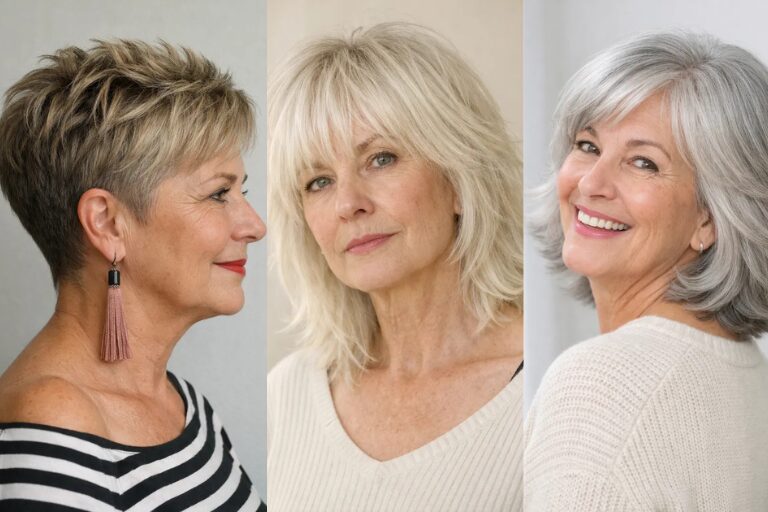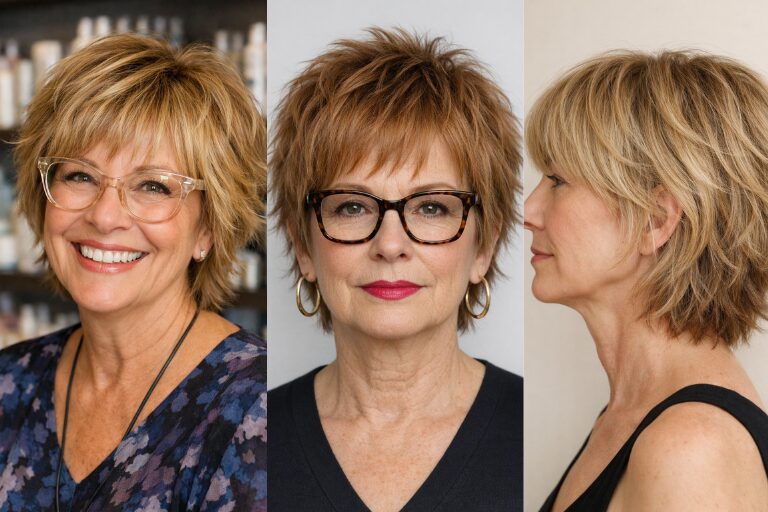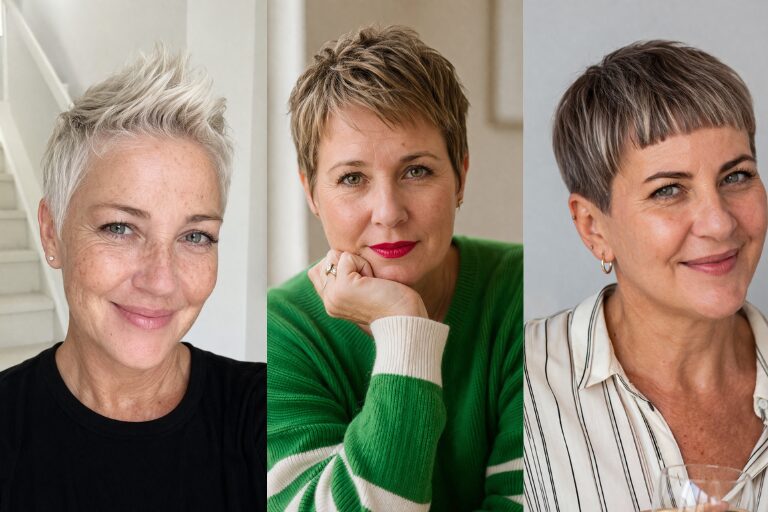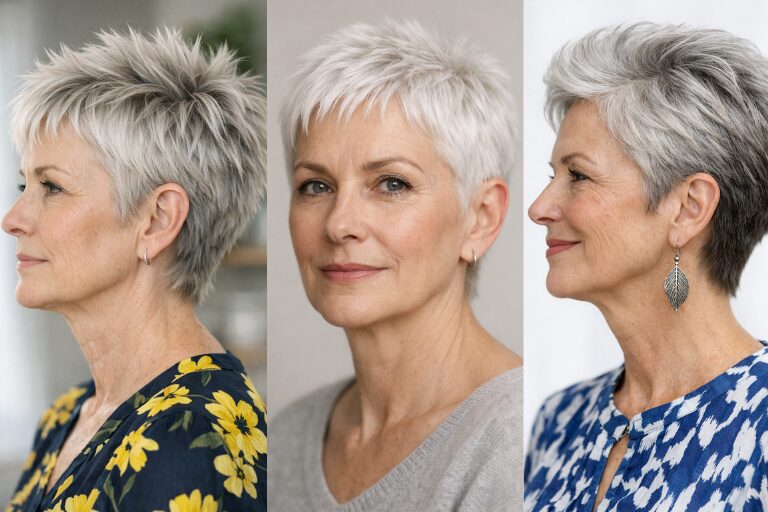
19 Short Hairstyles for Older Black Women To Try
Short hair isn’t a compromise. For many older Black women, it’s a deliberate, confident choice — one that honors changing hair texture, simplifies a daily routine that no longer needs to revolve around styling, and lets natural color and curl pattern take center stage rather than being managed or suppressed.
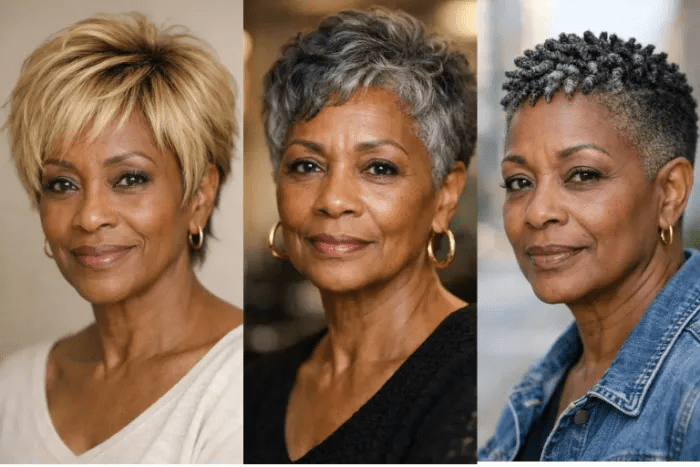
What changes about hair after a certain age isn’t just aesthetics. The texture often shifts. Density can change. Gray and silver tones develop their own personality that’s worth showcasing rather than covering. And the patience for styles that demand an hour of daily effort — the kind of patience that younger hair sometimes required — is something most women would rather spend elsewhere.
Short hairstyles for older Black women work specifically because they’re cut with intention rather than simplicity. A well-placed shape at the crown creates presence without length. A soft taper at the sides creates structure without harshness. A teeny weeny afro that’s shaped rather than simply grown out looks as intentional as any elaborate style — and it takes two minutes to maintain.
Every style in this guide was chosen because it works with natural texture rather than against it. You’ll see close-cropped cuts, soft afros, defined coil styles, pixies, fades, and curl-forward shapes — each selected for how well it wears in real life, not just how it looks freshly done. The cut, the grow-out, the effort level, and the way it interacts with natural gray or silver tones all factored into the selection.
Before choosing: think about three things that matter more than the visual of a style. First, how much daily styling you want to do — some of these styles maintain themselves, others benefit from a quick product routine. Second, how often you can see your stylist — tapered and faded styles need more frequent visits than natural, rounded shapes. Third, how your hair behaves after wash day — whether it coils, curls, shrinks significantly, or stays relatively stretched will determine which shape holds best for you.
1. Close-Cropped Natural Gray
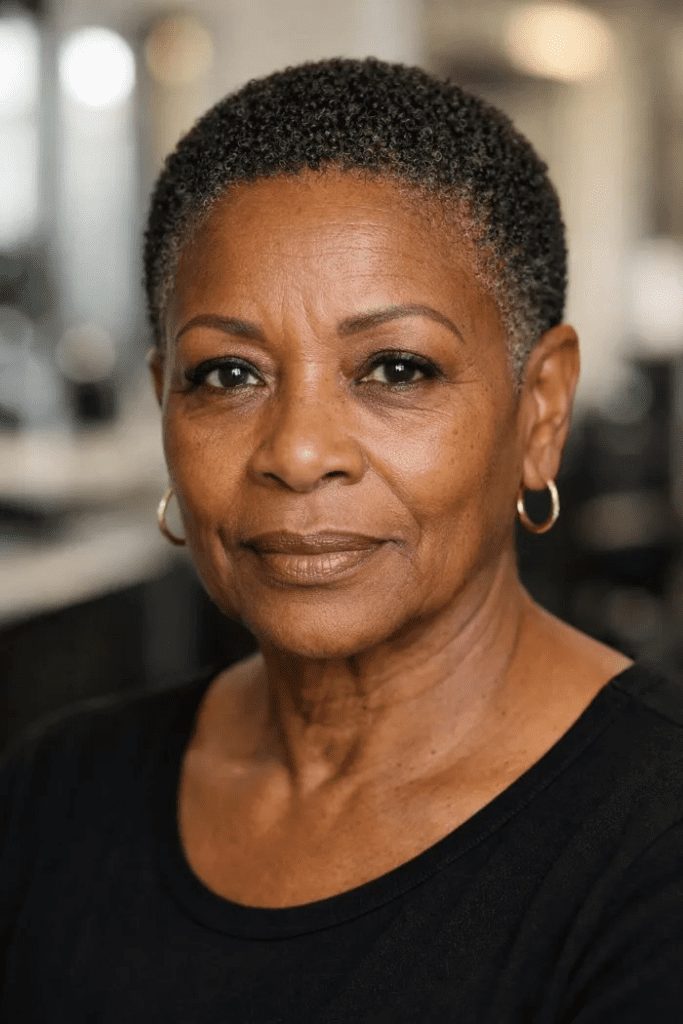
A close-cropped style on natural gray hair is one of the most confident, self-possessed looks on this list — and it works specifically because it makes no apology for either the length or the color. Both are presented as exactly what they are: intentional choices.
At this length, natural gray texture becomes the entire aesthetic. The curl pattern — even when it’s tight and close to the scalp — creates its own visual interest through the variation in color and texture that gray hair naturally has. No style reads as more certain of itself than a close crop that lets that natural variation be the point.
The maintenance demand is genuinely minimal. With no length to style and no color to maintain, the primary focus is keeping the scalp moisturized and the shape fresh with regular trims.
What to ask your stylist: Ask for a consistent, even clipper length across the top with a clean, natural taper at the nape and temples. Specify that you want the taper to follow the natural hairline rather than being pushed back or sharply defined — a natural line is more flattering on most face shapes and grows out much more cleanly.
Maintenance tip: A lightweight scalp oil applied after washing keeps the scalp healthy and gives the short gray texture a subtle sheen without the heaviness of butter or heavy cream. At this length, product should feed the scalp, not coat the hair.
Best for: Women who want the absolute minimum daily maintenance and are fully embracing their natural gray — a look that requires confidence to wear and rewards that confidence with striking, effortless presence.
2. Soft Short Crop
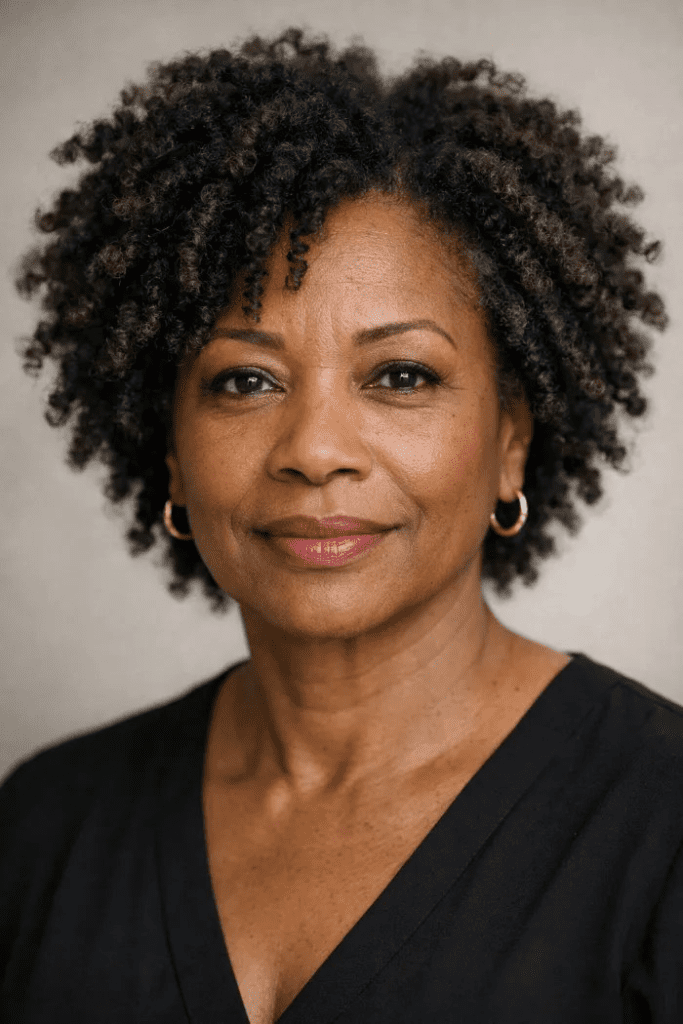
The soft short crop is the most gently shaped option on this list — it has the low length of a cropped cut but with deliberate softness around the face and edges that prevents it from looking severe or overly precise. The shaping is there; it’s just not announcing itself.
For older Black women whose hair has started to change in texture — becoming finer, softer, or more variable in density — the soft crop is one of the most forgiving shapes available. Because the silhouette is rounded and relaxed rather than architectural, it accommodates natural variation in texture and density without looking uneven.
What to ask your stylist: Ask for a soft crop with no sharp edges — tell your stylist you want the shaping to feel like a suggestion rather than a definition. If you have any areas of thinner density at the temples or crown, ask your stylist to shape around those areas with a soft blend rather than a defined line.
Maintenance tip: A light curl defining cream worked through the crop on wash day and left to dry naturally is typically all this style needs between trims. The cut is doing most of the structural work — the product’s job is to enhance the natural texture, not create a shape that doesn’t already exist.
Best for: Women who want a short style that looks put together without looking like it required significant effort — a relaxed, approachable shape that wears well throughout the day.
3. Short Natural Curls
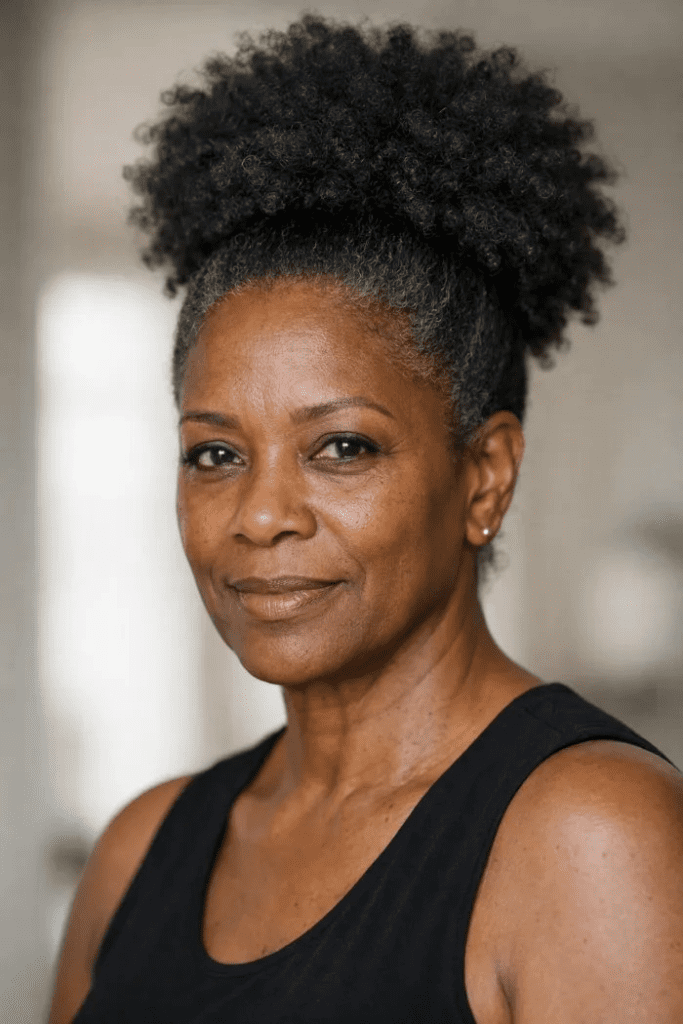
Short natural curls — sitting just away from the scalp with enough length for the curl pattern to form fully — are one of the most flattering lengths for older Black women because this length zone allows the curl to express its natural shape without the weight of longer hair pulling the pattern out.
As hair changes with age and sometimes becomes finer, longer natural styles can lose the definition and fullness that made them work. At a shorter length, the curl pattern often performs better — tighter, more defined, and more consistent — because each strand has less length to support and therefore retains its natural spring more completely.
What to ask your stylist: Ask for a shape that allows the curl to form naturally away from the scalp rather than being cut so short that the curl can’t fully develop. The specific length depends on your individual curl pattern — tighter coils can be cut shorter while retaining their shape; looser curls need a little more length to show their pattern. Discuss your specific texture with your stylist rather than choosing a length from a photo alone.
Maintenance tip: Apply a curl defining product to soaking wet hair section by section to encourage each curl to form in its natural grouping. Finger coiling specific sections that need more definition adds shape without a lot of additional product. Avoid touching the curls while they dry — disturbing wet natural curls is the most common cause of frizz.
Best for: Women who want their natural curl pattern to be the defining feature of their style — a cut that celebrates the texture rather than minimizing or flattening it.
4. Close-Cropped Gray Fade
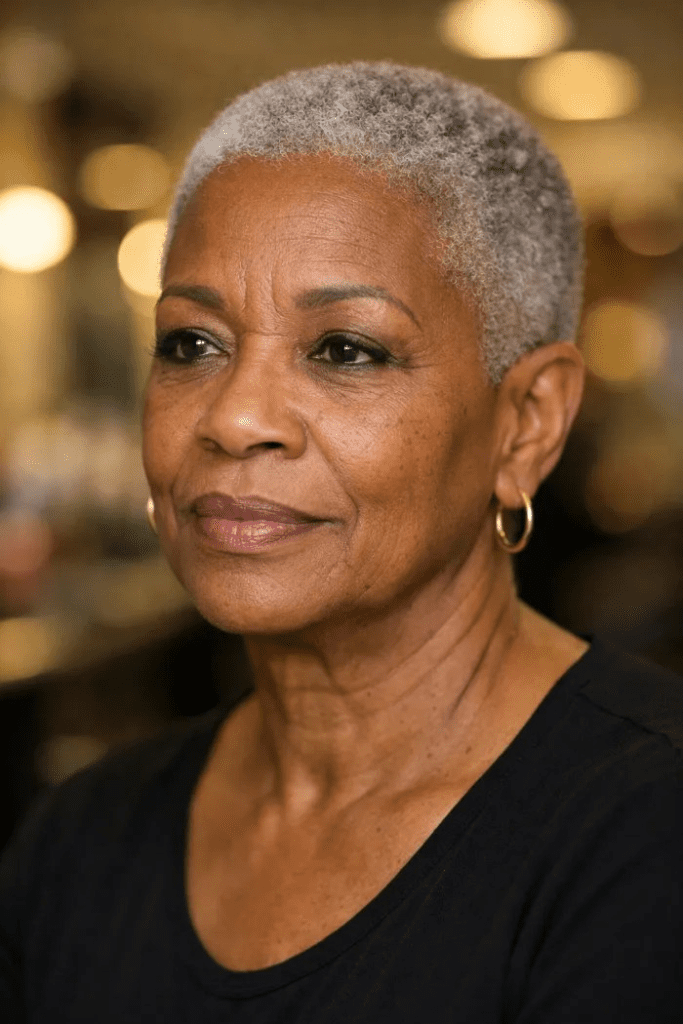
The close-cropped gray fade adds a layer of intentional structure to the close crop through the gradient taper at the sides and back. Where a straight close crop has a consistent length throughout, the fade creates a subtle graduation from shorter at the sides to slightly more present at the crown — which adds visual structure and a modern quality to what is otherwise a minimal style.
Gray hair and a fade are a particularly effective combination because the gray tones naturally create their own tonal graduation — darker at the root, lighter toward the ends — that complements the gradient of the fade itself. The two gradients, one tonal and one structural, work in the same visual direction.
What to ask your stylist: Ask for a low or mid fade rather than a high fade — on older skin, a high fade can create a stark contrast that reads as harsh rather than sharp. A low or mid fade gives the style its structure without the severity. Ask for the fade to blend smoothly rather than dropping sharply.
Maintenance tip: A fade requires more frequent visits than a natural shape — every two to three weeks to keep the gradient clean rather than grown out. If that frequency isn’t realistic for your schedule, a soft taper is a better choice than a true fade — it creates similar structure but grows out more gracefully between appointments.
Best for: Women who want modern, structured lines in their short cut and are comfortable with the slightly more frequent maintenance that a faded shape requires to stay looking intentional.
5. Short Finger Coils
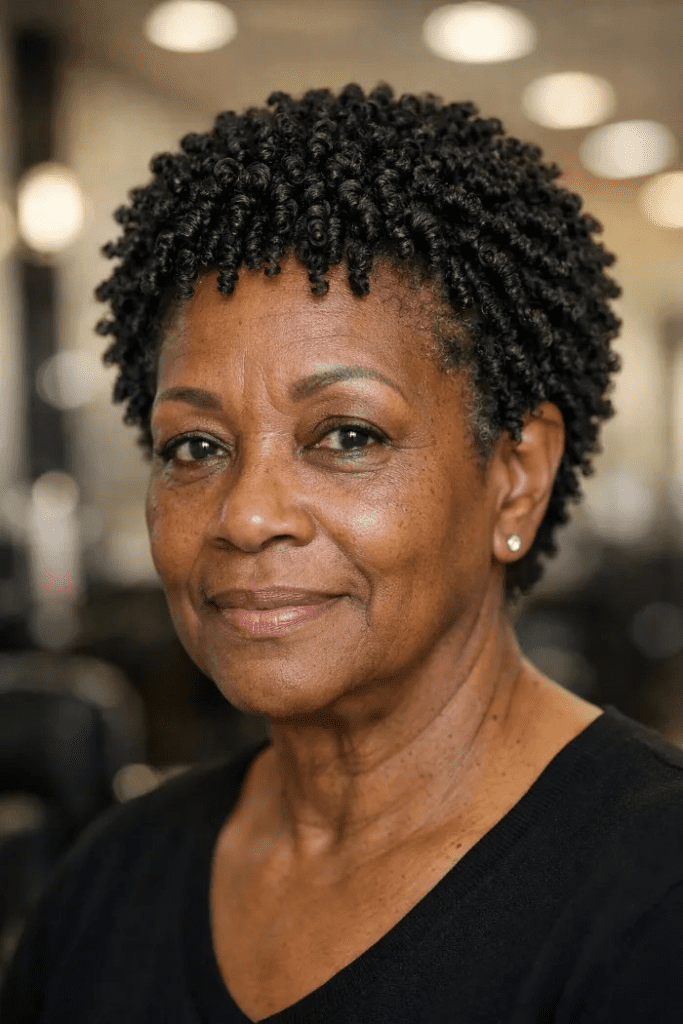
Finger coils at a short length are one of the most texturally rich styling options on this list — because the deliberate coiling technique creates defined, uniform spirals that look both intentional and beautifully natural simultaneously. This is a protective style direction that doubles as a finished look requiring no additional manipulation once the coils are set.
At a shorter length, finger coils are also significantly more manageable to apply and maintain than on longer hair. The product dries faster, the coils hold their definition longer without weight pulling them out, and re-coiling specific sections is quick rather than time-consuming.
What to ask your stylist: Ask for a shape that allows the coils to sit evenly rather than being cut at a length where some sections are too short to hold the coil and others are long enough to hang out of it. A rounded, even shape at the top with a clean taper or fade at the sides gives the coils a flattering silhouette.
Maintenance tip: Apply a gel or coiling cream to each section on wet hair, then wrap each section around your finger from root to tip and hold momentarily before releasing. Diffuse on low heat or air dry completely before touching. Reactivate individual coils that lose definition between wash days with a light mist of water and a tiny amount of additional gel.
Best for: Women with tighter curl patterns who want defined, textured style that holds its shape well between wash days and grows out gracefully without needing immediate restyling.
6. Shoulder-Length Natural Curls
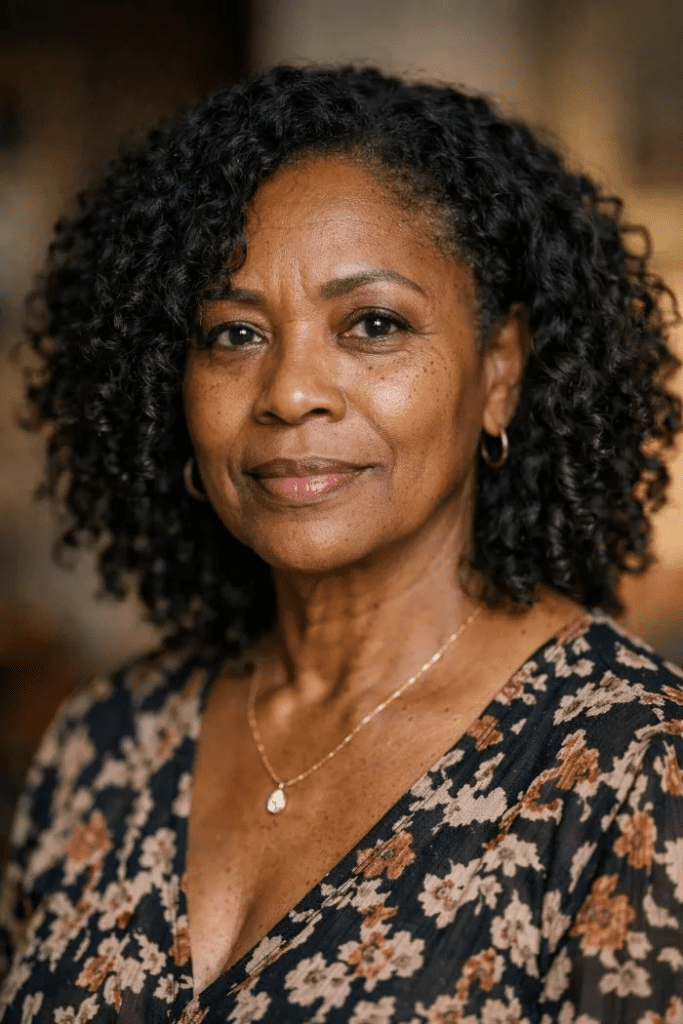
Shoulder-length is the longest style on this list — included because it represents the short-to-medium zone that many older Black women occupy when their primary goal is manageability rather than dramatic length reduction.
At this length, natural curls have enough weight to stay more elongated than at shorter lengths, which can be specifically flattering for face shapes that benefit from a little length. The shoulder-adjacent fall also creates natural movement and framing that shorter cuts don’t have. This is the right length for women who want something between a close crop and longer natural styles — easier than the latter, more presence than the former.
What to ask your stylist: Ask for light dusting of the ends to maintain the shape rather than significant length removal — on natural hair, this length needs shape maintenance rather than regular aggressive trimming. Ask for face-framing shaping that allows the curls at the front to fall forward rather than pulling everything back.
Maintenance tip: A deep conditioning treatment monthly is the most important maintenance step at this length — shoulder-length natural hair is long enough that the ends need more intensive moisture support than shorter lengths. Protective styling on nights you’re not washing extends the definition significantly.
Best for: Women who want the most versatility from a shorter natural style — the shoulder-length zone gives you the option to wear the hair down, half up, or pulled back with accessories on different occasions.
7. Salt-and-Pepper Curly Crop
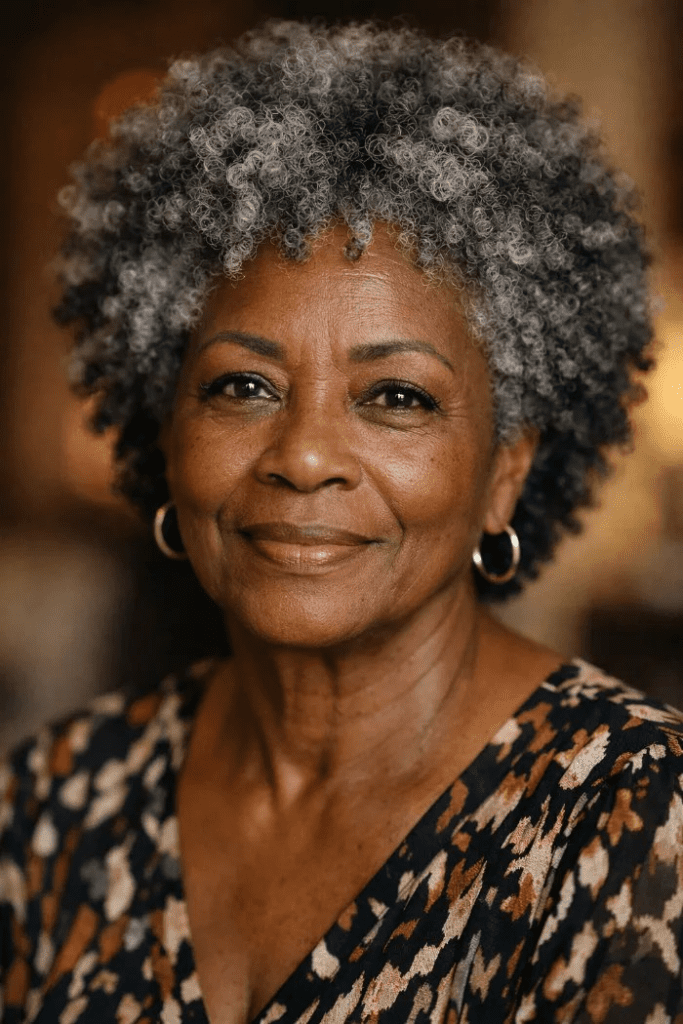
Salt-and-pepper hair has a natural visual complexity that few single-tone colors can replicate — the interplay between darker and lighter strands within the same curl creates dimension and depth that looks distinctly sophisticated at any length. At a cropped length, that complexity becomes the entire visual story of the style.
The cropped shape specifically flatters salt-and-pepper natural hair because it allows the tonal variation to read across the full silhouette of the style rather than being concentrated at the tips or fading through the length. Every section of the crop shows the salt-and-pepper quality equally.
What to ask your stylist: Ask for a rounded crop shape with enough length for the curl pattern to form fully — the curls themselves are what create the movement and shape that makes salt-and-pepper hair look most beautiful at this length. A crop that’s cut too short to curl reads as simply short rather than as a curl-forward style.
Maintenance tip: Embrace the natural variation in the curl pattern that salt-and-pepper hair often develops — gray strands sometimes have a different texture than pigmented strands, creating a natural variation in curl tightness. A curl cream that works on multiple textures simultaneously keeps the mixed-texture curl pattern looking unified rather than patchy.
Best for: Women who are fully embracing their natural salt-and-pepper color and want a cut that presents it as the beautiful, intentional choice it is rather than minimizing or working around it.
8. Short Twisted Coils With Natural Fade
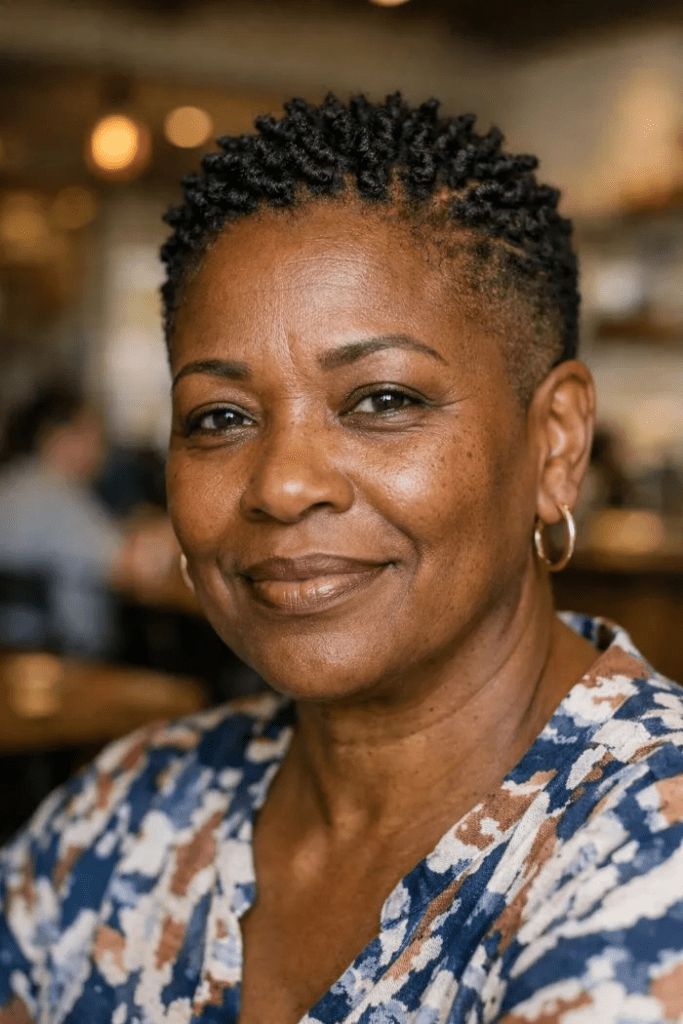
Twisted coils on a naturally faded base is a combination that balances texture with structure — the twists provide expressive, defined texture at the top and crown, while the natural fade at the sides creates a clean, modern framework for that texture to sit within.
The natural fade specifically — softer and less tapered than a clipper fade — is the right choice for this style because it grows out more gracefully and maintains its relationship to the twisted texture on top for longer between visits. A hard clipper fade against twisted coils can look mismatched as it grows out; a soft natural fade grows alongside the style more harmoniously.
What to ask your stylist: Ask for the fade to blend naturally rather than drop sharply — tell your stylist you want a soft graduation rather than a defined line where the fade ends and the full-length section begins. For the twists themselves, ask for uniform two-strand twists through the top section sized to your preference.
Maintenance tip: Twisted coils hold their definition significantly longer than loose natural styles — retwist individual sections that begin to unravel rather than redoing the full style. A light oil applied to the scalp between wash days keeps both the scalp healthy and the twists from looking dry without needing to disturb the style.
Best for: Women who want a defined, textured style with a modern structural element — expressive on top, clean at the sides, and easy to maintain between styling sessions.
9. Soft Rounded Natural Afro
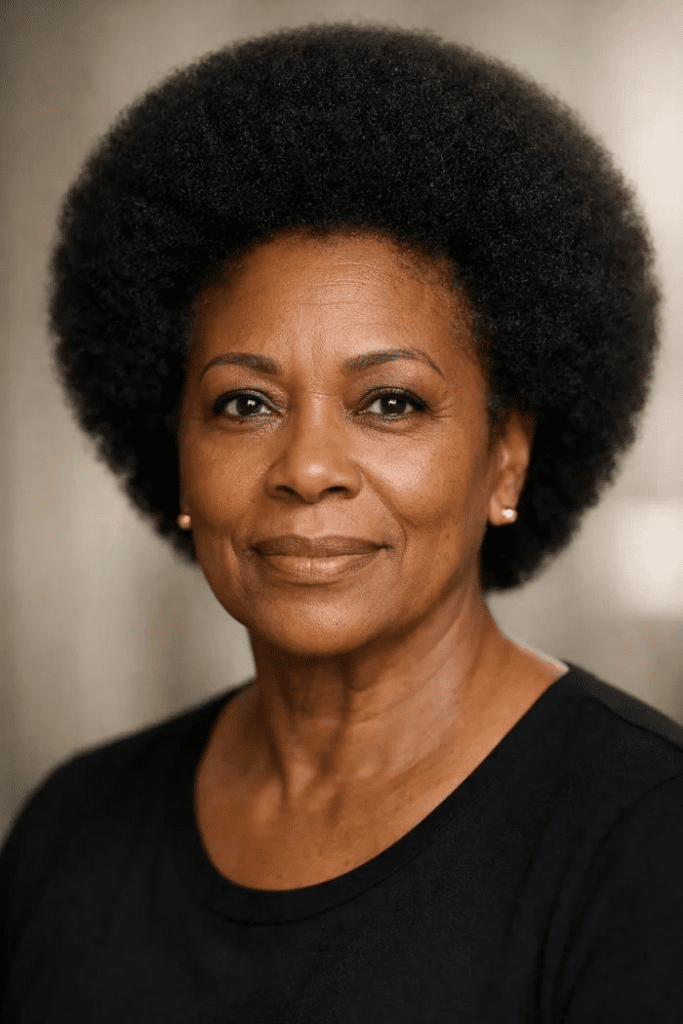
The soft rounded afro is the most classically beautiful natural shape on this list — and it’s specifically “soft” and “rounded” rather than sharply sculpted for an important reason. A harshly geometrical afro shape requires constant maintenance to maintain its precision. A soft, rounded afro maintains its character as it grows and responds to humidity, sleep, and daily life rather than fighting all of those things to stay in a particular geometric form.
For older Black women, the soft rounded afro is often the most practically sustainable version of an afro shape — it looks intentional because the overall silhouette is even and rounded, but it accommodates natural variation in the texture without requiring the style to be re-set after every night’s sleep.
What to ask your stylist: Ask for a rounded shape rather than a flat-top or geometrically precise afro — tell your stylist you want the shape to feel organic rather than architectural. Ask for the shaping to be done following the natural growth direction of your hair rather than cutting against it, which creates a shape that holds longer.
Maintenance tip: Pick the afro gently from the roots outward after washing and conditioning to restore the rounded shape without disrupting the curl pattern. A light water spray and a puff with a pick in the morning refreshes the shape after sleep without requiring a full restyling. A satin bonnet or pillowcase at night significantly reduces the amount of morning reshaping needed.
Best for: Women who love the presence and personality of a natural afro shape and want a version that works with their daily life rather than requiring constant maintenance to stay looking intentional.
10. Sophisticated Salt-and-Pepper Pixie
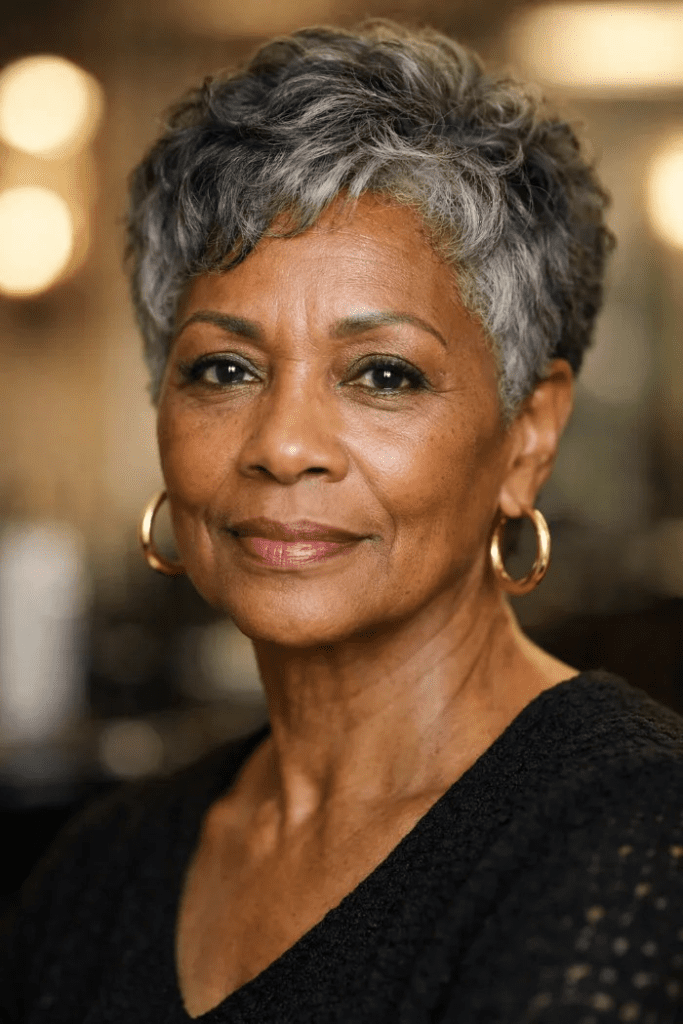
The pixie cut on natural Black hair with salt-and-pepper color is one of the most sophisticated looks on this list — because it combines the precision of a shaped cut with the inherent visual interest of natural gray and silver tones in a way that reads as genuinely refined rather than simply short.
The shaping around the crown and temples is what gives the pixie its sophisticated quality. Rather than simply cutting the hair close everywhere, a well-executed pixie leaves specific lengths at the crown for styling variation while keeping the temples and nape clean and neat. That structural decision is what elevates a pixie from simply short to genuinely styled.
What to ask your stylist: Ask for a pixie with slightly more length at the crown than at the sides — this gives you the option to style the crown section in different directions depending on the day. Ask specifically for clean, neat shaping at the temples and nape rather than a tapered blend — the precision there is what makes the sophistication of this cut read correctly.
Maintenance tip: A tiny amount of edge control or light pomade at the temples keeps the clean shaping looking precise between trims. The crown section can be left to express its natural texture or lightly defined with a curl cream depending on the day’s preference — the pixie is versatile enough to work with both approaches.
Best for: Women who want a short, shaped style that reads as sophisticated and deliberate — a cut that requires no explanation and makes a strong visual impression without any daily styling effort.
11. Tapered Natural Cut With Crown Volume
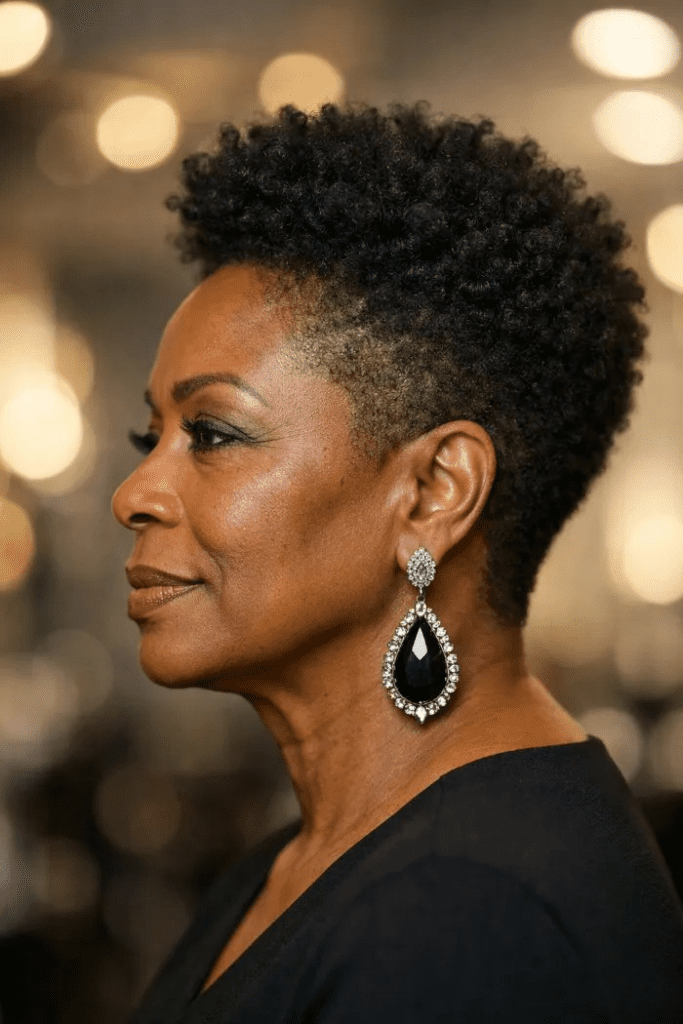
The tapered natural cut with crown volume is the most structurally strategic style on this list because it uses the taper to visually create fullness at the crown — the narrow sides contrast against the fuller top, making the crown appear even more voluminous than it actually is.
This shape is particularly beneficial for women whose hair has started to thin slightly at the sides or temples with age — the taper at the sides naturally accommodates lower density in those areas while maintaining a full, present silhouette through the crown where density is typically better preserved.
What to ask your stylist: Ask for the taper to be gradual rather than abrupt — the transition from the fuller crown to the tapered sides should feel like a continuous flow rather than a distinct shift between two lengths. Tell your stylist you want volume concentrated specifically at the crown rather than distributed evenly throughout the cut.
Maintenance tip: This style grows out in one of the most forgiving ways of any cut on this list — the taper simply becomes softer and the crown becomes slightly fuller, which is a natural evolution of the shape rather than an obvious overgrown look. A trim every six to eight weeks maintains the structural integrity without requiring the constant schedule of a fade.
Best for: Women who want crown volume and presence in a short cut and appreciate a shape that grows out gracefully between appointments rather than requiring frequent maintenance to look intentional.
12. Feathered Pixie With Warm Tone
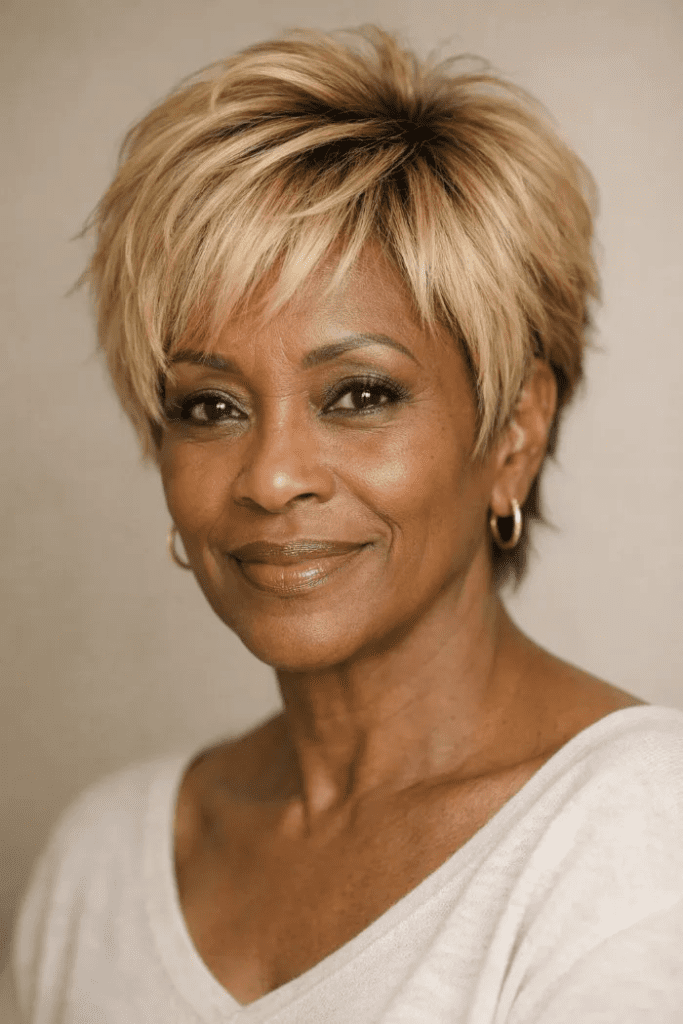
A feathered pixie on natural Black hair with a warm color tone — whether natural honey-brown or a warm blonde — is one of the most movement-forward styles on this list because the feathering technique creates airiness and lightness at the crown that most short cuts don’t have.
Feathering means the ends of the pixie sections are texturized to move individually rather than as a single, blunt mass. The result is a pixie that has visible lightness and movement through the top, which prevents it from looking severe or flat against the head. The warm color tone specifically amplifies this effect — warm tones catch light more actively than cool or neutral tones, which makes the feathered movement visible from greater distances.
What to ask your stylist: Ask specifically for feathered ends rather than a blunt-cut pixie — feathering is a technique that not all stylists apply by default, so being specific about wanting it ensures the result you’re after. Ask for the feathering to be concentrated through the crown and top sections where movement is most visible.
Maintenance tip: A light hold spray misted through the crown section after styling preserves the feathered movement without stiffening the ends. Heavy products collapse feathered sections together and eliminate the light, individual movement that makes this style distinctive.
Best for: Women who want a short cut with visible movement and warmth — a pixie that looks light and airy rather than close and flat.
13. Voluminous Short Curls
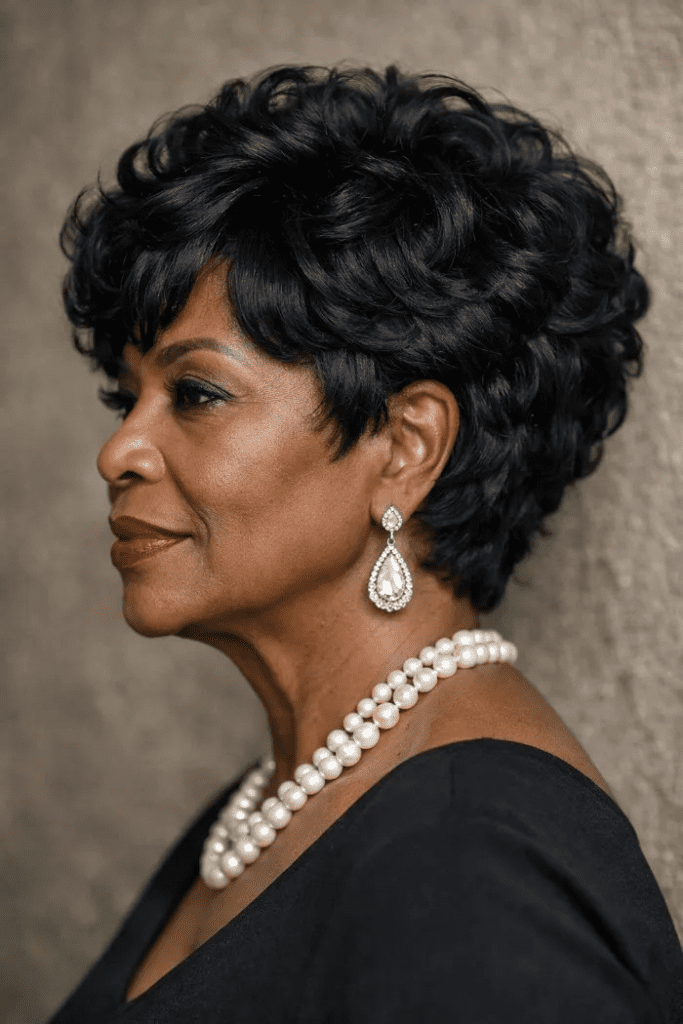
Voluminous short curls shaped to sit away from the scalp rather than lying against it are one of the most expressive and confidence-projecting styles on this list — because the shape claims space in a way that closer, flatter styles don’t. This is a cut designed to be noticed.
The key to this style working on older natural hair is in the shaping technique. The stylist shapes the curl volume outward and upward rather than simply cutting it short, which creates a silhouette that reads as deliberate and sculptural. The finish looks natural because the curl pattern is intact; it reads as intentional because the volume is shaped rather than simply grown.
What to ask your stylist: Ask for the shaping to be done dry rather than on wet hair — natural curls shrink significantly when wet, and a shape cut on wet natural hair often becomes a much shorter, flatter shape once the hair dries. Dry shaping allows the stylist to work with the actual curl volume rather than the compressed wet version.
Maintenance tip: Define individual curl sections with a curl cream applied on wash day to keep the volume from reading as frizz rather than intentional fullness. The volume itself is structural — the product’s job is to define individual curls within the volume, not to create the volume from scratch.
Best for: Women who want a short cut with genuine presence and personality — a shape that takes up space with confidence and looks most at home on women who wear their natural hair with the same energy.
14. Soft Silver Curls
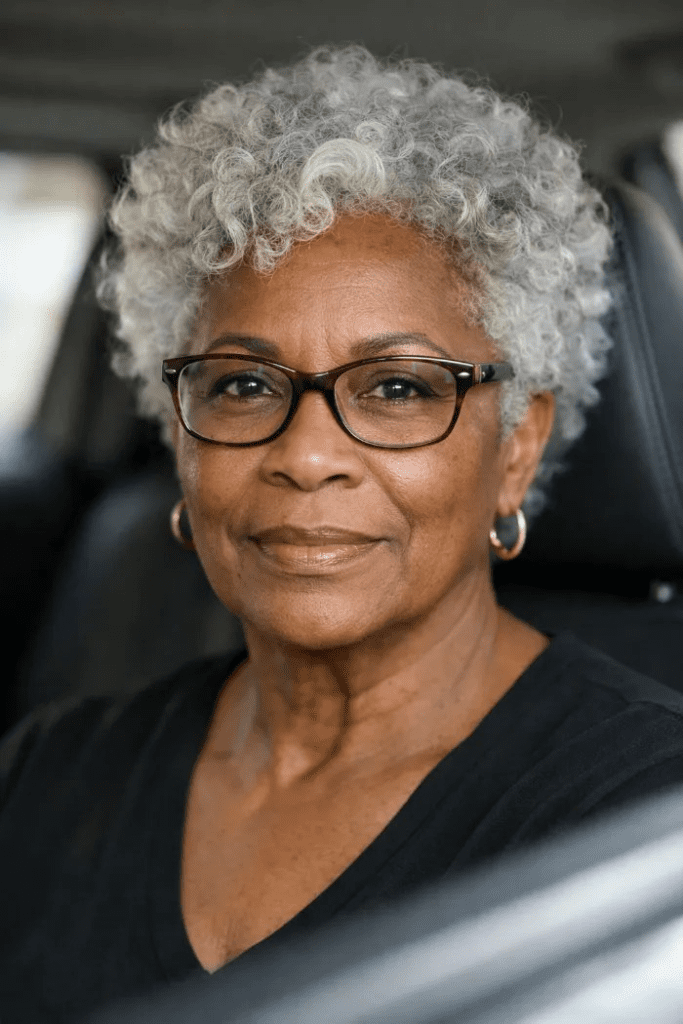
Silver hair on natural Black hair deserves its own style category — because fully developed silver natural hair has a luminous, almost metallic quality that interacts with light in a way that darker hair simply doesn’t. At a medium-short length that allows the curls to frame the face, silver natural curls create one of the most genuinely striking looks on this list without requiring any color work or styling complexity.
The softness of this style is specifically what lets the silver color do its work. A tightly sculpted or aggressively shaped style on silver curls can look harsh; a softly framed, loosely defined approach allows the natural movement of the silver curl to be the visual story.
What to ask your stylist: Ask for a length that allows the curls to fall naturally around the face rather than spring back tight to the scalp — silver curls framing the face have significantly more visual impact than silver curls pressed tight to the head. A soft face-framing shape rather than a uniform all-around length gives the style its most flattering quality.
Maintenance tip: Silver natural hair often benefits from a purple or violet rinse every four to six weeks to maintain the cool, bright silver quality rather than developing a yellowish cast. A lightweight deep conditioner used weekly maintains the softness that keeps silver curls looking luminous rather than dry and coarse.
Best for: Women who have fully or largely transitioned to silver natural hair and want a style that presents that color as the stunning natural feature it is — unhidden, unapologetic, and beautifully framed.
15. Short Twisted Coils Close to the Head
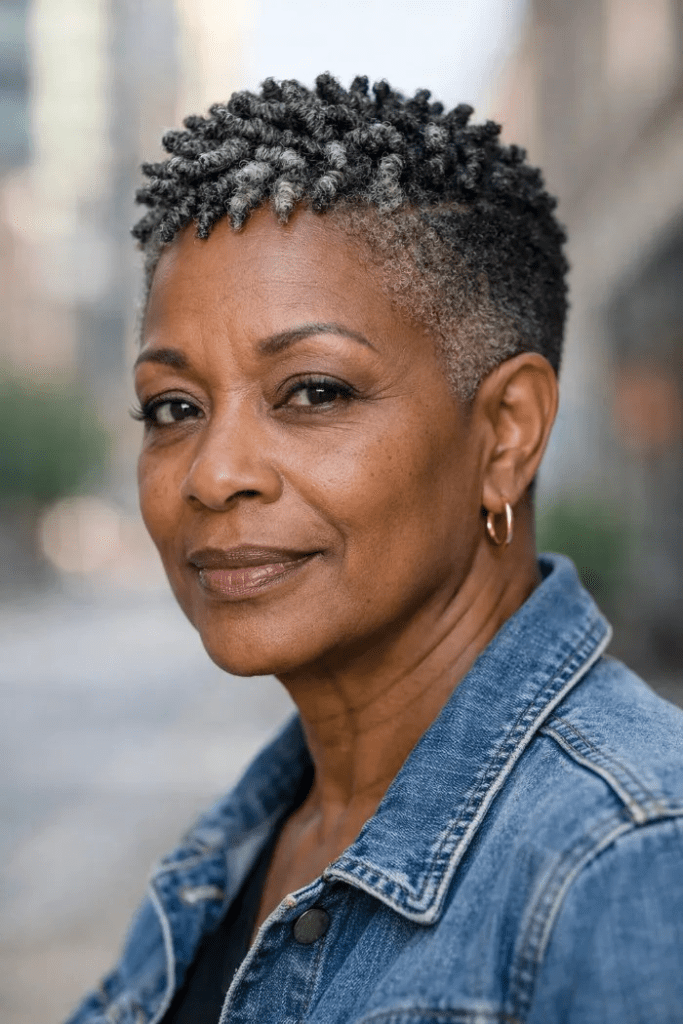
Compact, close-to-the-head twisted coils are the tidiest, most groomed-looking style on this list — and for women whose priority is a style that holds its shape across multiple days without daily manipulation, this is one of the most practical options available.
The close positioning of the twists to the head — rather than sitting away from the scalp with volume — means the style doesn’t change significantly as the day progresses. There’s no volume to compress during work, no curl pattern to lose definition in humidity, and no shape to reset before leaving the house. It simply stays as it was when set.
What to ask your stylist: Ask for a shape that allows the twists to sit close to the head naturally — this is partly about the twist size (smaller, tighter twists sit closer) and partly about the length (shorter lengths don’t have enough weight to pull away from the scalp). Discuss the right combination for your specific curl pattern.
Maintenance tip: Cover with a satin bonnet every night without exception — this is the single most effective maintenance practice for twisted coils. Without covering, the twists frizz and lose their definition from friction during sleep. A light oil to the scalp between wash days maintains health without disturbing the style.
Best for: Women who want a tidy, defined style that holds its appearance across multiple days with minimal morning effort — the most practically self-maintaining textured style on the list.
16. Sculpted Pixie Cut
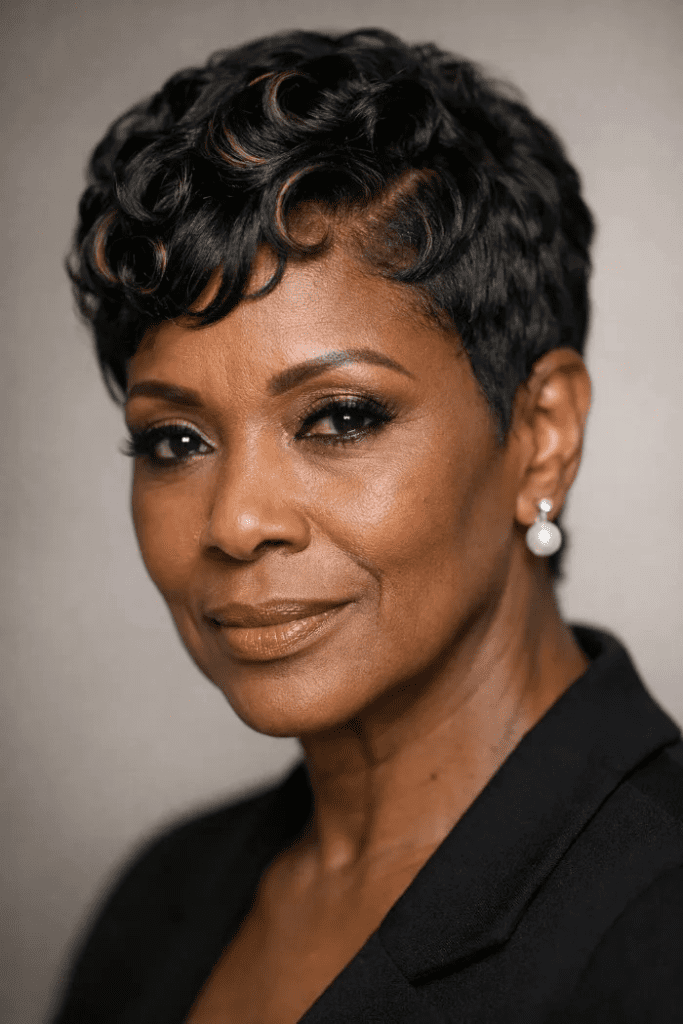
The sculpted pixie is the most precisely shaped style on this list — every section is cut with intention, the crown shape is deliberate, and the overall silhouette reads as a considered design choice rather than simply short hair. It’s the difference between a pixie that looks like a style and a pixie that looks like the hair was cut without a specific vision.
The sculpting specifically around the temples and crown defines the character of this style. The shape at the crown — whether it’s rounded, slightly flat on top, or angled forward — gives the pixie its identity. The clean, neat finish at the temples anchors the style and prevents it from looking undefined at its edges.
What to ask your stylist: Bring a reference image that specifically shows the crown shaping you want — “sculpted pixie” means different things to different stylists. The crown shape is the most important detail to communicate clearly. Specify whether you want the crown to be rounded, slightly directional, or flat at the top.
Maintenance tip: A sculpted pixie requires the most frequent maintenance of any style on this list — every three to four weeks to keep the sculpted shape from growing into something undefined. If that frequency isn’t manageable, consider a tapered natural cut instead, which offers similar structure with a more forgiving grow-out.
Best for: Women who specifically want a styled, shaped pixie rather than simply a short cut — and who can commit to the regular trimming schedule needed to maintain that precision.
17. Natural Silver TWA
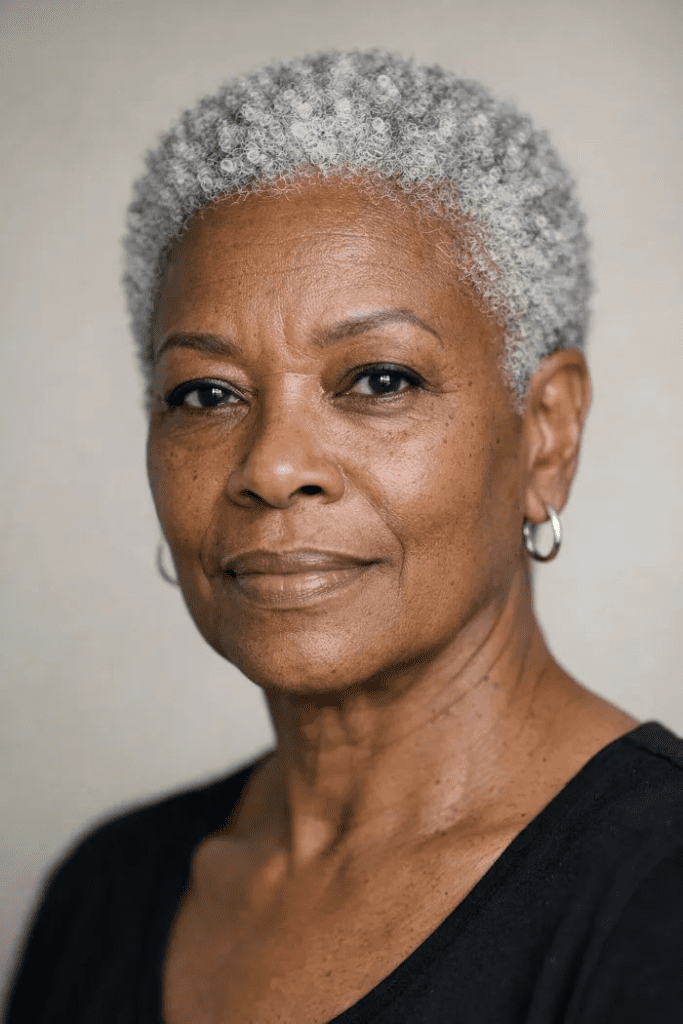
The teeny weeny afro — TWA — on natural silver hair is the most pared-back, essential style on this list. It removes everything that doesn’t need to be there and leaves what does: the natural texture of the hair, the authentic color, and the shape that comes from the hair growing as it wants to grow.
On silver natural hair, the TWA is specifically effective because the silver tone is visible across the entire close surface of the style with equal intensity — there’s no length gradient or wave movement to create tonal variation. The silver is simply present, fully expressed, across every part of the silhouette.
What to ask your stylist: Ask for an even shape across the top with a soft natural taper at the nape — the shape should look intentional from every angle without requiring a geometric precision that would need constant maintenance. Discuss the specific length with your stylist in the context of your curl pattern, since shrinkage affects how much length is needed for the shape to look rounded rather than patchy.
Maintenance tip: A TWA is the most maintenance-friendly option on this list in terms of daily effort — a light water mist and a palm press resets the shape after sleep in under thirty seconds. A scalp oil worked in lightly keeps the scalp healthy and gives the short silver texture a subtle natural sheen.
Best for: Women who want the absolute simplicity of a TWA paired with the striking visual quality of natural silver hair — a combination that requires nothing and communicates everything.
18. High-Top Fade With Natural Texture
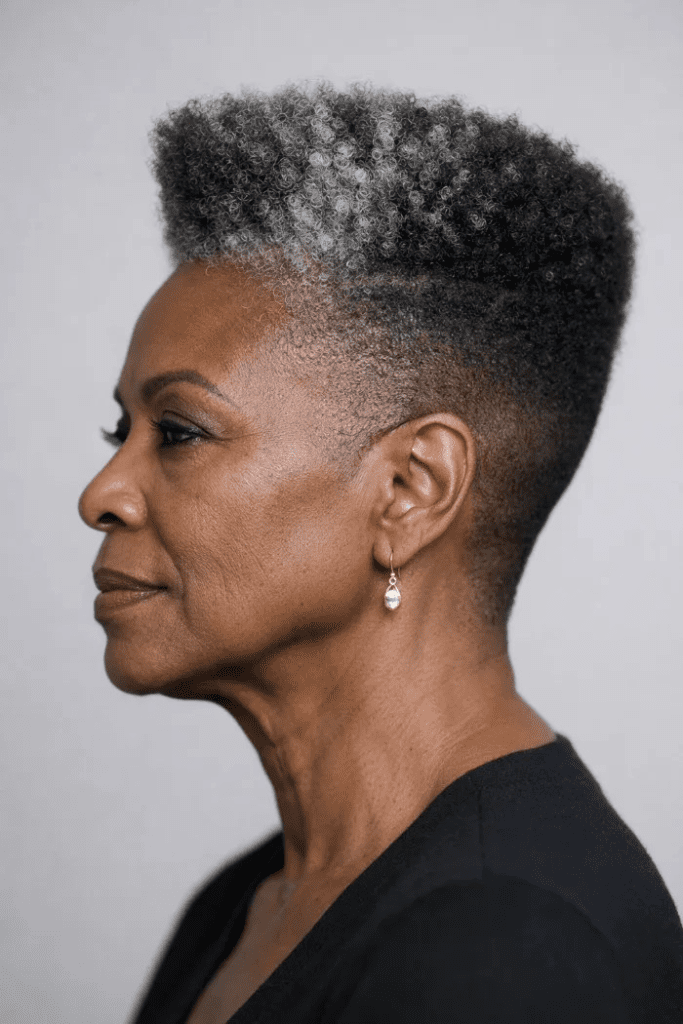
The high-top fade with natural texture is the most architecturally bold style on this list — and it’s specifically worth including in a guide for older Black women because the boldness of the shape comes from the structure of the cut rather than from length or color complexity. The shape creates the presence; the natural texture creates the authenticity.
The height at the crown creates the visual story of the style. The clean faded sides are the structural contrast that makes that crown height most visible. Together, they create a silhouette that has genuine presence and personality without requiring elaborate styling technique or daily manipulation.
What to ask your stylist: Ask for the crown height to be shaped rather than simply grown — the top section should have a deliberate, even surface rather than growing in whatever direction the hair naturally falls. The fade at the sides should be clean and smooth, blending gradually from the skin at the lowest point to the full-length crown section.
Maintenance tip: A pick used daily to restore crown height that compresses overnight is the primary maintenance tool for this style. Work the pick from the roots outward in small sections, lifting gently rather than dragging. A light holding cream on the crown section after picking maintains the height without stiffening the natural texture.
Best for: Women who want a short style with maximum presence and visual boldness — a cut that announces itself with confidence and looks most at home on women who wear short natural hair as a full expression of their personal style.
19. Short Natural Afro
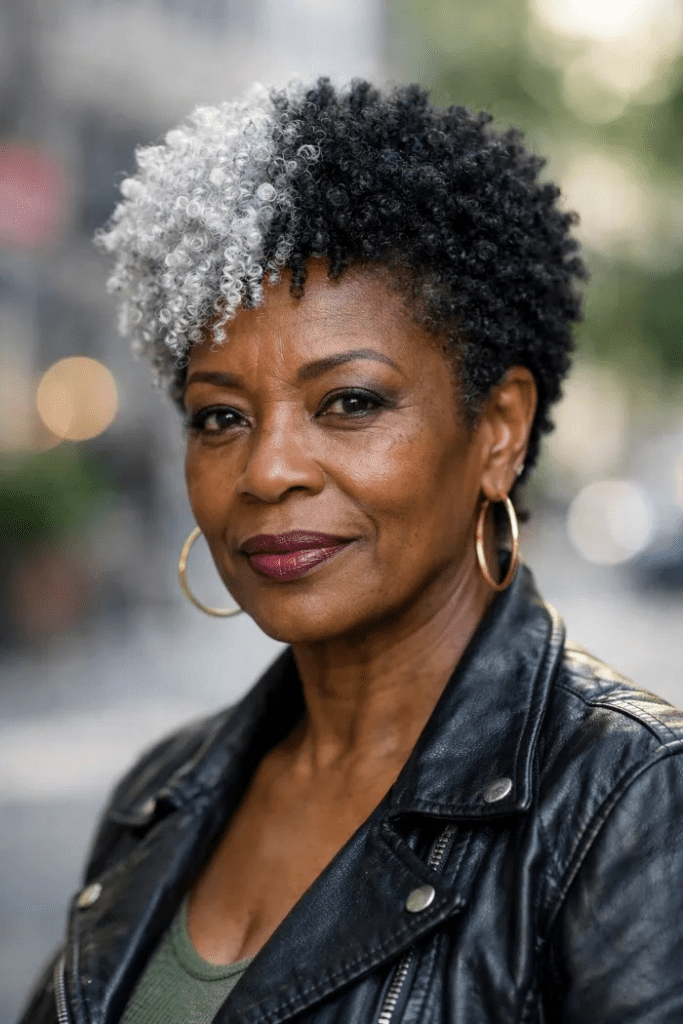
The short natural afro is the most universally wearable style on this list — it works across curl patterns, face shapes, and density levels, grows out in the most forgiving way of any cut on the list, and requires the least specialized styling knowledge to maintain well at home.
At a short length, the afro silhouette is compact enough to be genuinely manageable while still having the rounded, full presence that makes a natural afro shape visually distinctive. It’s the right choice for women who want natural volume and shape without the maintenance demands of a longer afro or the close precision of a tapered cut.
What to ask your stylist: Ask for a rounded, even shape with no flat spots or uneven sections — the consistency of the silhouette is what makes a short afro look intentional rather than simply uncut. If you have any areas of thinner density, ask your stylist to account for those in the shaping so the silhouette looks even from every angle.
Maintenance tip: The LOC method — liquid, oil, cream — applied to freshly washed hair in that order keeps short afro texture moisturized and defined throughout the week. The liquid step (water or a water-based leave-in) is the most important for short natural afro health — it’s the moisture foundation that all subsequent products seal in.
Best for: Women who want a natural, rounded afro shape that works with their curl pattern as it is rather than requiring specific styling technique to look intentional — the most accessible, universally flattering natural short style on the list.
Final Thoughts
The right short hairstyle for older Black women isn’t the one that looks most striking in a photo — it’s the one that works best in your actual daily life, grows out in a way that stays flattering between appointments, and interacts well with your specific curl pattern and natural color.
Short natural hair at any age is a choice that gets better with intention. A cut chosen specifically for how it suits your texture, your face shape, and your routine will outlast any trend and feel genuinely right in a way that a style chosen purely from aesthetics rarely does.
Take your two or three favorites from this guide to your stylist. Tell them what specifically appeals to you about each — the volume placement, the texture, the face-framing quality, the maintenance level — and have an honest conversation about which of those elements is achievable with your specific hair. That conversation is what gets you to a style you’ll love not just on the first day, but on every day until the next appointment.
Will short hairstyles work with natural gray or silver hair?
Short cuts and natural gray or silver hair are genuinely one of the most flattering combinations available to older Black women — because shorter lengths allow the full tonal complexity of gray and silver natural hair to be visible across the entire silhouette rather than being concentrated at the tips or fading through the length. Gray and silver natural hair often has multiple tones — cooler silver, warmer gray, remaining darker strands — that create natural dimension at short lengths without any color work. The key is choosing a shape that has enough surface area and structure to show that tonal variation rather than pressing it too flat or too close to the scalp.
How do I choose the right short style for my curl pattern?
Start with two questions: how much definition do you want daily, and how does your hair behave on days two and three after washing? Tighter coil patterns — 4a, 4b, 4c — benefit most from deliberate shaping and defined styles like finger coils, twisted coils, or close crops, because the shrinkage that affects these patterns can make undefined styles look patchy rather than full. Looser curl patterns — 3a through 3c — can handle more softness and rounded shapes because the looser curl maintains visible definition at shorter lengths without as much deliberate product work. Discuss your specific curl type with your stylist in the context of your lifestyle rather than choosing a style from a photo without that conversation.
Are short natural styles high maintenance?
The majority of styles on this list are significantly lower maintenance than the longer natural styles many women transitioned away from. The most maintenance-intensive options are fades and sculpted pixies, which need trimming every three to four weeks to maintain their precision. The most maintenance-friendly are TWAs, soft rounded afros, and twisted coil styles, which can go six to eight weeks between trims and require only basic daily moisture management. The universal maintenance principle across all short natural styles is this: regular moisture is more important than regular products. Water, leave-in, and a light sealant as the daily or every-other-day routine handles most of what short natural hair needs between wash days.
What short styles work best for thinning hair or changing density?
Two style approaches specifically address thinning or changing density. The first is a tapered cut with crown volume — the taper at the sides removes the length where density is often lowest (temples, sides) while concentrating the remaining volume at the crown where density is typically best preserved. The second is a close crop or TWA, which makes any variation in density less visible by reducing all sections to a length where the density differences between areas are minimal. Avoid styles that require a specific density throughout — finger coils, voluminous afros — if your density varies significantly across the scalp, as these styles can look patchy rather than full in lower-density areas.
How do I talk to my stylist about getting the right short natural style?
Three pieces of information make the biggest difference: your lifestyle (how much daily styling time you’re willing to spend and how often you can visit the salon), your curl pattern behavior (what your hair does on wash day, how much it shrinks, and how it behaves without manipulation), and your density and any areas of concern. Bring reference photos — two or three that specifically show the shape, the texture, and the styling finish you want. Be specific about what you like in each photo rather than simply pointing at the whole look — “I like the crown height in this one” and “I like the softness around the face in this one” gives your stylist more useful information than “I want this.”