13 Braided Hairstyles for Older Black Women That Are Easy to Maintain, Comfortable to Wear, and Genuinely Beautiful
Braided and twisted styles have always been more than a haircut decision — they’re a relationship between the hair, the hands that shape it, and the person wearing it. For older Black women, that relationship takes on specific priorities. Scalp health matters more than length. Comfort through the day matters more than an elaborate finish. A style that holds up gracefully for four to six weeks of real life matters more than one that looks perfect in a photo and requires constant attention in practice.
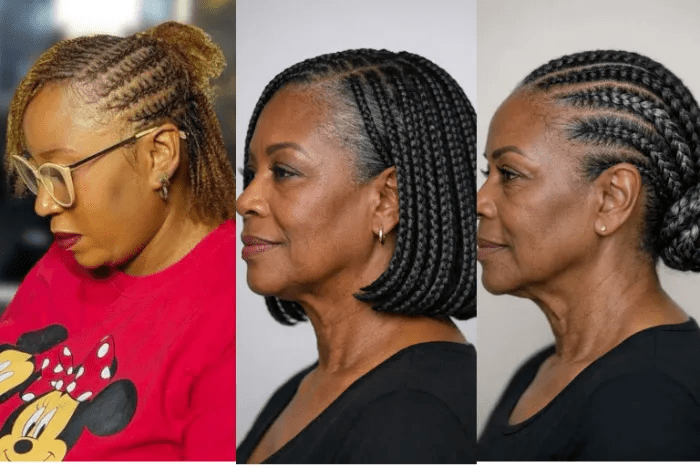
The good news is that braided styles are among the most naturally suited to those priorities of any hair approach available. A well-executed braid or twist set protects the hair underneath, requires almost no daily styling once it’s set, and frames the face in ways that grow even more beautiful as gray and silver tones develop through the lengths. The balance between maintenance ease and genuine elegance — which is specifically what this age and life stage requires from a hairstyle — is built into the format.
The 13 styles below are all grounded in that balance: wearable over weeks, comfortable at the hairline, and consistently beautiful whether the hair is natural, salt-and-pepper, silver-blended, or fully gray.
What Makes a Braided Style Work for Older Black Women
Three principles consistently separate braided styles that serve older Black women well from those that don’t.
Tension is never worth style. Tight braids at the hairline and scalp create traction alopecia over time, and older hairlines are already more vulnerable to tension-related recession than younger ones. Any braided style should be comfortable immediately after installation — if it feels tight or causes soreness within the first few hours, the tension is too high. A style that looks perfect and causes gradual hairline recession is not a good style.
Weight should suit the scalp’s current capacity. Very long, heavy braids or extensions that worked comfortably at 35 may feel burdensome or cause scalp fatigue at 60. Shoulder-length to medium-length braids and twists almost universally strike the best balance between visual presence and comfortable daily wear for mature hairlines and scalps.
Gray tones are an asset, not an obstacle. The instinct to blend gray completely away — through dark extensions that don’t match the natural hair — often produces results that look less natural and less flattering than embracing the existing gray or silver and working with it. Gray blended through braids and twists adds the kind of dimensional variation that intentional color tries to replicate.
13 Braided Hairstyles for Older Black Women
1. Side-Parted Cornrows With Long Braids
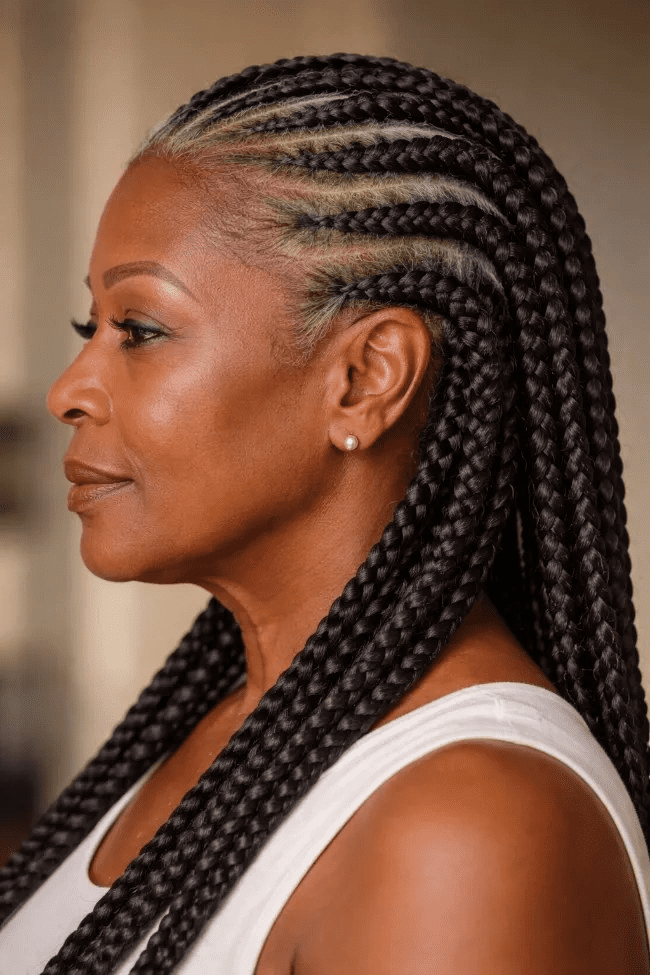
A deep side part that immediately softens the overall shape, with neat cornrows through the crown section and long braids flowing in the back — the side part is the detail that shifts this from a standard cornrow style into something more flattering and face-specific. The long braids behind add presence and length without feeling heavy at the front, and the cornrow precision at the scalp keeps the parting clean and the overall shape polished throughout the wear period.
Ask for: A deep side part positioned at your most flattering angle — your braider can help identify where the part best frames your specific face shape. Not-too-tight cornrows at the scalp, especially around the hairline area. Braids at a comfortable length rather than the maximum possible length.
Best for: Women who want a traditional cornrow style with added softness and face-framing from the side part placement. Works beautifully on natural, salt-and-pepper, and gray-blended hair.
2. Center-Part Box Braids With Silver Blend
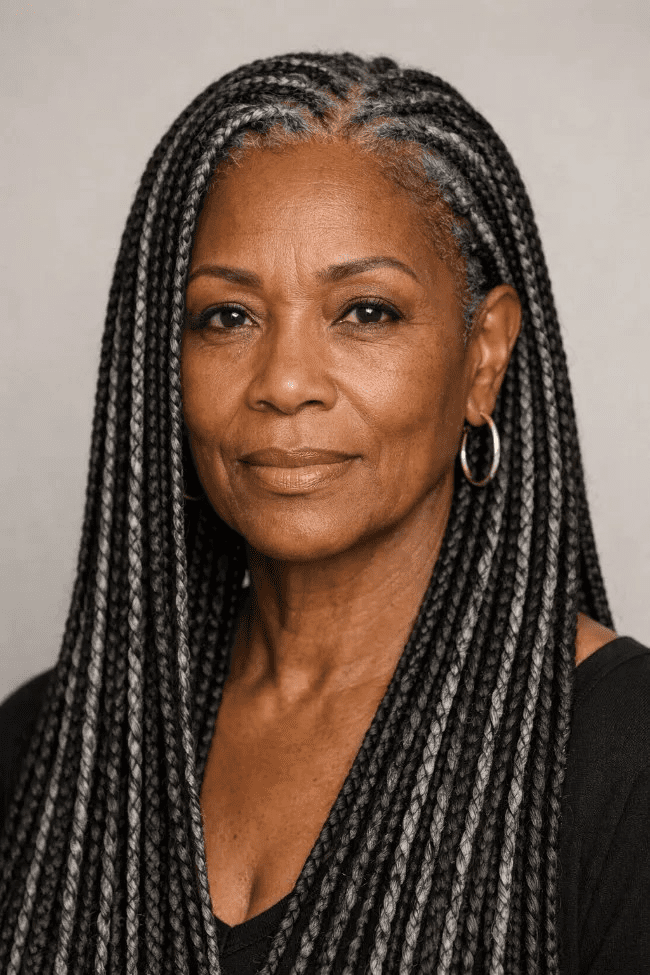
Clean box braids with a precise center part and silver or gray extension hair blended through the natural hair — the center part creates a symmetrical, structured appearance that reads as modern and deliberate, and the silver blend through the lengths does something that covering gray tones can’t: it makes the color look intentional and dimensional rather than uniform and flat. The result reads as sophisticated rather than simply colored.
Ask for: A clean center part established precisely before braiding begins. Silver or gray extension hair blended with whatever natural color you have rather than extensions that try to match or cover the existing shade. Part sizes that suit your preference for thickness and maintenance frequency.
Best for: Women who are embracing gray or silver tones and want a box braid style that works with rather than against those tones. One of the most contemporary and flattering approaches to box braids for women with significant natural gray.
3. Shoulder-Length Natural Twists With Soft Shape
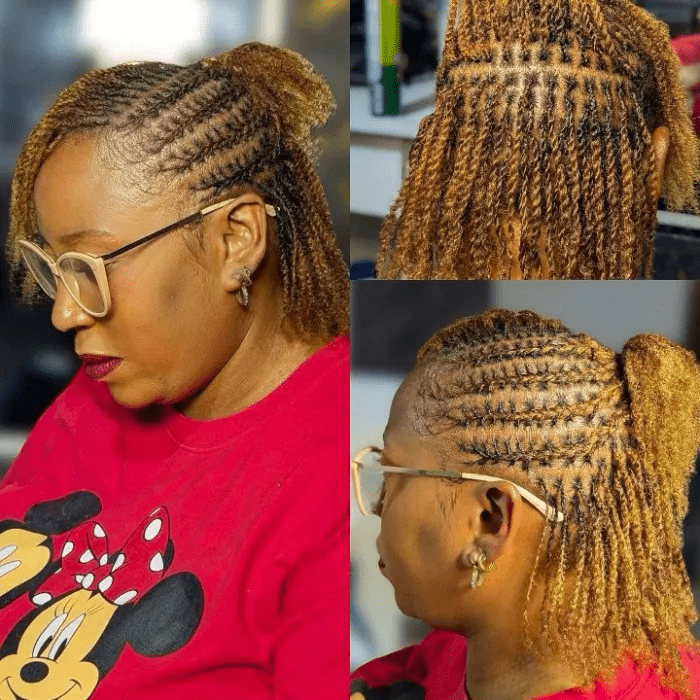
Two-strand twists or flat twists at a shoulder-skimming length that keeps the silhouette light and the weight comfortable throughout the wear period — the shoulder-length is specifically chosen for its balance between presence and practicality. Long enough to move and frame the face, short enough to avoid the weight and daily management concerns of very long twists.
Ask for: Shoulder-length rather than beyond — if extensions are being added, confirm the finished length before the braider begins. A soft, natural shape rather than a precisely uniform one. Gentle tension throughout, particularly at the hairline.
Best for: Women who want a versatile, wearable twist set that suits most occasions from casual to semi-formal. One of the most broadly comfortable and practical options on this list.
4. Braided High Bun With Cornrow Detail
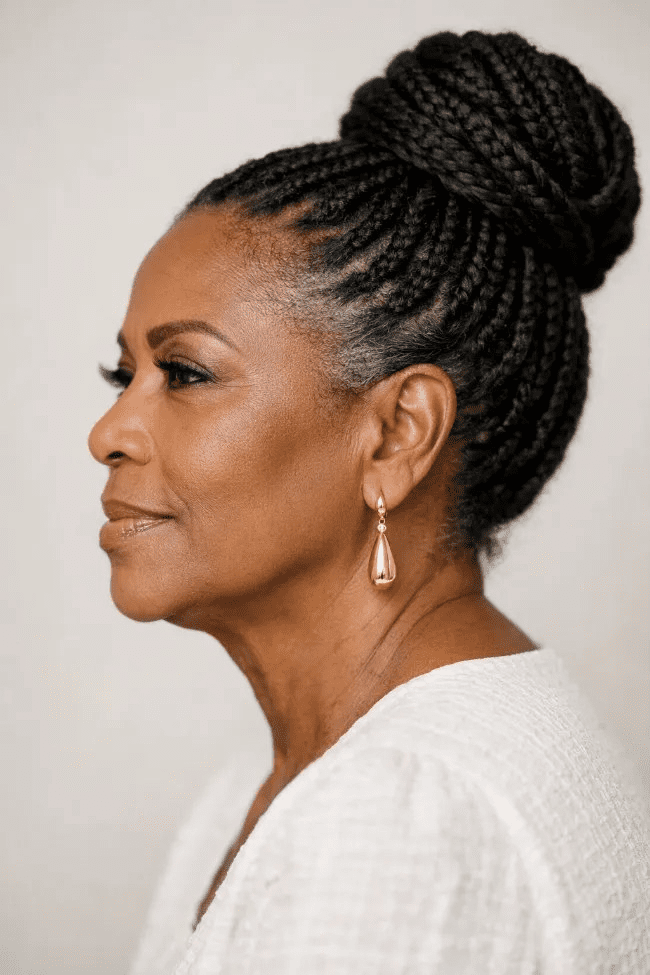
Cornrows along the scalp that feed up into a gathered high bun — the cornrow detail provides the structured, clean scalp work while the high bun creates height and an elevated profile. This style keeps hair completely off the neck and shoulders, which is specifically comfortable in warm weather or for women who prefer their hair not to touch their neck throughout the day.
Ask for: Cornrows that lay smooth and flat without pulling the hairline — the hair going up into a bun shouldn’t require any additional tension beyond what the cornrow itself needs to sit smooth. A bun that’s gathered rather than tightly wound for maximum comfort at the base.
Best for: Warm weather, active lifestyles, and women who want a polished, face-lifted style that stays secure through a full day of activity. Works for formal occasions as well as everyday wear.
5. Long Box Braids With Natural Gray Dimension
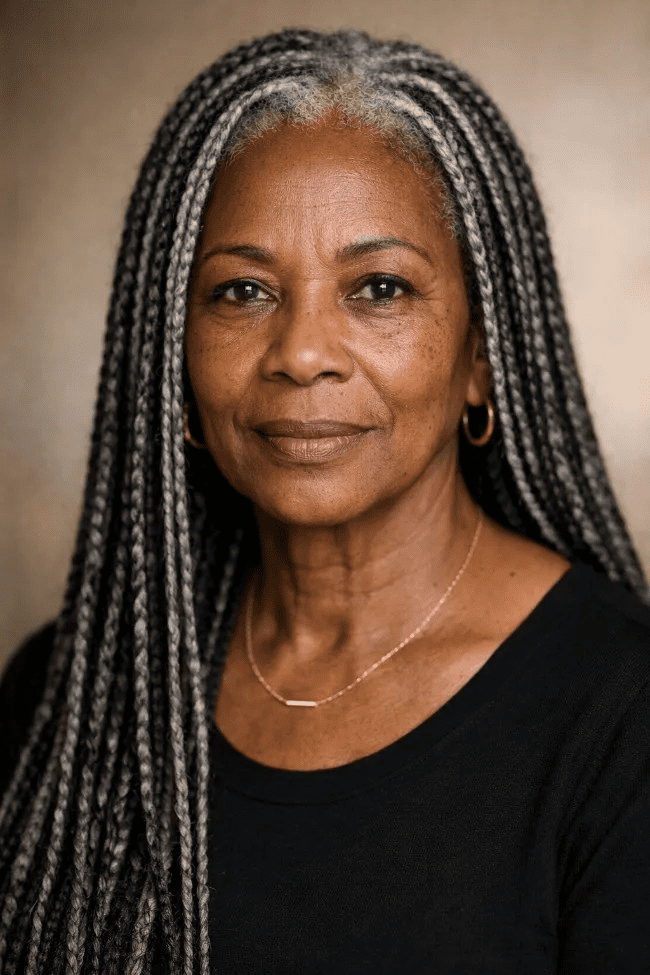
Classic, evenly sized box braids at a length that allows full movement with gray tones blended naturally through the lengths — the gray variation gives box braids at this scale a softness and depth that uniform dark extensions don’t have. Rather than looking like a young woman’s style worn by an older woman, this reads as a mature and confident box braid approach where the silver dimension is part of the aesthetic.
Ask for: An even braid size throughout for a clean, consistent finish. Gray or silver extension hair blended at a ratio that feels natural rather than one that tries to achieve a specific color uniformity. A length that suits your current comfort and lifestyle rather than the longest possible option.
Best for: Women who love long box braids and want a version that honors their current natural color tones while maintaining the classic box braid aesthetic.
6. Short Natural Twists With Defined Parting
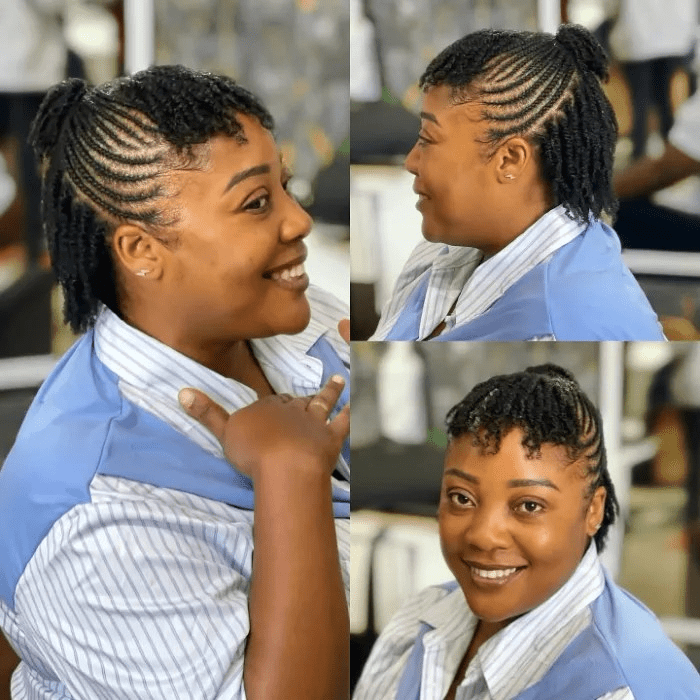
Close, neat two-strand twists at a short length with clean parting — the short length is what makes this one of the most comfortable and most genuinely low-maintenance options on the list. There’s less weight, less daily management, and less styling concern than with longer options, and the clean parting gives the short style the intentional quality it needs to read as a definite style choice rather than simply short hair.
Ask for: Clean, consistently sized parts throughout. Twists kept short enough to eliminate any weight concern. Gentle tension — short twists have a tendency to be installed with more tension than necessary because the installer may feel the shorter length requires more grip.
Best for: Women who want the lowest-weight and lowest-management braided option. Works for very active lifestyles and for those who find longer styles too heavy or too warm.
7. Sleek Cornrows Into a Low Braided Bun
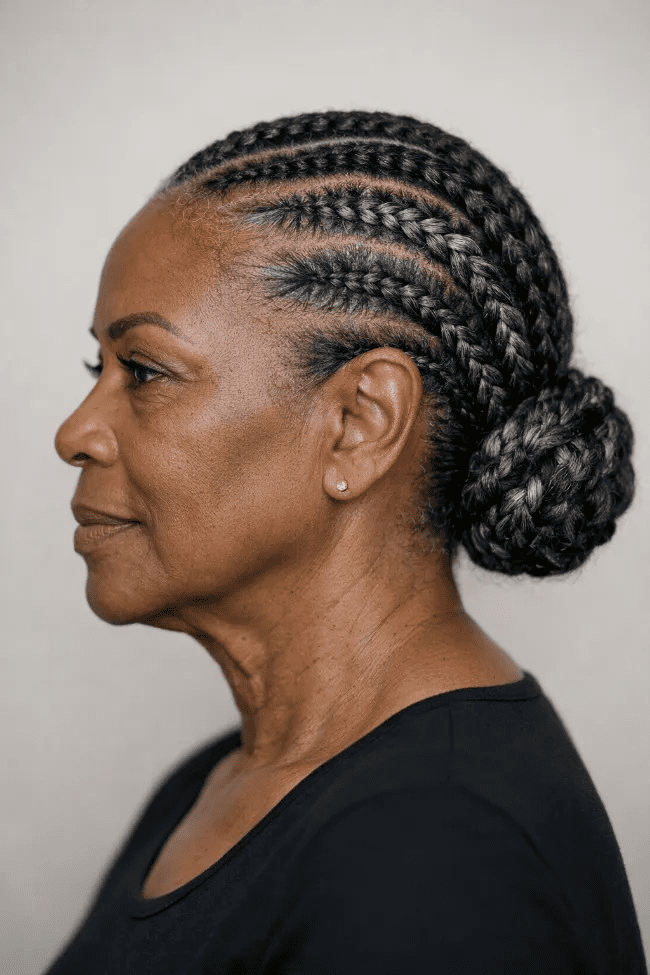
Cornrows laid straight back from the hairline to the nape, gathered into a low, neat braided bun at the back — this is the classic, structural cornrow style that highlights the face and cheekbones by keeping all the hair moving away from the face rather than toward it. The low bun at the back completes the profile elegantly and keeps the finished style comfortable at the nape rather than bulky.
Ask for: Cornrows that lay particularly flat and smooth at the hairline — this is the section most visible and most important for the overall elegance of the style. A low bun positioned at or below the nape rather than on top of the head. Gentle tension consistently throughout.
Best for: Women who want a clean, face-revealing style that reads as polished and intentional for both everyday and special occasion wear. One of the most consistently elegant options on this list.
8. Braided Updo With Fine, Neat Cornrow Rows
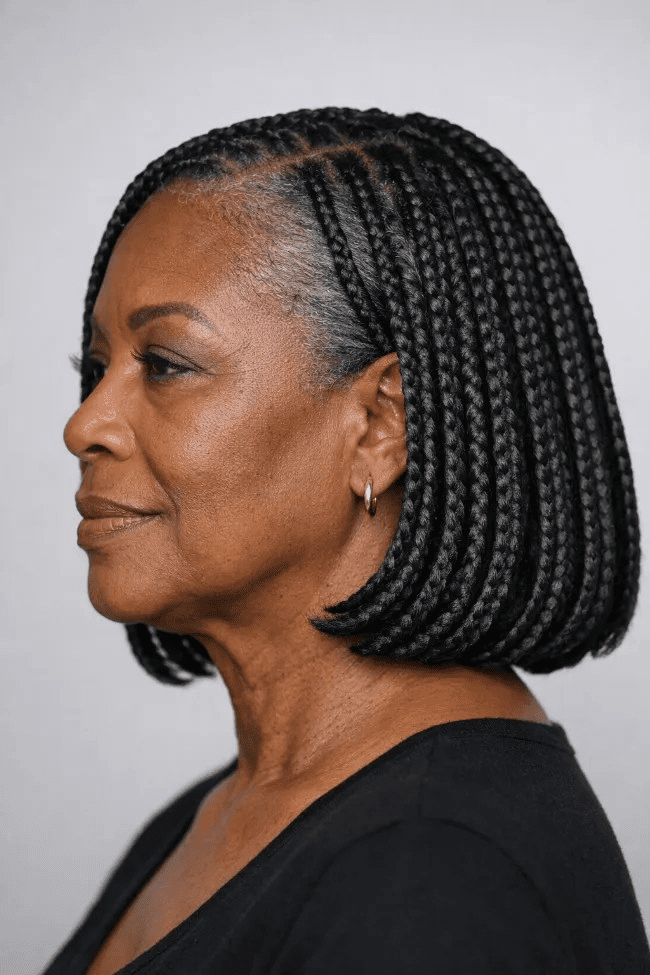
Fine, precisely executed cornrows that gather into an updo at the crown — the finer row size makes this feel detailed and intentional without being loud or dramatic. Everything sits close and tidy at the scalp, and the updo finish keeps the overall shape balanced and neat from every angle. This style reads as grown-up and polished in a way that larger, more casual cornrow patterns don’t.
Ask for: Fine rows rather than larger-pattern cornrows — confirm the row size with your braider before beginning. The updo should be positioned for comfort rather than maximum height. The scalp parting between rows should be clean and even throughout.
Best for: Women who want the most formal and refined braided updo on this list. Suitable for events and occasions that call for a genuinely polished appearance.
9. Medium-Length Natural Twists With Easy Volume
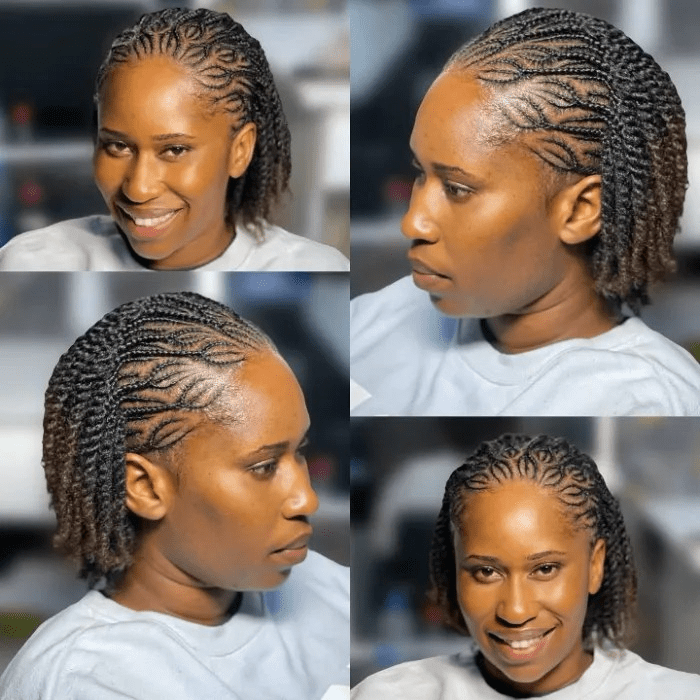
Two-strand or Senegalese twists at a medium length that creates soft volume and natural movement without the weight of longer options — the medium length is specifically the most universally comfortable braid and twist length for mature scalps, and the soft volume produced by slightly fuller twists gives the style a dimensional, flattering shape without requiring any daily manipulation.
Ask for: Medium length confirmed before installation — between shoulder and collarbone is the most practical range. Fuller twists rather than very fine ones for the soft volume quality. A rounded, balanced overall shape.
Best for: Women who want a comfortable, everyday-wearable twist set that looks beautifully dimensional without high maintenance. Works across all natural gray and silver tones.
10. Cornrow Braids With Low Twisted Knot
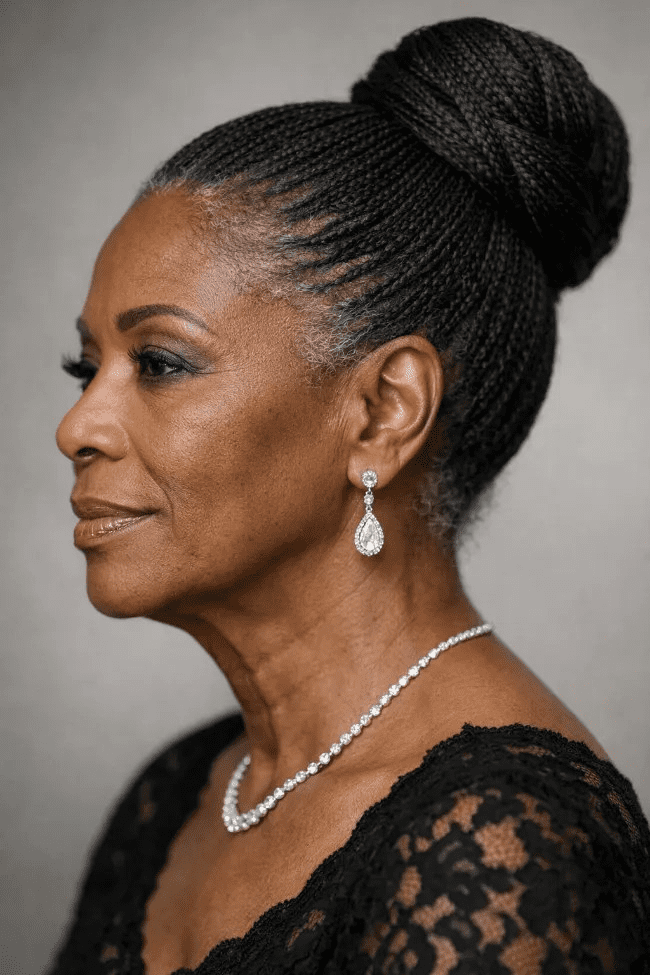
Smooth, flat cornrows laid back cleanly and gathered into a low twisted knot — the twisted knot rather than a gathered bun creates a slightly softer, more relaxed finish that suits this style’s understated quality. The clean cornrows stay looking fresh even as they grow out, and the low knot placement keeps the style comfortable throughout the day without the scalp fatigue that higher bun placements can create.
Ask for: Cornrows that stay flat and smooth from installation through the full wear period — clean parting and correct tension are both important for this. A low knot rather than a high bun. The knot should sit comfortably at or below the nape.
Best for: Women who prefer a quiet, understated braided finish. Works beautifully for women whose personal style tends toward understated elegance rather than visible statement.
11. Defined Natural Twists With a Fuller Finish
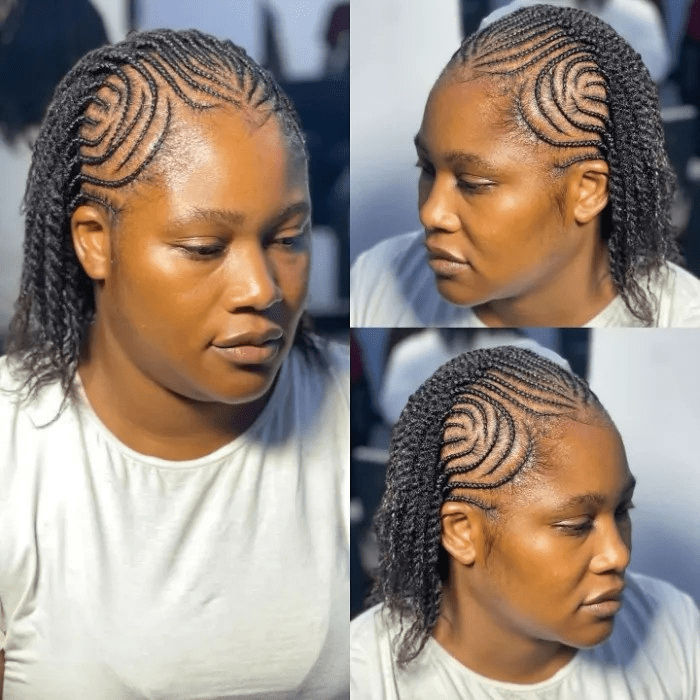
Two-strand twists with a slightly fuller overall volume — not oversized, but allowing each twist to have a rounder, more dimensional presence than a very fine or tightly wound twist set — giving the completed style a soft, flattering shape that reads as more dimensional than a uniform flat-twist set. The definition keeps it neat rather than loose, but the fuller quality prevents the stiffness that perfectly uniform twist sets can develop.
Ask for: Fuller twists rather than fine or tightly compressed ones. The definition should come from a curl-enhancing or twist cream applied during installation rather than from tight compression. Allow the twists to sit naturally rather than perfectly uniform.
Best for: Women who want a dimensionally flattering twist set that looks genuinely beautiful as it settles in and ages through the wear period.
12. Short Braided Style With Curved Cornrow Pattern
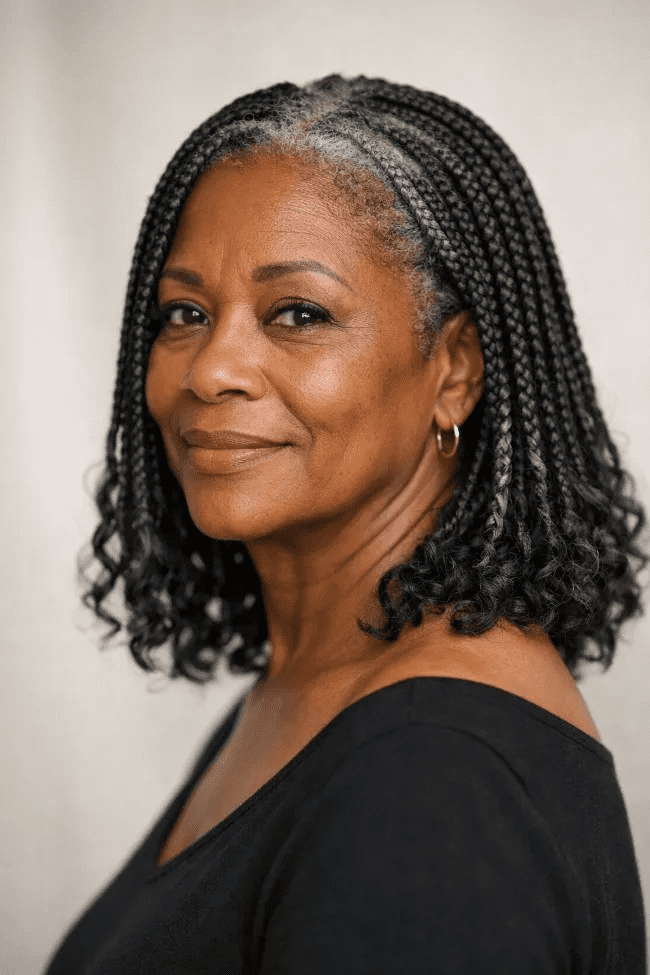
A shorter braided style with a curved or swooping cornrow pattern that adds artistic interest and movement to the design without requiring length or complexity — the curved pattern creates visual interest from every angle, and the shorter length keeps the style completely secure and practical for daily wear. The artistry is in the pattern rather than the length.
Ask for: A curved or swooping pattern discussed and confirmed before braiding begins — bring a reference photo that shows the specific curve direction you prefer. Shorter length that sits close to the head for security and comfort. Clean, smooth parting between rows.
Best for: Women who want a braided style with visible artistry but practical short length. Works for those who like a signature detail in their braided style without the commitment of length.
13. Classic Natural Twists With a Soft Tapered Shape
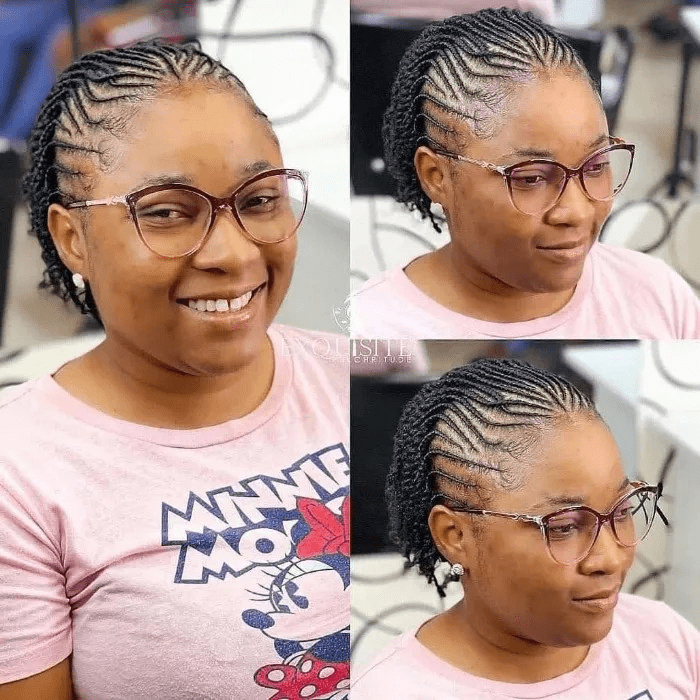
A natural two-strand twist set with a gently tapered finish — the twists become slightly slimmer toward the ends, which keeps the tips light and prevents the heaviness that blunt-ended twists can develop as they age. The gentle taper is what gives this style its clean, flattering quality without requiring any specific styling or maintenance once it’s installed.
Ask for: Twists that taper naturally toward the ends rather than being cut blunt or left with extension hair bulging at the tips. A length and fullness that suits your natural hair’s density and the comfort you want through the wear period.
Best for: Women who want the most classic and universally flattering natural twist set. Works beautifully on natural, salt-and-pepper, and gray-blended hair as a clean, effortless everyday style.
Final Thoughts
The most consistently successful braided styles for older Black women share a quality that has less to do with the specific pattern or length and more to do with the relationship between the style and the person wearing it. A braid set that’s too tight looks strained regardless of how beautiful the pattern is. A length that’s too heavy to wear comfortably all day looks like an obligation rather than a choice. A style that tries to hide or minimize gray tones rather than working with them reads as self-conscious rather than confident.
The 13 styles above all navigate that relationship well — they’re specific enough to be genuinely beautiful and recognizable as deliberate style choices, and flexible enough to be genuinely comfortable across the full wear period. The right one for you is the one that suits your natural hair’s current density, your scalp’s comfort threshold, and the level of formality that fits your life right now.
Save the ones that feel right. Bring photos to your appointment. Be specific about tension, length, and comfort — those conversations consistently lead to better results than photos alone.
Are braided styles safe for older or aging hairlines?
Yes — when installed with appropriate tension and maintained correctly. The critical factors are gentle tension at the hairline specifically (which is where traction alopecia most commonly develops), avoiding very heavy extensions that create downward pull on the follicle, and taking the style down promptly when the scalp begins to feel uncomfortable. A skilled braider who works specifically with mature hair or natural hair will understand these considerations. If a style feels tight immediately after installation, it’s too tight — styles should feel secure but never painful.
How long should a braided style be worn before taking it down?
Four to six weeks is the general guideline for most braided and twisted styles. Signs that it’s time to take the style down include scalp tenderness, visible new growth that’s beginning to tangle into the base of the braids, product buildup that’s difficult to address through normal maintenance, or any feeling of tightness or tension that develops as the style ages. Taking styles down on schedule rather than extending them protects the natural hair underneath.
How should the scalp be cared for during a braided style?
A lightweight scalp oil or moisturizing spray applied directly to the scalp between the braids or twists every two to three days maintains moisture and prevents the dryness that leads to flaking and irritation. A diluted witch hazel or cleansing scalp spray can address any buildup or mild irritation between wash appointments. Full wash appointments — with a diluted shampoo worked carefully through the braids — every two to three weeks maintains scalp health without fully disrupting the style.
Do extensions work well with significantly gray natural hair?
Yes — when the extension choice works with rather than against the existing gray. Extension hair in gray, silver, or white tones blended with natural gray creates a cohesive, dimensional result that looks genuinely beautiful and age-appropriate. Dark extensions that try to cover or contrast with significant natural gray can look mismatched and draw attention to the contrast between the root area and the extension lengths. The most flattering choice for most women with significant gray is always a blend rather than a cover.
What braided styles are best for women experiencing thinning around the hairline?
Styles that minimize tension at the most vulnerable areas specifically — the temples and the immediate hairline edge — are the most appropriate. Cornrow patterns that begin slightly behind the hairline rather than at the very edge, twists that are installed with light tension throughout, and styles that don’t pull the hairline forward or backward all reduce risk. Avoid very small, tight braids and any style that requires significant smoothing or gel application at the hairline to achieve a clean finish, as these create the most consistent tension-related stress on already-vulnerable follicles.