How to Play Guitar with Long Nails Without Sacrificing Your Manicure or Your Music
The assumption that long nails and guitar playing are mutually exclusive is one of the most persistent misconceptions in music, and it’s completely wrong. Classical guitarists have deliberately grown their picking-hand nails for centuries, using them as natural extensions of the fingertip to produce clearer, more resonant tones. Flamenco players cultivate specific nail shapes as carefully as they cultivate their technique. The nail and the string have always had a relationship — the question is simply how to manage it.
What makes long nails challenging for guitarists isn’t that they make playing impossible. It’s that they require technique adjustments that most beginners haven’t encountered and most tutorials don’t address. Once those adjustments become second nature, long nails stop being a limitation and start being, in some respects, an advantage.
The Core Challenge: Fretting Hand vs. Picking Hand
The experience of playing guitar with long nails is fundamentally different on each hand, and treating them separately is the key to managing both.
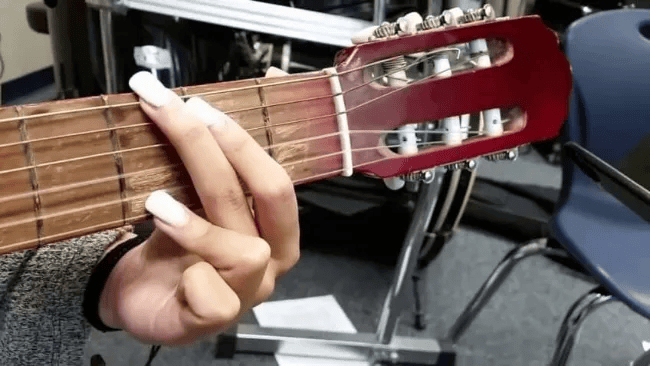
The fretting hand — the hand that presses strings against the fretboard to form notes and chords — is where most of the challenge lives. Pressing strings down with curved, arched fingers requires the fingertip to make contact with the string, which is difficult when a nail extends past that point. The nail either interferes with clean contact or forces an awkward finger angle.
The picking hand — the hand that plucks or strums the strings — is where long nails can actively improve the experience. A nail of the right length and shape acts as a natural pick, producing a brighter, cleaner tone than a fingertip alone. Classical and fingerstyle guitarists specifically cultivate and shape their picking-hand nails for exactly this reason.
Understanding this difference allows you to approach each hand with the appropriate strategy rather than treating long nails as a single uniform problem.
Fretting Hand: Adjustments That Actually Work
Play with the pad, not the tip. The standard beginner instruction is to press strings down with the very tip of the finger, keeping nails short enough to clear the fretboard. With long nails, you shift contact slightly toward the pad of the finger — the fleshy part just below the fingertip. Angling the wrist slightly away from the neck and dropping the thumb position lower on the back of the neck both help achieve this contact point naturally.
Use the minimum pressure necessary. Many guitarists press far harder than a clean note requires. With long nails, excess pressure becomes a specific problem because the nail hits the fretboard before the finger pad has made adequate contact. Working deliberately with lighter pressure — enough for a clear sound, nothing more — often resolves buzzing and muting issues entirely.
Adjust your wrist angle. Rotating the fretting wrist slightly so the knuckles move away from the headstock creates clearance between the nails and the fretboard. This adjustment feels counterintuitive at first because it differs from standard technique, but for players with longer nails it frequently makes the difference between frustrating buzzing and clean, clear notes.
Give it genuine practice time. The fretting adjustments required for long nails involve building new muscle memory, which takes longer than learning a technique the standard way. Expecting immediate results leads to frustration and the conclusion that long nails don’t work. Expecting gradual improvement over several weeks leads to actual adaptation.
Picking Hand: Using Nails as an Asset
Fingerpicking becomes more natural, not harder. Long nails on the picking hand provide the same function as the fingerpicks that some players use as accessories — a hard, smooth surface that glides across the string and releases it cleanly. The tone produced by a nail-plucked string has more clarity and brightness than a fingertip-plucked one, which is why dedicated fingerstyle players cultivate this hand’s nails deliberately.
Find your strumming angle. Strumming with the flat face of the nail against the strings produces a harsher, less controlled sound than angling the hand so the nails glide across the strings with a slight tilt. Experiment with wrist rotation and hand angle until you find the point where the strum feels smooth and sounds even. This is a refinement of technique rather than a fundamental change to strumming mechanics.
Protect the polish. The picking hand’s nails take significantly more wear than the fretting hand’s because they make string contact on every note. A reinforcing clear top coat applied every few days extends the life of gel or regular polish considerably under playing conditions. For natural nails, a strengthening base coat applied to the picking hand’s nails specifically helps prevent chipping and breaking at the contact point.
Nail Shape Matters More Than You Might Think
The shape of the nail affects both how it contacts the fretboard on the fretting hand and how it produces tone on the picking hand.
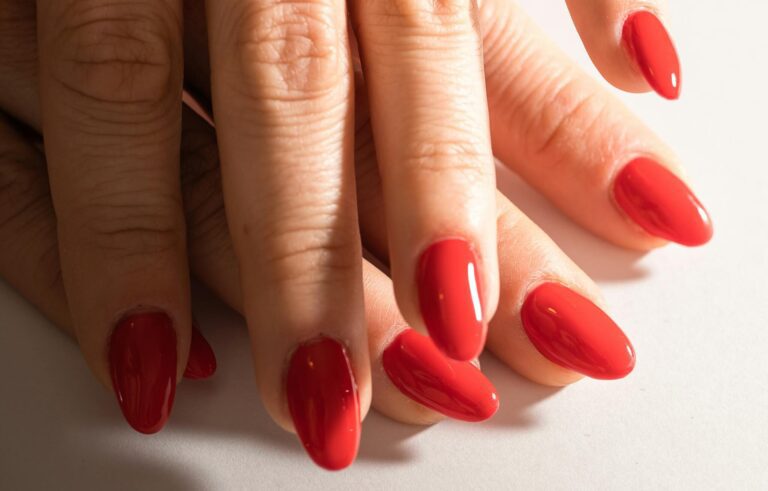
Oval and almond shapes are the most guitar-compatible for the fretting hand. The tapering toward the tip reduces the surface area that might contact the fretboard, and the curved edge slides past potential contact points more forgivingly than a flat edge.
Square shapes are the most challenging for fretting because the flat, sharp edge is more likely to catch on the fretboard or adjacent strings. Square nails on the picking hand are also less common among classical players because the flat tip creates less consistent tone than a curved nail edge.
Stiletto and coffin shapes require the most technique adaptation on the fretting hand but can produce an excellent picking-hand tone because of their pointed or straight edge. Players who favor these shapes typically have a longer adjustment period but can successfully accommodate them once the fretting technique is dialed in.
A practical approach many guitarists use: Keep the fretting hand’s nails at a shorter length than the picking hand’s. This isn’t an all-or-nothing compromise — you can still have stylish, shaped nails on the fretting hand, just at a length that allows the pad contact described above. The picking hand, where nails are an asset, can be maintained at the length and style you prefer.
Acrylics, Gel, and Press-Ons: What Actually Works
Gel and acrylic nails are durability advantages for playing guitar. They’re significantly harder than natural nails and resist the chipping and breaking that natural nails experience at string contact points. The main consideration for gel and acrylics is thickness — very thick acrylic applications can reduce the tactile sensitivity in the fingertip that tells you how much pressure you’re applying to a string. Thinner, more natural-feeling applications work better for playing.
Press-on nails present an obvious practical concern: security. A press-on nail that releases mid-song is both a playing interruption and a potential string-tangling hazard. If you play with press-ons, apply them with quality adhesive rather than the included adhesive tabs, and test their security before playing. Many players find press-ons work acceptably for casual playing sessions but aren’t reliable enough for regular practice.
Natural long nails are the most tactile-sensitive option and the approach classical guitarists historically use. The trade-off is maintenance — natural nails chip and break more easily than gel or acrylics, and a broken picking-hand nail can genuinely affect tone quality. Filing and buffing regularly to maintain smooth edges prevents string snagging and maintains consistent tone.
Practical Tips for the Transition Period
Start with simple material. Open chords and simple melodies in first position are the right starting point for adapting to long nails. Complex chord shapes and fast runs require the adapted technique to be more established before they feel natural.
Nylon strings over steel strings. If you have access to a nylon-string classical or acoustic guitar, the lower string tension and softer string surface are significantly more forgiving for both fretting and picking during the adaptation period. Nylon strings produce a warmer tone with nails and require less pressure to fret cleanly.
File regularly for smooth edges. Rough or uneven nail edges catch on strings, produce inconsistent tone, and can cause the nail to grab rather than release cleanly. A fine-grit nail file used regularly to maintain smooth, consistent edges makes a meaningful difference to both the playing experience and the longevity of the nail itself.
Record yourself. Listening back to recordings of your practice reveals whether the tone is actually compromised or whether the discomfort of the adaptation period is creating the perception of worse sound than is actually present. Many players discover their nails are producing better tone than they expected once they hear it objectively.
Final Thoughts
Playing guitar with long nails is genuinely possible, genuinely practiced by serious musicians, and becomes genuinely comfortable with the right technique adjustments and a realistic expectation of the adaptation timeline. The fretting hand requires patience and intentional technique modification. The picking hand rewards long nails with better tone than most players expect.
The stylistic and the musical don’t have to compete for your hands. With the right approach, your nails become part of your instrument rather than an obstacle to it — a signature element of how you sound and how you look while playing.
Pick up the guitar. Keep the nails. Start slow. Give it time.
Do I have to keep one hand’s nails shorter?
Not necessarily, but it’s the most practical starting compromise. Many players keep fretting-hand nails at a shorter length that still allows for shaping and styling, while maintaining longer nails on the picking hand where length is an advantage. As technique adapts, some players find they can accommodate longer fretting-hand nails than they initially thought.
Will long nails damage my guitar strings?
Nails themselves don’t damage strings. Sharp or rough nail edges can produce premature string wear at the contact point, which is why filing for smooth edges is part of regular nail maintenance for guitar players. Acrylic or gel nails aren’t harder on strings than natural nails of equivalent length.
How do professional guitarists handle this?
Classical guitarists are the most deliberate about nail management — they maintain specific lengths on picking-hand nails, shape them to specific profiles for optimal tone, and treat nail care as an integral part of instrument maintenance. Most keep fretting-hand nails short. Some flamenco and steel-string players maintain longer nails on both hands with adjusted technique. The common thread is that it’s always a deliberate, managed choice rather than something left to chance.
Can I learn guitar from scratch with long nails?
Yes, though the learning curve is steeper because you’re adapting to technique adjustments alongside learning the instrument itself. Learning on nylon strings with lighter gauge reduces the pressure-related challenges during the initial period.