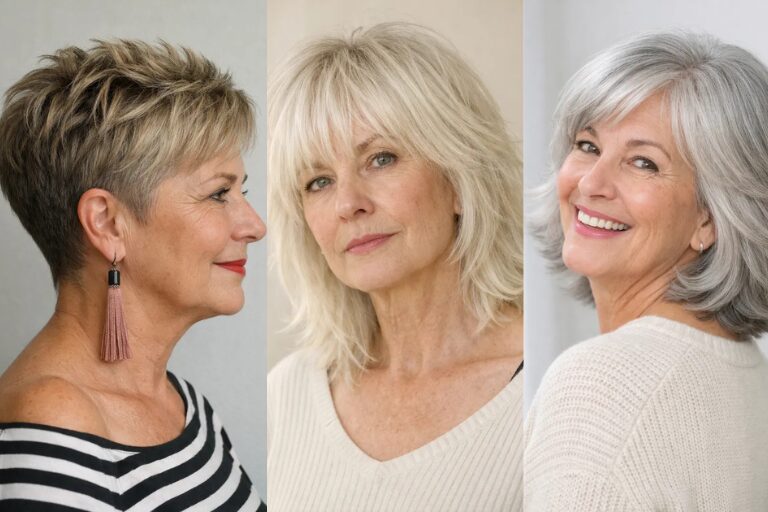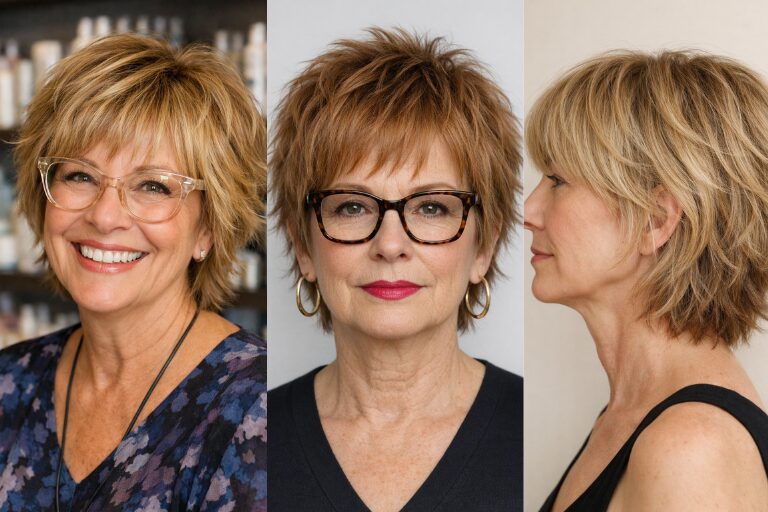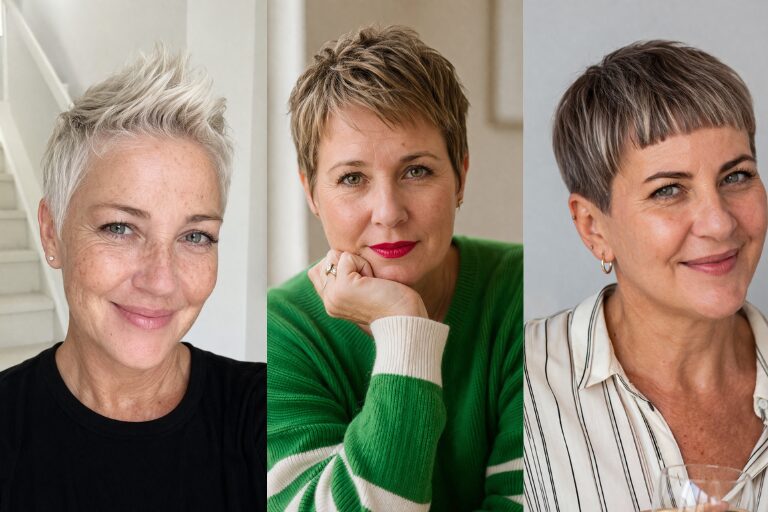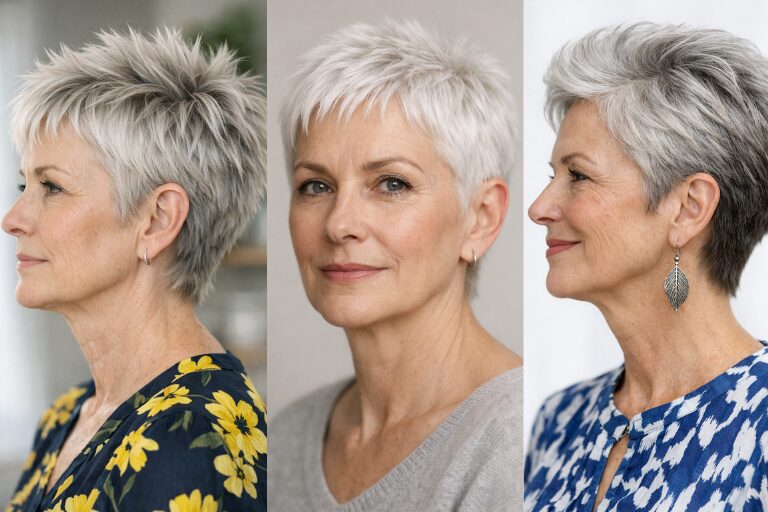
20 Chic Pixie Hairstyles for Older Black Women That Look Polished Every Time
There is a reason so many older Black women make the switch to a pixie cut and never look back. It’s not just about the ease of it, though that’s real — it’s about what a well-executed pixie actually does for a face. It draws every bit of attention upward. It showcases the cheekbones, the eyes, the jawline, the neck. It turns every pair of earrings into a statement. And it brings a level of polished confidence to everyday life that longer styles often bury rather than reveal.
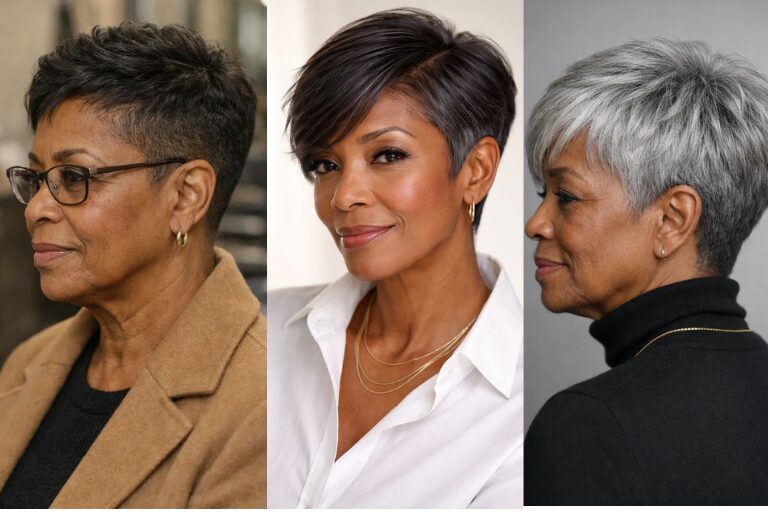
The range within the pixie category is also something most people underestimate until they start exploring it. A pixie cut is not one thing. It’s sleek and close, soft and curly, tall and textured, sculpted and finger-waved, salt-and-pepper tapered, naturally coiled, side-swept and glamorous. There is a version of the pixie for every texture, every lifestyle, every level of morning styling commitment, and every decade of Black womanhood.
These 20 pixie hairstyles for older Black women cover the full spectrum — from the simplest, most low-maintenance TWA to the most architecturally precise tapered fade. Each style comes with specific guidance on what to ask your stylist and how to maintain it at home, because a great pixie depends as much on technique as it does on the cut itself.
Before you choose, think honestly about two things: how often you’re willing to visit the salon for upkeep, and what you want your morning routine to feel like. A tight taper or fade looks sharp and precise but typically needs a clean-up every two to three weeks to stay that way. A softer, more textured pixie grows out more forgivingly and can look intentional for four to six weeks between visits. Knowing which version of yourself you’re dressing for makes the decision much easier.
20 Pixie Hairstyles for Older Black Women
1. Classic Close-Cropped Pixie
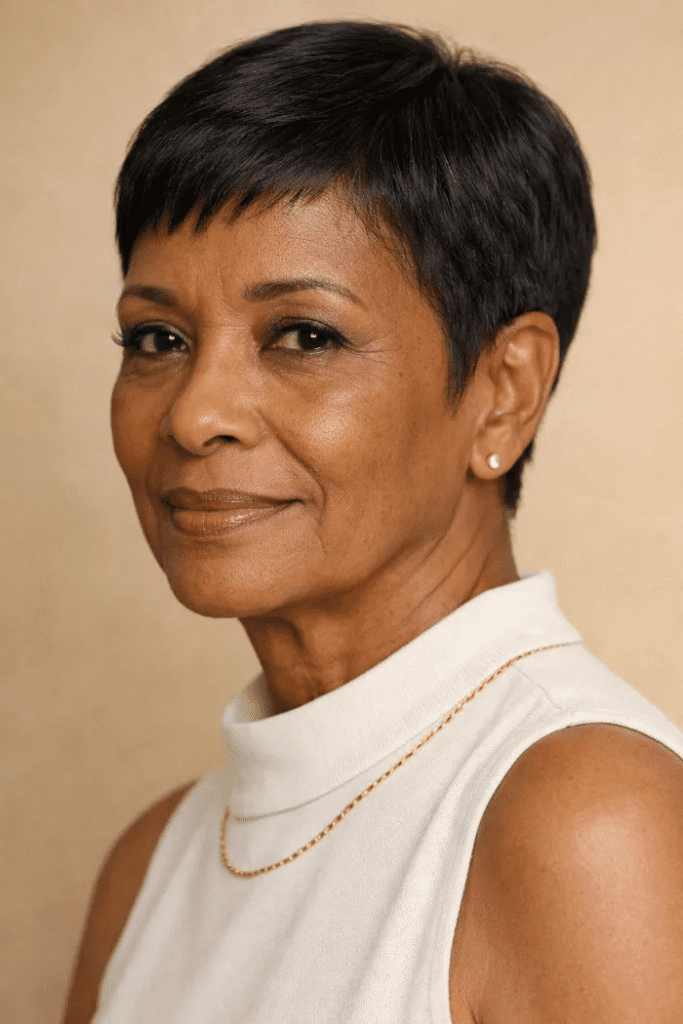
The classic close-cropped pixie is the standard against which every other pixie variation is measured — and for good reason. The sides sit snug and clean, the top is smooth and directed, and a light fringe sits softly across the forehead without calling attention to itself. It is a style that requires almost no thought to look completely put-together, which is precisely why it has remained one of the most chosen pixie cuts for Black women for decades.
The beauty of this cut for older Black women is in its simplicity. There are no complicated styling steps, no products that need to be layered in a specific order, and no length to manage. A pea-sized amount of lightweight serum worked through the top section after moisturizing, and you’re done.
Ask your stylist for: Soft, gradual tapering at the nape rather than a hard, sharp line. A fringe that sits slightly loose and natural across the forehead rather than slicked flat. The goal is polished ease, not rigidity.
Styling tip: A tiny amount of lightweight serum or hair milk warmed between the palms and pressed gently through the top section is all this style needs daily. For extra definition, a soft-bristle brush directed in the intended styling direction while the product is still damp sets the shape cleanly.
2. Pin-Curl Pixie with Soft Definition
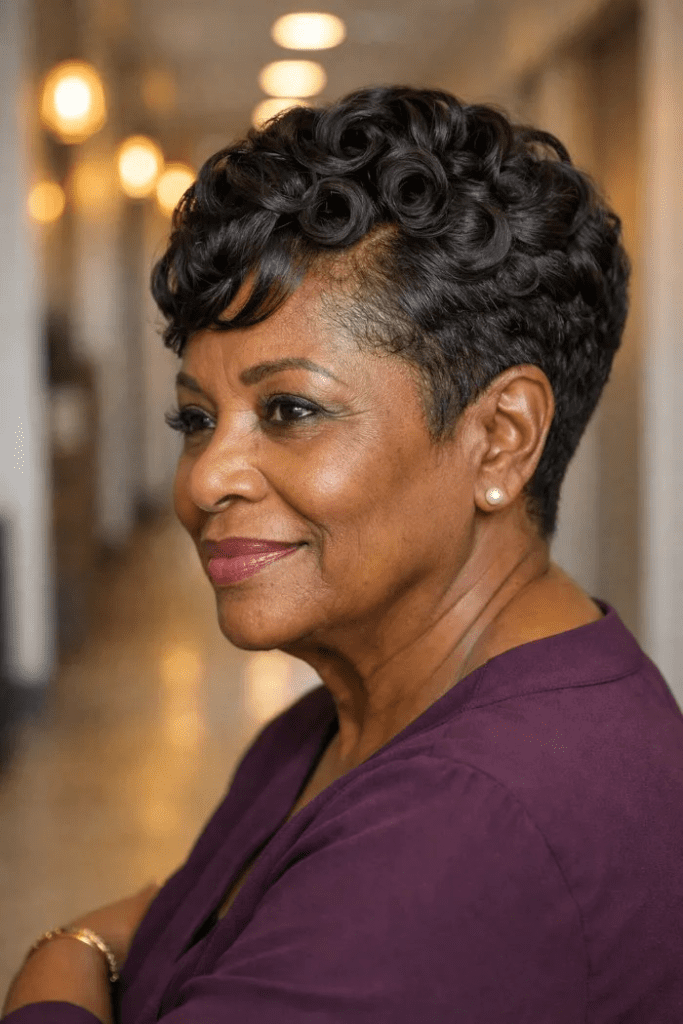
The pin-curl pixie is grown-woman glamour made wearable — the kind of style that looks like you spent significant time on it when you actually spent very little. The sculpted curls at the front and crown do all the expressive, architectural work while the rest of the cut stays tightly tapered and precise. The contrast between the defined curls and the clean taper is what makes this style feel so elegant.
For older Black women, this style is particularly flattering because the defined curl placement at the crown creates height and fullness right where facial features benefit most from the lift. Varying the curl sizes — some tighter, some looser — prevents the style from looking rigid or overly structured and gives it a natural, dimensional quality.
Ask your stylist for: A varied curl set — ask your stylist or yourself to vary the pin-curl sizes so the result looks natural rather than uniform. A tight, clean taper at the sides and nape that provides strong contrast against the defined curls. The sharper and cleaner the taper, the more intentional the curls look.
Styling tip: A light setting foam applied section by section before curling gives the curls memory and hold. A satin scarf tied overnight preserves the curl definition and shape, and a quick refresh with a light oil mist the next morning brings the sheen back without restarting the whole styling process.
3. Silver Curly Pixie Crop
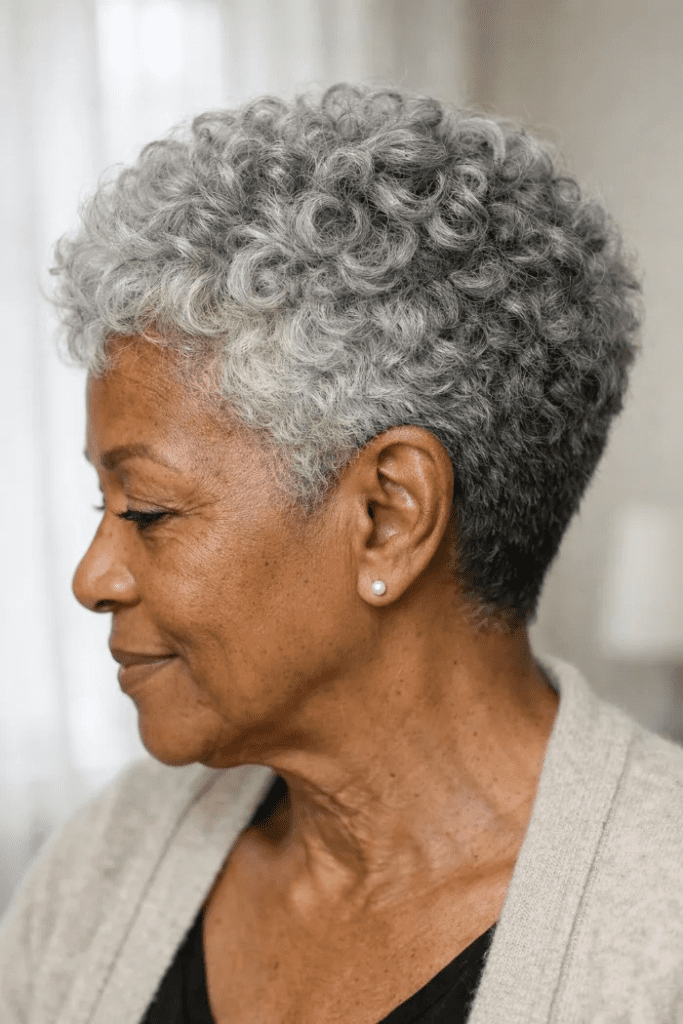
Natural gray and silver curls in a cropped pixie shape are one of the most genuinely beautiful combinations in all of short hairstyling. The silver tones catch light in a way that pigmented hair simply doesn’t, and when those silver curls are shaped into a clean, rounded crop with close sides, the result is a style that looks intentional, fresh, and unmistakably sophisticated.
The key for this style on older Black women is keeping the silhouette rounded rather than boxy. A rounded crown feels soft and face-framing; a boxy crown can feel heavy. Clean sides give the curls room to be the focal point without any distracting bulk at the temples.
Ask your stylist for: A rounded crown silhouette — explicitly ask for “rounded, not boxy” so your stylist understands the shape priority. Clean, close sides that don’t compete with the crown volume. Light tapering at the nape and temples to keep the overall shape precise.
Styling tip: A light mousse worked through the curls on slightly damp hair and then left to air dry completely is the most effective way to maintain definition without disrupting the curl pattern. Avoid touching the curls while they’re drying — manipulation during the drying process creates frizz that flattens the very definition you’re trying to preserve.
4. TWA Pixie with Soft Coils
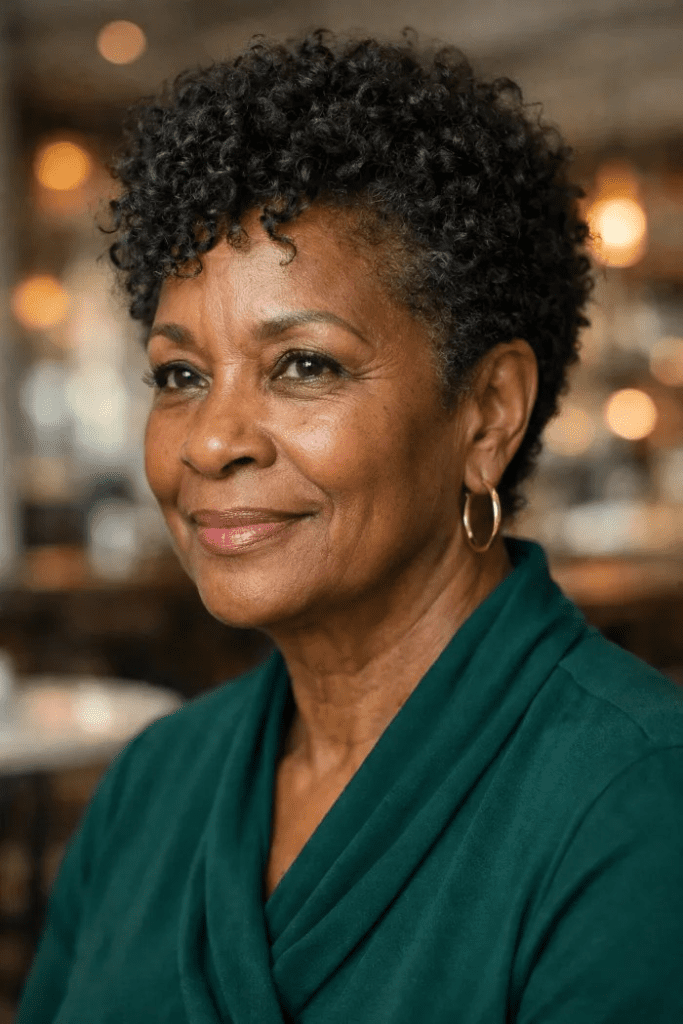
The TWA — teeny weeny afro — is in many ways the most liberating pixie available to Black women. It celebrates natural coil texture in its most organic, unmanipulated state and requires the least product and the least time of any style on this list. The taper around the ears and nape provides the structural definition that keeps it looking deliberate and polished rather than unfinished.
For older Black women who are transitioning away from relaxers or heat styling, the TWA is often the first style that reveals what their natural texture truly looks like — and it’s frequently a revelation. The coils at the crown are full, touchable, and effortlessly beautiful with virtually no styling intervention.
Ask your stylist for: A soft taper at the ears and nape — not aggressively short, but clean and graduated enough to frame the natural coil section at the crown. The goal is a silhouette that looks rounded and intentional. Keep the edge-up natural and soft rather than sharp and painted.
Styling tip: A curl cream applied section by section to slightly damp hair and then left completely alone is genuinely the ideal approach for this style. Over-manipulation of coily hair during and after product application creates frizz and disrupts the coil pattern. Define it and step away. A silk scarf at the hairline during any sweaty activity protects the edges beautifully.
5. Discreet Undercut Side-Swept Pixie
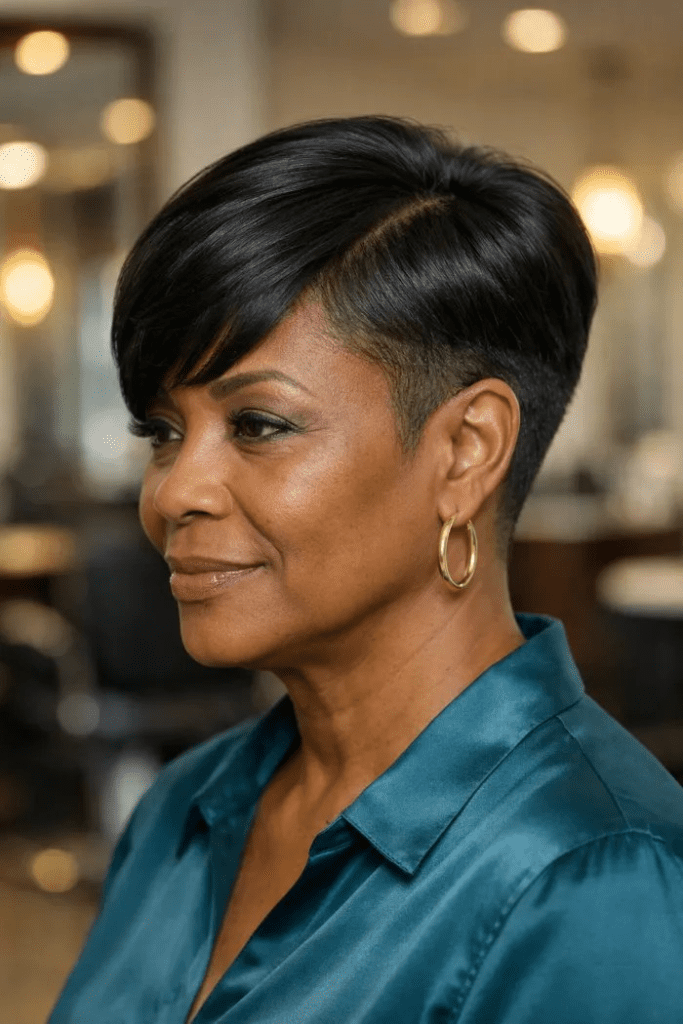
The discreet undercut takes the volume and potential bulk out of the temple and side sections while leaving the top section long enough to create a dramatic, sweeping fringe that falls across the forehead with genuine glamour. The hidden nature of the undercut means it reads as a sleek side-swept style until you look closely — which is exactly the kind of thoughtful, layered detail that elevates a pixie from simple to chic.
This is an excellent choice for older Black women whose hair tends to feel bulky or heavy at the temples, a common concern as hair changes texture with age. The undercut removes that bulk precisely and permanently, making the top section lighter and more manageable by comparison.
Ask your stylist for: A gentle, graduated fade at the undercut rather than a harsh, sharply defined line. The transition from the undercut section to the longer top section should be smooth and gradual. Ask for the fade to stay below the visible surface of the styled hair so it genuinely reads as “discreet.”
Styling tip: A round brush used on the top section during blow-drying creates the bend and direction that makes the side-sweep look intentional and polished rather than accidentally windswept. Blow-dry the fringe section forward first, then sweep it to the intended side with the brush as you finish.
6. Classic Finger-Wave Pixie
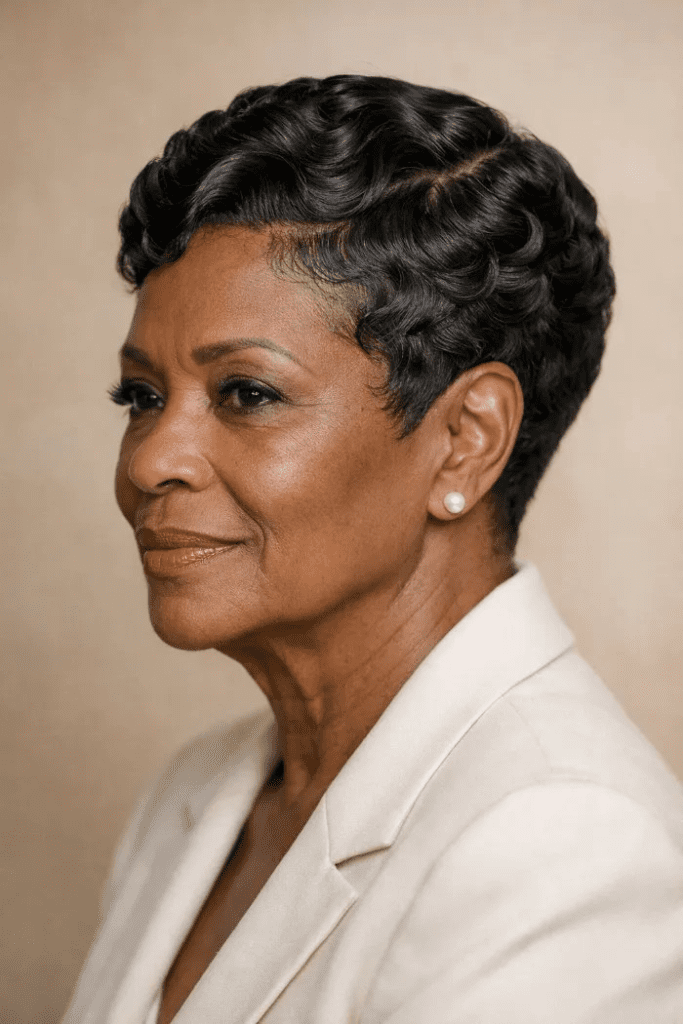
Finger waves carry a cultural elegance that spans generations of Black hair history — from the Harlem Renaissance to today, they’ve remained one of the most sophisticated styling techniques available. On a close-cropped pixie with a clean tapered nape, finger waves bring that heritage into the present with unmistakable grace. The key is movement rather than rigidity: S-curves that flow naturally rather than stiff, mechanical ridges.
For older Black women who love a dressed-up moment without the maintenance of a full updo, the finger-wave pixie delivers. It can take a simple daily outfit and make it feel occasion-ready with virtually no additional effort.
Ask your stylist for: Soft S-waves rather than sharp, rigid ridges. The waves should appear to flow naturally from the hairline back rather than looking stenciled on. A clean, precise taper at the nape and sides provides the contrast that makes the wave pattern look intentional. Specify a “satin finish” rather than a high-shine one.
Styling tip: A light setting foam — not a heavy gel that flakes — applied before wave molding gives the waves definition and memory. A soft-bristle wave brush worked in the S-pattern while the product is still wet sets the shape. A satin scarf tied snugly and worn for at least 20 minutes sets the waves flat and defined. At night, keeping the scarf on preserves the pattern beautifully.
7. Modern Pixie with Micro-Bangs
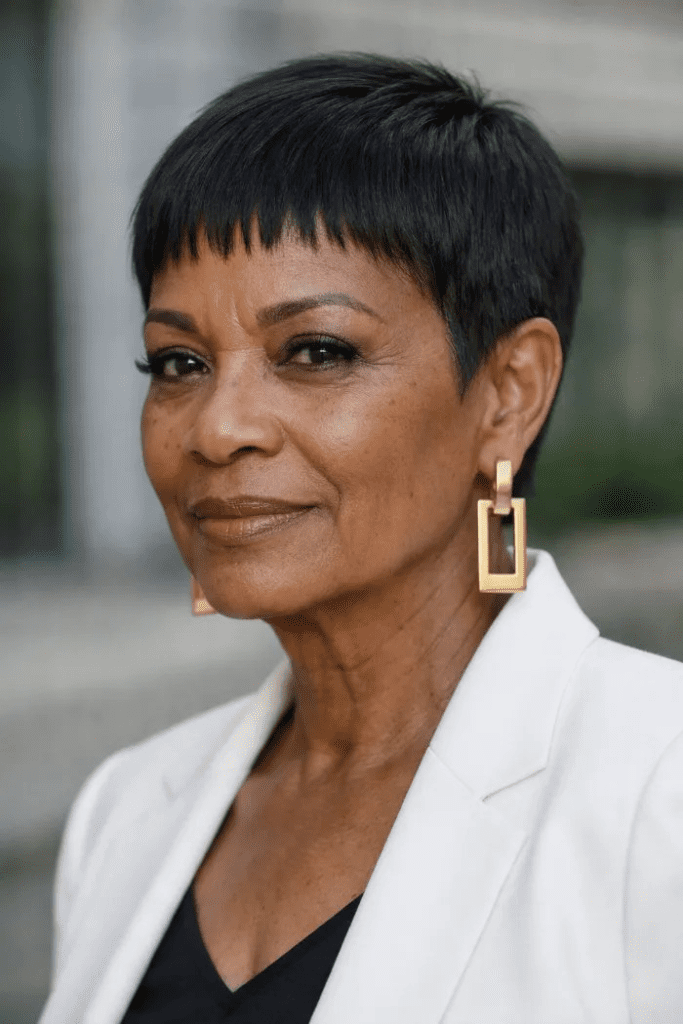
Micro-bangs are not for the faint-hearted — but they are for the woman who knows her face and isn’t afraid to frame it boldly. On a pixie cut, micro-bangs sit just at or slightly above the brow line and give the entire style a directional, editorial quality that no other bang style can replicate. The trick to keeping them chic rather than costume-like is intentional imperfection: a fringe that’s slightly irregular and separated looks modern; a fringe that’s ruler-straight and perfectly groomed can look dated.
This style works particularly well with glasses, where the micro-bang creates a deliberate relationship between the frames and the hairline that looks considered and purposeful.
Ask your stylist for: A short fringe that sits just above or at the brow. Specify that you want it to look “slightly irregular and separated, not perfectly blunt.” The texture at the ends of the micro-bang is what gives it its modern quality. Keep the rest of the cut clean and close so the bangs carry all the visual weight.
Styling tip: A tiny amount of lightweight wax or soft paste used to separate and define individual pieces of the micro-bang gives it the piecey, modern finish that makes this style work. Apply with fingertips — never a brush — and work lightly. The less controlled it looks, the more intentional it reads.
8. Textured Faux-Hawk Pixie
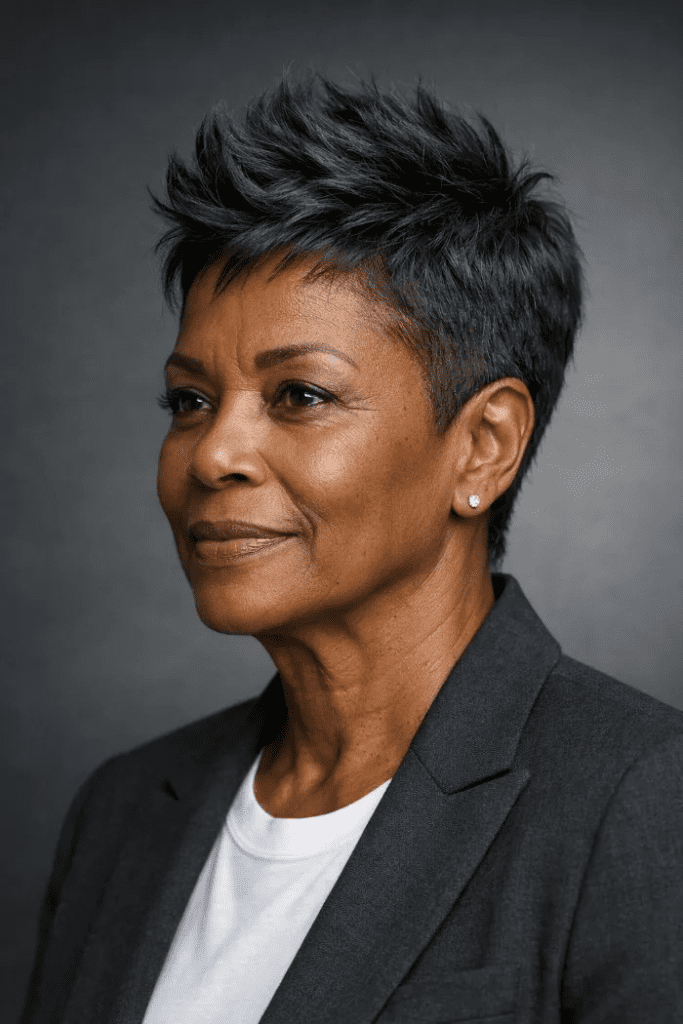
The faux-hawk pixie gives you height and presence through the center of the crown without committing to the severity of a full mohawk. The tapered sides draw all the visual attention upward and inward toward the raised, textured center strip, which creates a striking silhouette that photographs beautifully and holds its shape through a full day.
For older Black women who want a pixie with personality — something that feels bold but not alienating — the faux-hawk version is the sweet spot. It’s simultaneously edgy and elegant, which is a genuinely difficult balance to achieve in a hairstyle.
Ask your stylist for: Point-cutting through the crown section to create organic, piecey texture rather than a blunt, flat surface on top. Tapered sides that graduate smoothly rather than dropping sharply. The center strip should have enough length to be lifted but not so much that it collapses under its own weight on fine or medium hair.
Styling tip: A matte paste rather than a glossy product is essential for this style — gloss can flatten the textured crown and make it look slick rather than lifted. Work the paste through the crown section with fingertips, pinching and lifting rather than smoothing, until the desired height and texture are achieved.
9. Salt-and-Pepper Tapered Pixie
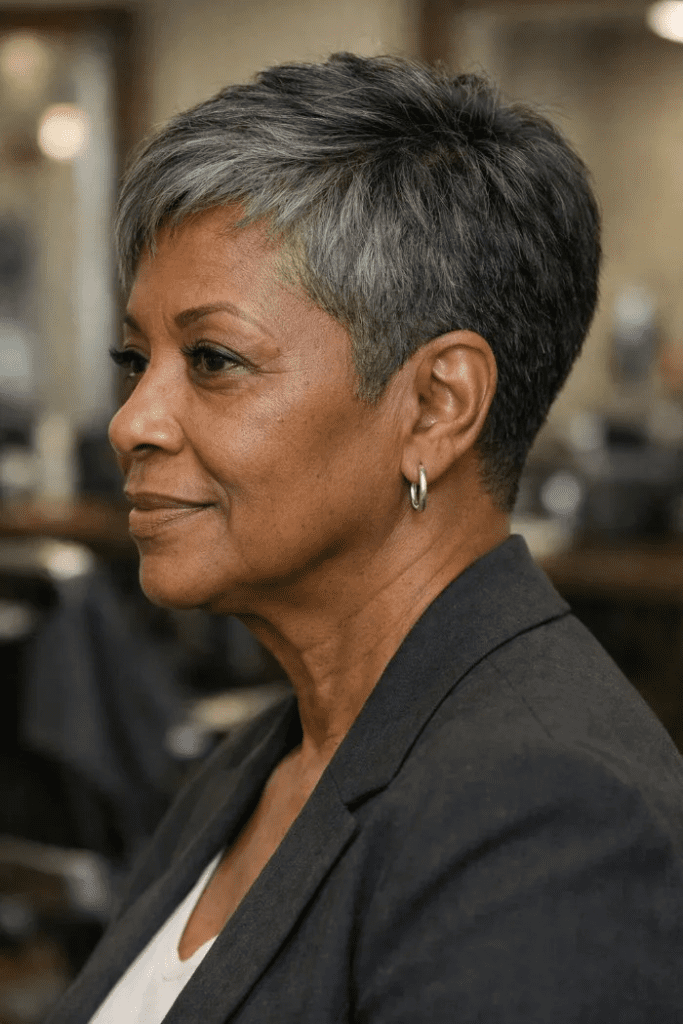
The salt-and-pepper tapered pixie is the style that makes natural gray and silver transition hair look like a deliberate, enviable color choice rather than something in progress. The tight, precise taper gives the mixed tones a clean outline that makes them look rich and intentional — when gray hair is surrounded by a clean shape, it reads as sophisticated. When it’s surrounded by length and weight, it can read as dull.
The longer, softer top section provides the contrast that keeps the salt-and-pepper tones from looking flat and one-dimensional. Light and shadow through the lengths show off the tonal variation beautifully.
Ask your stylist for: A low-to-mid taper at the sides and nape with a natural, soft edge-up at the hairline — avoid a painted or overly sharp edge, which can look harsh against the natural gray. A slightly longer top section with enough length to show the tonal variation of the salt-and-pepper color.
Styling tip: A purple or silver-toning shampoo used once a week keeps the silver tones bright and prevents the yellowish brassiness that gray hair can develop over time. A lightweight leave-in conditioner keeps gray hair supple — gray strands tend to be coarser and drier than pigmented ones, and a little moisture goes a long way toward keeping them looking polished rather than wiry.
10. Deep Side-Part Pixie with Long Fringe
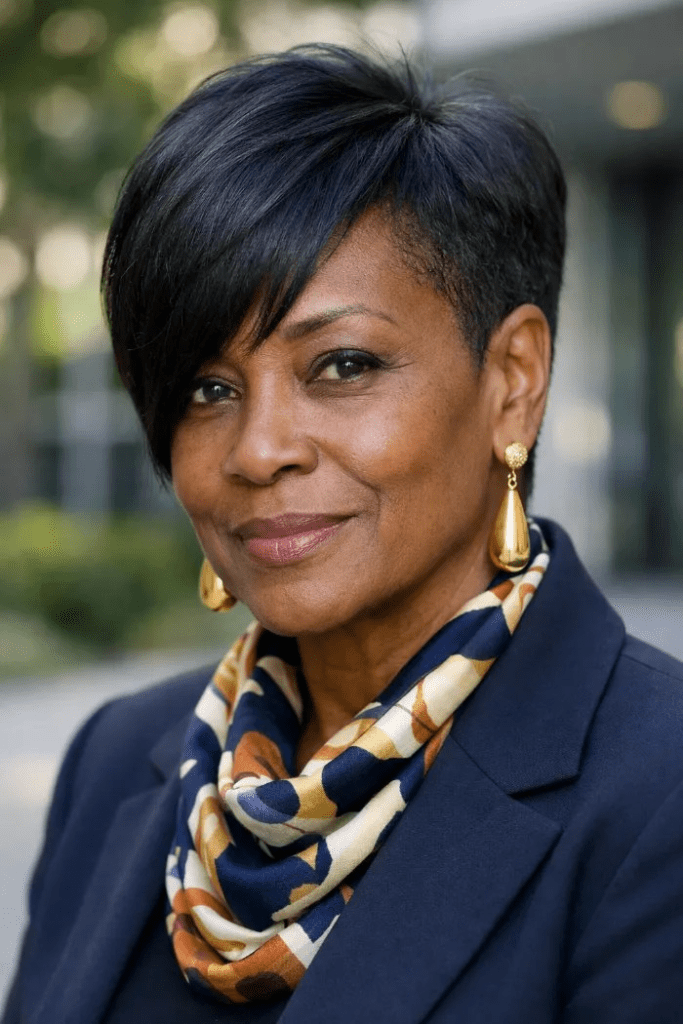
The deep side part is one of the most versatile face-framing techniques in all of hairstyling, and on a pixie cut, it creates a dramatic asymmetry that feels simultaneously classic and contemporary. One side of the head stays close and clean while the longer fringe drapes softly across the forehead on the other side, creating a sweeping, graceful movement that frames the face and draws attention to the eyes.
For older Black women who want coverage and elegance without a full updo, this style delivers both with very little daily effort.
Ask your stylist for: A scalp-realistic part — meaning the part should look like it originates naturally from the scalp rather than being a perfectly drawn line. Ask for the longer fringe section to have enough length and flexibility to be worn forward, to the side, or tucked behind the ear for versatility.
Styling tip: A flat iron used on just the fringe section — a single, smooth pass in the intended direction — keeps the drape clean and the style looking intentional throughout the day. A light serum applied to the fringe before flat-ironing adds shine and reduces the frizz that can form where the longer fringe section meets the shorter sides.
11. Side-Part Pixie with Polished Sweep
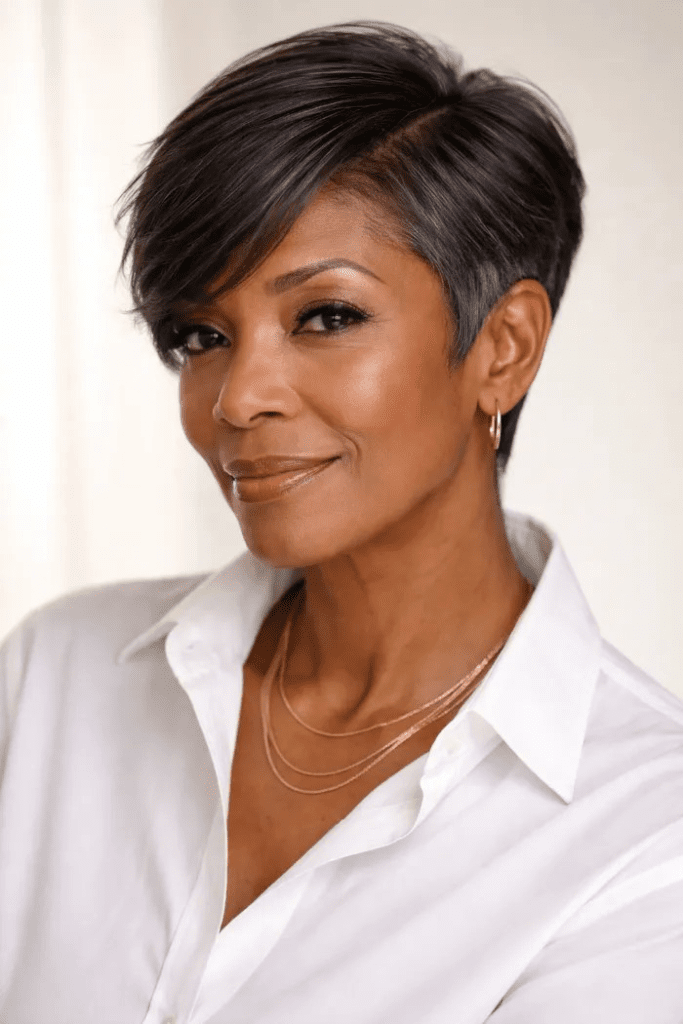
If the deep side-part pixie is the dramatic option, this is its polished, refined cousin. The top is smoothed over in a clean, directed sweep that stays tight and controlled rather than loosely draped. The sides stay close and tidy. The entire style reads as precisely groomed without being stiff or overly formal — it’s the pixie cut equivalent of a perfectly pressed outfit.
For older Black women who work in professional or corporate environments, this is one of the most consistently appropriate and powerful short styles available. It looks authoritative and put-together from the first moment of the day to the last.
Ask your stylist for: A deep, clean part with soft blending at the temple rather than a harsh line where the part meets the side section. The top should have enough length to sweep cleanly to one side. Soft tapering at the sides rather than a severe fade keeps the overall look refined rather than severe.
Styling tip: A light serum or hair milk applied to the top section and then swept into place with a soft-bristle brush gives this style its signature smooth, controlled finish. Press gently with the brush rather than dragging — pressing maintains the smoothness without disrupting the part direction.
12. Silver Gray Cropped Pixie with Soft Volume
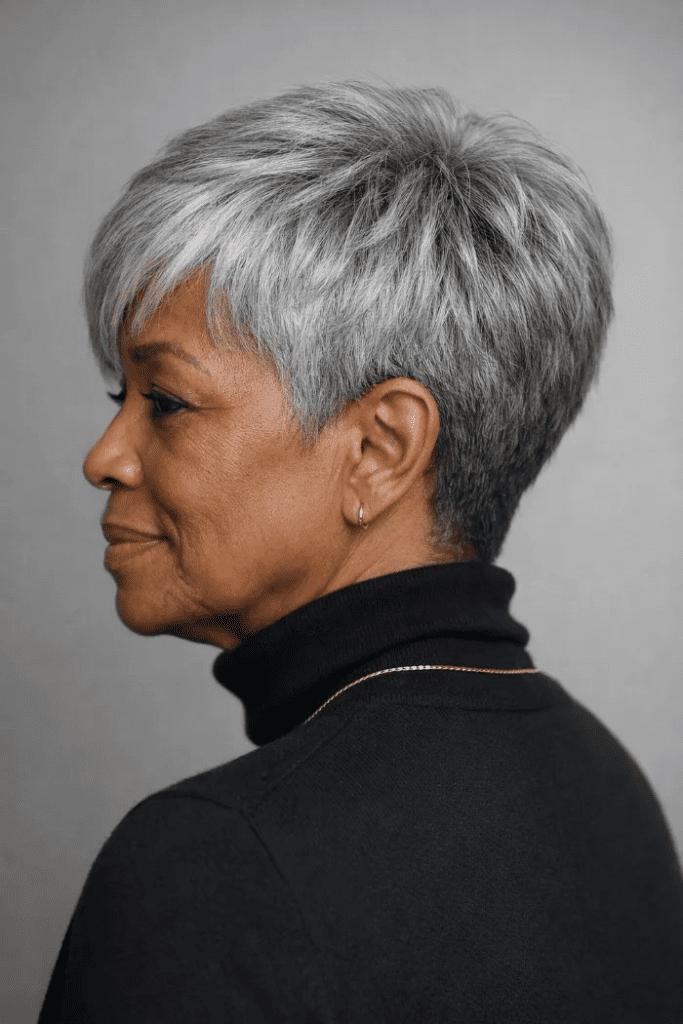
Natural silver and gray hair in a cropped pixie with gentle volume at the crown is one of those rare style combinations that looks better as it grows rather than worse. The silver tones add luminosity and visual interest that creates the appearance of fullness even when the individual strands are fine, and the cropped length keeps the overall silhouette precise and intentional.
The soft volume at the crown — achieved through light feathered layering rather than structural backcombing — lifts the face gently and creates the slightly elevated profile that is so flattering on older women specifically.
Ask your stylist for: Feathered layering through the crown section only — this is what creates the soft volume without making the style look puffy or over-done. Close, clean sides that keep the crown volume looking intentional. A soft fringe that falls naturally around the forehead rather than being directed or pinned.
Styling tip: A pea-sized amount of lightweight mousse worked through the crown section on damp hair, then left to air dry completely, gives this style its soft, natural-looking volume. Avoid blow-drying on high heat, which can disrupt the soft texture and make gray hair look frizzed rather than voluminous.
13. Sleek Tapered Pixie with Side Fringe
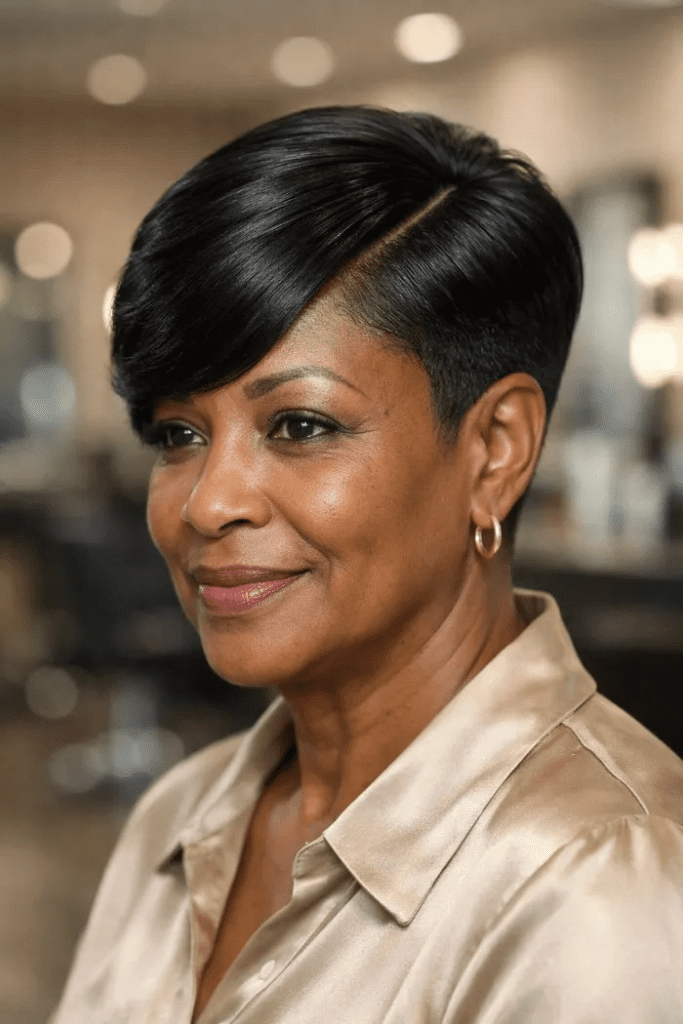
The sleek tapered pixie with a side fringe is the style for the woman who wants to feel completely assembled from the moment she walks out the door. Every element of this cut is purposeful: the taper keeps the nape and sides clean and minimal, the side fringe adds a single face-framing element at the front, and the sleek finish through the rest of the style ties everything together into a unified, polished whole.
It’s also one of the most reliably flattering pixie styles across a wide range of face shapes, because the side fringe element can be customized in length and direction to suit almost any feature.
Ask your stylist for: A soft outline at the nape and sides — not razor-sharp, but clean and intentional. A side fringe that skims the cheekbone rather than falling past it, which keeps the framing light and elegant. Specify a “soft, controlled” finish rather than a “tight, slicked” finish — there’s a meaningful difference.
Styling tip: Wrapping the hair at night with a satin scarf preserves both the sleek finish and the direction of the side fringe, which means morning styling takes about 60 seconds rather than starting from scratch. A quick smoothing pass with a soft brush and a drop of serum in the morning refreshes the style instantly.
14. Warm Highlight Tapered Pixie
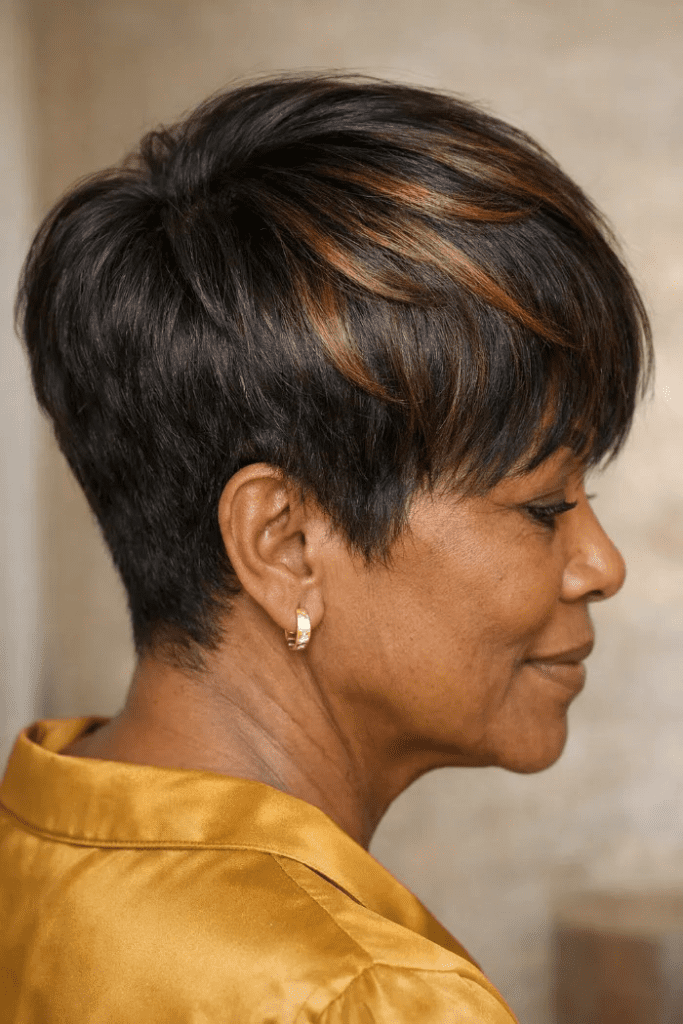
Color is one of the most underrated tools in the pixie styling toolkit, and warm highlights demonstrate exactly why. Strategic highlights placed through the crown and fringe of a tapered pixie add dimension and depth that make even fine, close-cut hair look rich and full. The color variation catches light from multiple angles and creates the visual impression of more hair — something that flat, one-dimensional color simply can’t achieve.
For older Black women whose natural color has become less vibrant with age, warm highlights specifically brighten the face and add warmth to the overall complexion in a way that cool or neutral tones can’t replicate.
Ask your stylist for: Subtle, face-brightening highlights concentrated on the top section and fringe — not throughout the entire cut, which can look over-processed at shorter lengths. Ask your colorist for warm, dimensional tones that complement your skin’s undertone.
Styling tip: A clear gloss treatment done every four to six weeks in the salon keeps highlighted hair looking fresh, shiny, and intentional between color appointments. At home, a color-safe conditioner used consistently prevents the warm tones from fading and keeps the hair looking vibrant longer.
15. Low-Profile Tapered Pixie with Clean Outline
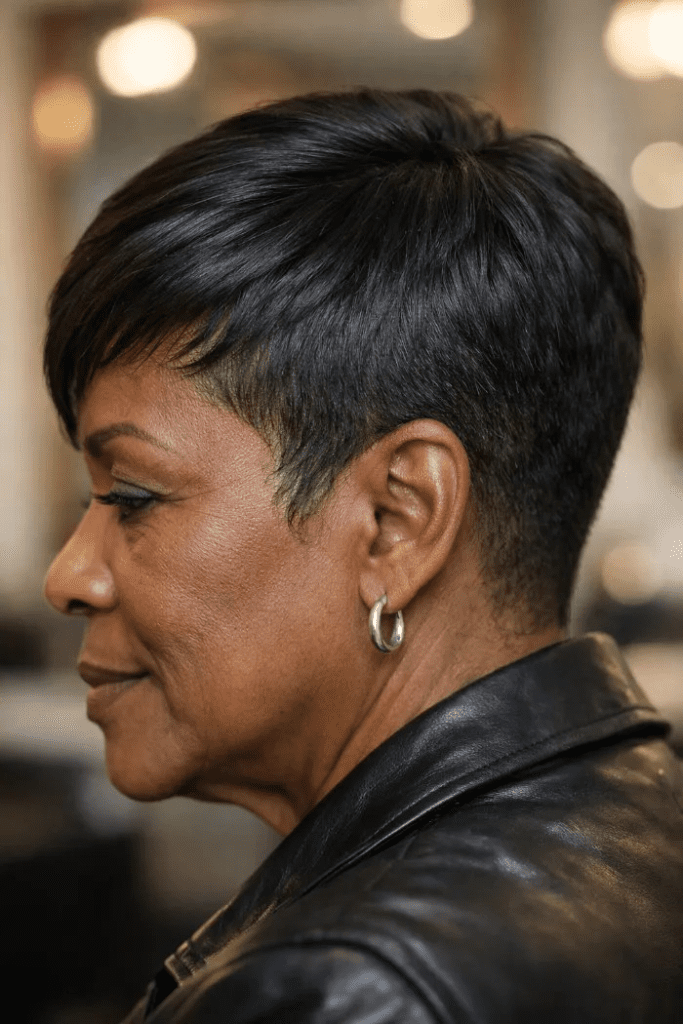
This is the pixie for the woman who wants a style that holds its look for as long as possible between appointments without requiring daily styling intervention. The low-profile shape sits close to the head throughout — there’s no elevated crown volume to maintain, no complex fringe to direct — and the clean, precise outline is what keeps it looking polished even as it grows.
It’s also one of the most versatile pixie cuts across occasions, moving comfortably from a casual Tuesday morning to a formal weekend event with no change in styling routine.
Ask your stylist for: A soft taper at the nape rather than a tight, close fade — this gives the style slightly more longevity between shape-ups. A clean outline that’s precise without being harshly sharp. The fringe should sit naturally close to the forehead rather than being elevated or directed.
Styling tip: A light pomade worked through the top section with fingertips and smoothed into place is all this style needs for daily maintenance. The lightness of the product is important — anything heavy will flatten the close-cut style and make the scalp visible in a way that’s unflattering.
16. Tapered Pixie Fade with Soft Lift
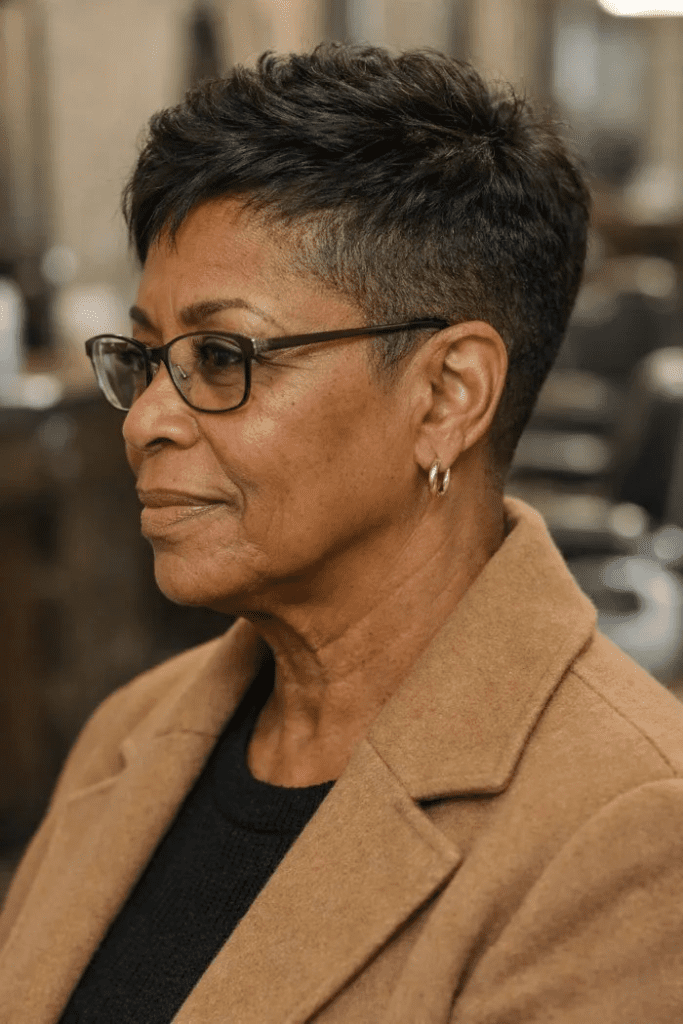
The pixie fade is for the woman who loves the clean, graphic quality of a well-executed fade but wants her overall style to remain soft and wearable rather than severe. The sides graduate smoothly from close to the scalp upward toward the longer top section, and the top itself has a gentle, natural lift that adds height at the crown without requiring architectural styling.
This style is particularly flattering with glasses — the fade clears the temples and sides beautifully, allowing frames to sit against the face without any hair competition, and the lifted crown creates a pleasing proportion above the frames.
Ask your stylist for: A natural hairline at the edge rather than a drawn or painted one — a natural hairline reads as more organic and requires less maintenance to look intentional. A smooth, even graduation from the fade into the longer top section without any harsh transitions.
Styling tip: A mousse applied to the crown section while damp and then finger-shaped upward gives the soft lift this style needs. Avoid using a comb or brush on the top section — fingertip styling on fine or medium hair creates a more natural, organic lift than any tool.
17. Classic Tapered Pixie with Natural Gray Blend
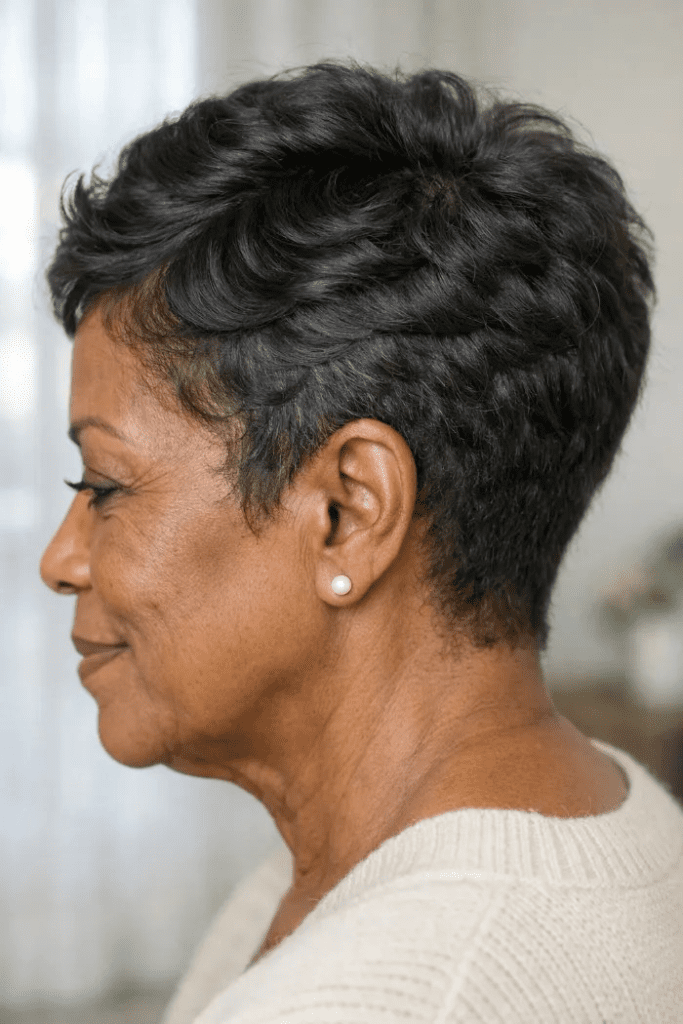
The natural gray blend tapered pixie is one of the most confident style statements an older Black woman can make — and it’s worth saying that plainly. Choosing to wear your natural gray in a well-executed pixie rather than covering it communicates exactly the kind of self-possession and ease that no color treatment can manufacture. The gray melts through the cut with genuine beauty, and the tapered shape keeps every tone looking deliberate and refined.
Ask your stylist for: Soft layering through the top section to create movement and show off the gray tonal variation. A clean, tapered nape that provides the structural precision that makes the natural color blend look like a styling decision rather than maintenance avoidance.
Styling tip: A lightweight leave-in conditioner is essential for natural gray hair, which tends to be coarser and drier than pigmented hair due to changes in the hair’s protein structure with age. Applied daily to the top section, it keeps gray hair supple, manageable, and visually smooth. Follow with a minimal amount of lightweight serum for shine.
18. Piecey Textured Pixie with Airy Crown
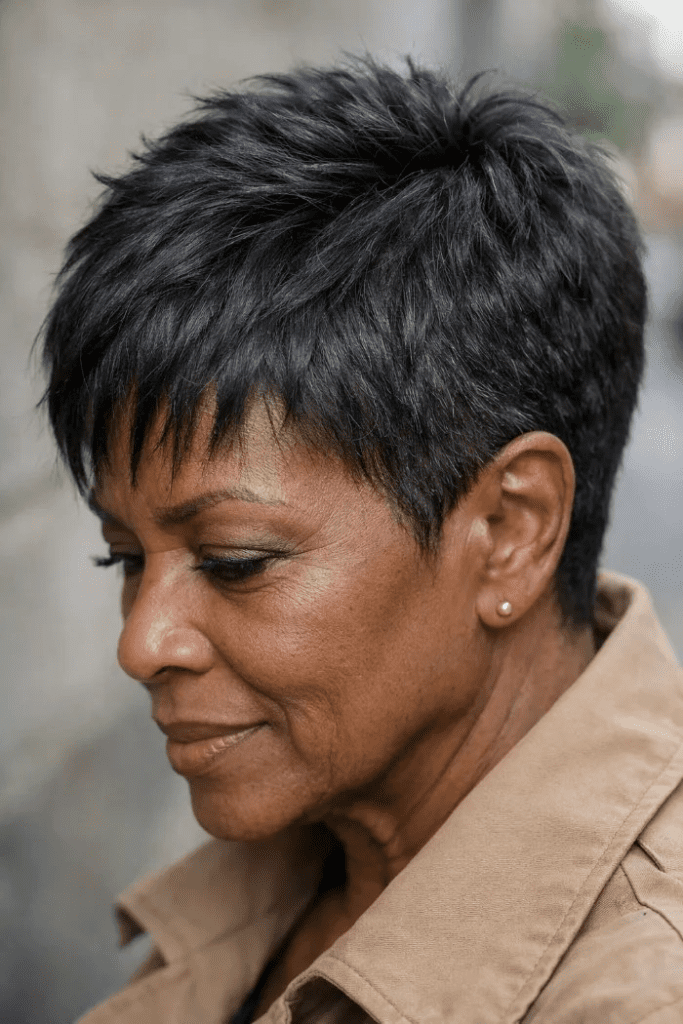
The piecey textured pixie is the pixie cut for the woman who wants her hair to look like she styled it in two minutes even though the cut itself is genuinely excellent. The airy crown creates a slightly elevated silhouette without any of the formality of a sleek or sculpted style, and the piecey fringe gives the front of the cut a relaxed, effortless quality that’s both modern and flattering.
The close sides prevent the casual styling from reading as unstyled — the structural precision of the taper is what gives the relaxed crown and fringe their intentional quality.
Ask your stylist for: Point-cutting through the top section and fringe for the piecey texture — this technique creates organic separation in the hair without harsh lines or blunt edges. Close sides that provide the structural counterpoint to the relaxed crown.
Styling tip: A matte paste applied with fingertips through the crown and fringe while hair is dry — not damp — gives this style its signature piecey, separated finish. Work lightly and imprecisely, lifting and separating rather than smoothing. The less groomed it looks, the more modern it reads.
19. TWA Pixie with Rounded Coils
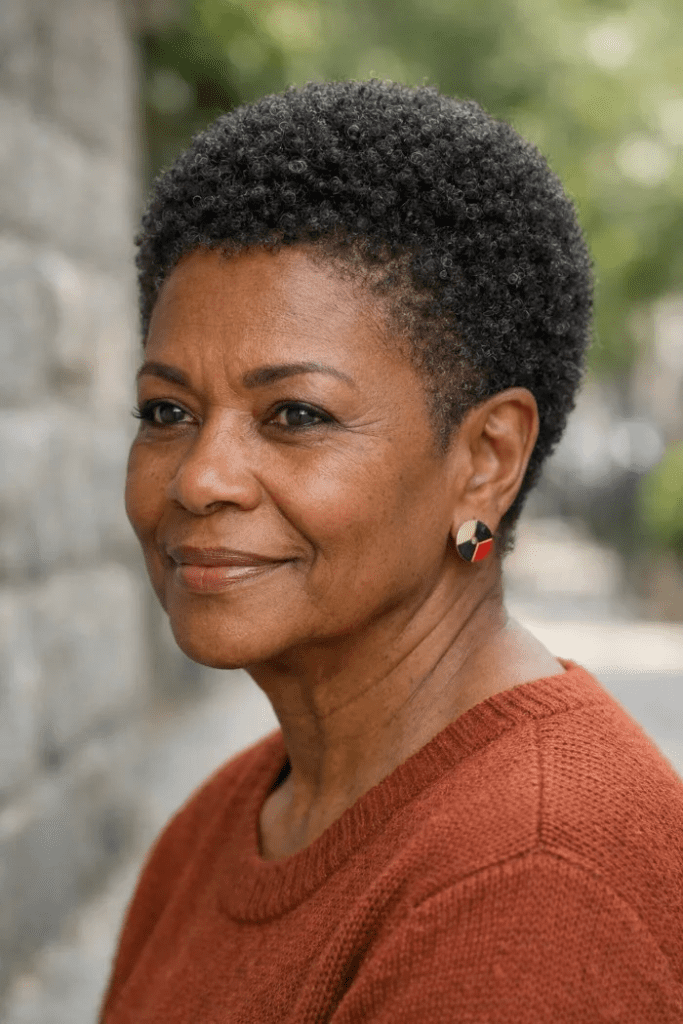
This TWA variation is all about shape. Where the first TWA on this list celebrates free, organic coil texture, this version emphasizes a specific rounded silhouette that frames the face with particular care. The coil pattern remains fully natural and unmanipulated, but the cut is designed to create a rounded crown shape and clean sides that give the natural coils a deliberate, architectural quality.
For older Black women who love the freedom of natural hair but want a style that reads as polished rather than simply unstyled, this rounded TWA delivers exactly that balance.
Ask your stylist for: A rounded crown shape that frames the face symmetrically. A soft taper at the nape and sides that keeps the overall silhouette clean without disrupting the natural coil pattern. The edge-up should be soft and natural rather than sharp and geometric.
Styling tip: A curl cream applied section by section to damp hair and then left completely alone is the full styling routine for this cut. Define and walk away. Over-handling coily hair after product application is the single most common mistake that disrupts natural coil formation, and this style genuinely rewards restraint.
20. Wavy Tousled Pixie with Side Sweep
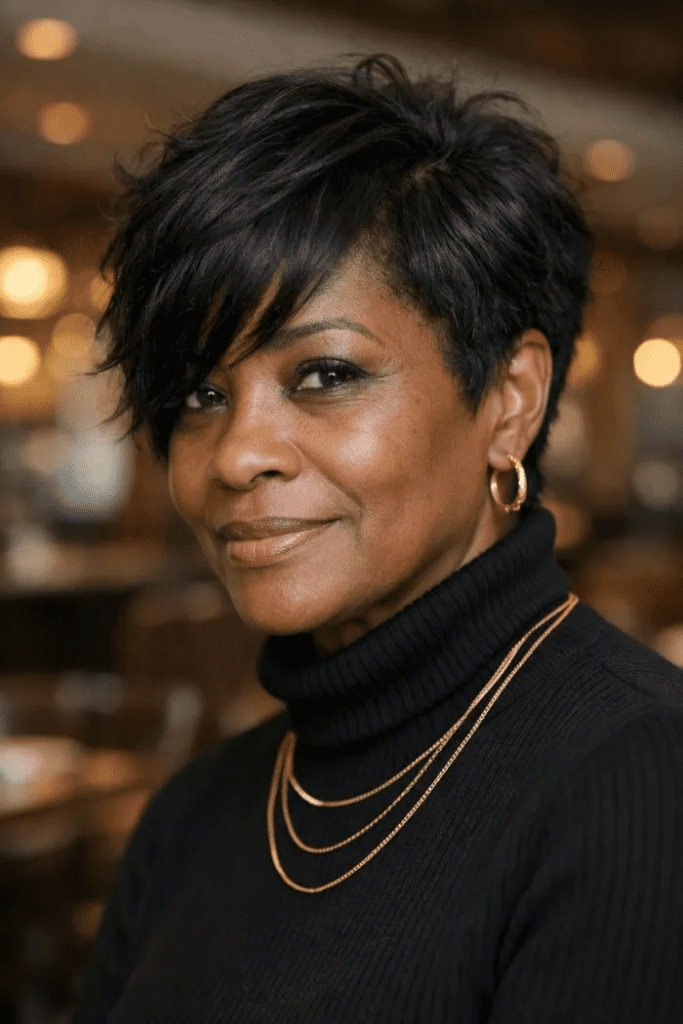
The wavy tousled pixie brings a relaxed, modern softness to the pixie category that tight tapers and sleek sweeps can’t quite achieve. The longer top section has real movement — a natural wave or a loosely curled bend — and the side sweep direction gives it a flowing, effortless quality that feels both current and timeless. It’s one of the few pixie styles that genuinely looks better on a less-than-perfect hair day.
Ask your stylist for: Airy, long layering through the top section that supports wave formation and movement. A deep side sweep direction built into the cut rather than just added during styling. The sides should be tapered cleanly to provide the structural contrast that makes the tousled top look intentional.
Styling tip: A small-barrel wand or curling iron used on just the front section of the top — a single pass, a single curl — refreshes the wave direction and gives the side sweep its signature bend instantly. A flexible-hold spray misted lightly over the finished style keeps the tousled quality in place without stiffening it.
What to Know Before Choosing a Pixie Cut After 60
Choosing the right pixie is about more than the shape. It’s about understanding your hair’s current texture and density, being honest about your styling habits, and knowing what your scalp and hairline can support comfortably.
Consider your hairline health first. If your edges are thinning or your hairline has become fragile, certain pixie elements — aggressive edge-ups, tight tapers that start very high, sharp drawn-in lines — can accelerate hairline thinning. Ask for soft, natural edge work and low-tension tapering. The pixie should work with your hairline, not against it.
Your natural texture determines the best approach. Coily and kinky textures have the most versatility in the pixie category — they can be worn in their natural state, defined with products, or smoothed for a sleeker look depending on the occasion. Relaxed or heat-straightened hair requires slightly different structural considerations, particularly around how the taper and crown layering interact.
Maintenance frequency is a real commitment. A tight fade or precise taper looks stunning for about two weeks before it starts to grow out noticeably. If you can’t commit to two-to-three-week salon visits, choose a softer, more textured pixie with less precise edges — it will hold its shape and look intentional for four to six weeks between appointments.
Product weight matters more at shorter lengths. On a pixie cut, there is nowhere for heavy product to hide. A cream or gel that’s too heavy will flatten the style against the scalp and make the hairline area look greasy. Always choose the lightest product that achieves your desired result, and apply it sparingly.
Best Styling Products for Pixie Cuts on Older Black Women
Lightweight hair milk or leave-in conditioner: Essential for daily moisture on gray, coily, or mature hair that tends toward dryness. Applied first, before any styling product, it keeps the hair supple and manageable.
Light setting foam: The ideal base product for finger waves, pin curls, and styled pixie shapes. Sets the style without the stiffness or flaking that heavy gels can cause, particularly on gray hair.
Curl cream: The foundation product for TWA and natural coil pixie styles. Applied to damp hair, section by section, it defines and supports the natural coil pattern without adding weight.
Matte paste: The essential finishing product for textured, tousled, and faux-hawk pixie styles. Adds separation and hold without the shine that can make close-cut hair look slick or flat.
Lightweight serum or hair gloss: Used sparingly on sleek and side-swept styles to add a controlled, healthy-looking shine without weight. Applied to the surface of the style, not worked through from roots to ends.
Purple or silver-toning shampoo: Used once a week on natural gray or silver hair to maintain the brightness of the tones and prevent yellowing. A non-negotiable product for anyone embracing their natural gray in a pixie.
Satin bonnet or scarf: The most important nighttime product for any pixie style. Preserves the styling direction, prevents friction-related frizz and breakage, and dramatically extends the life of any pixie variation.
Final Thoughts
The pixie cut, in all its variations, is one of the most genuinely empowering hairstyle decisions an older Black woman can make. It doesn’t hide anything — it showcases everything. The face, the bone structure, the neck, the ears, the eyes. It turns getting dressed in the morning into a faster, easier, more confident experience. And it grows with you, changing and evolving in ways that longer styles simply don’t.
Whether you choose the close, classic simplicity of a cropped sleek pixie, the cultural elegance of finger waves, the natural freedom of a rounded TWA, or the bold architectural statement of a faux-hawk, the decision to wear a pixie is a decision to let your face be the focal point. And after 60, that’s exactly where the focus should be.
Save the styles that speak to you most. Bring them to your next appointment. And wear whichever one you choose with the full confidence it deserves.
Pin your favorites to reference at your next salon visit — the more specific your photo reference, the better your stylist can execute the exact shape you want.
Do pixie cuts work for thinning edges or fine hair?
Yes — when the cut is designed thoughtfully for those specific concerns. For thinning edges, ask for a natural, soft edge-up rather than a sharp, drawn-in line, which puts additional stress on already-fragile hairline hairs. Avoid tight tapering that starts too high, which can accelerate thinning at the temples. For fine hair, a sleek pixie or a style with gentle crown layering adds fullness without looking puffy or over-done.
How often will I need a trim to keep my pixie looking fresh?
It depends entirely on the style. A tight taper or fade looks its best with a shape-up every two to three weeks. A softer, more textured pixie with natural edges can look intentional and polished for four to six weeks between appointments. If frequent salon visits aren’t realistic for your schedule, choose a style specifically designed to grow out gracefully — styles 18, 19, and 20 on this list are all excellent options for that reason.
What is the easiest way to style a pixie cut in the morning?
Start with moisture — always. A light leave-in conditioner or hair milk applied to dry or slightly damp hair gives mature and gray hair the suppleness it needs before any styling product goes on top. For sleek styles, follow with a small amount of serum or pomade and a soft-bristle brush. For curly and coily styles, curl cream plus a light mousse, finger-shaped and left alone, is the complete routine. For textured styles, a matte paste worked through with fingertips takes about 90 seconds. The common thread across all pixie styles is this: use less product than you think you need, and always start with moisture.
Can I wear a pixie cut if I’m transitioning from relaxed to natural hair?
Absolutely — and many women find that the transition period is the ideal time to try a pixie, because it allows the new natural growth to be showcased without the awkward length difference between relaxed and natural sections being as visible. A TWA or close-cropped natural pixie during transition is one of the cleanest, most stylish approaches to going natural available.
What pixie style is best for older Black women who wear glasses?
Styles with clean, close sides — tapered pixies, fades, and undercut variations — tend to be the most flattering with glasses because they keep the temple area clear and allow the frames to sit against the face without any hair competition. The lifted crown styles, like the tapered pixie fade and the faux-hawk variation, create a pleasing vertical proportion above the frames. The deep side-part pixie and the micro-bang pixie also work beautifully with glasses because they create a deliberate relationship between the hairline and the frame shape.