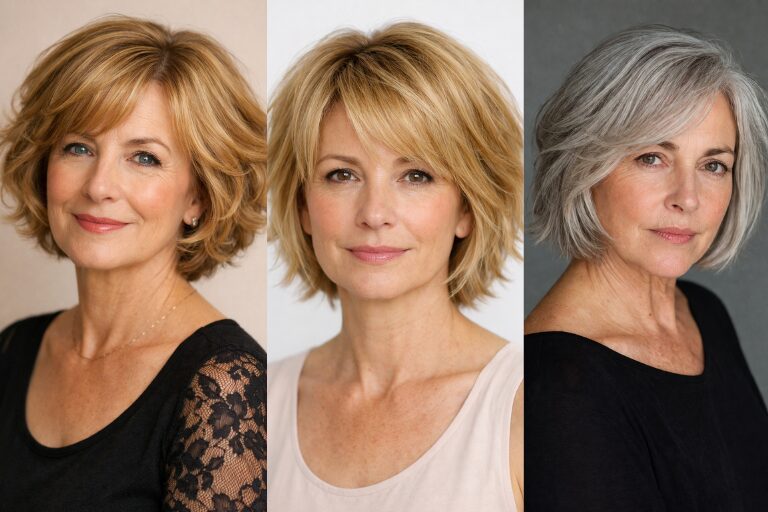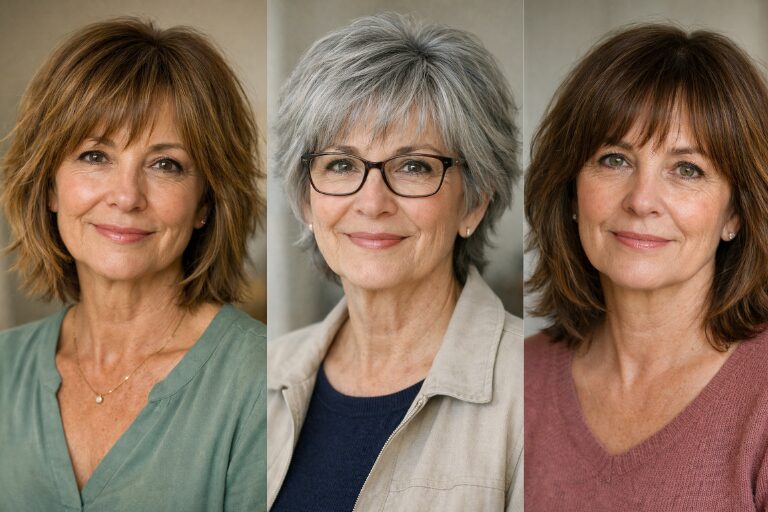
20 Hairstyles for Women Over 60 With Fine Hair That Create Fuller, Thicker-Looking Volume
Fine hair after 60 has a very particular set of challenges — and if you’ve been navigating them for a while, you already know the frustrations intimately. You wash your hair, it looks great for about 45 minutes, and then it slowly surrenders to gravity and goes flat before you’ve even finished your second cup of coffee. By lunchtime you’re reaching for dry shampoo. By evening you’ve given up entirely.
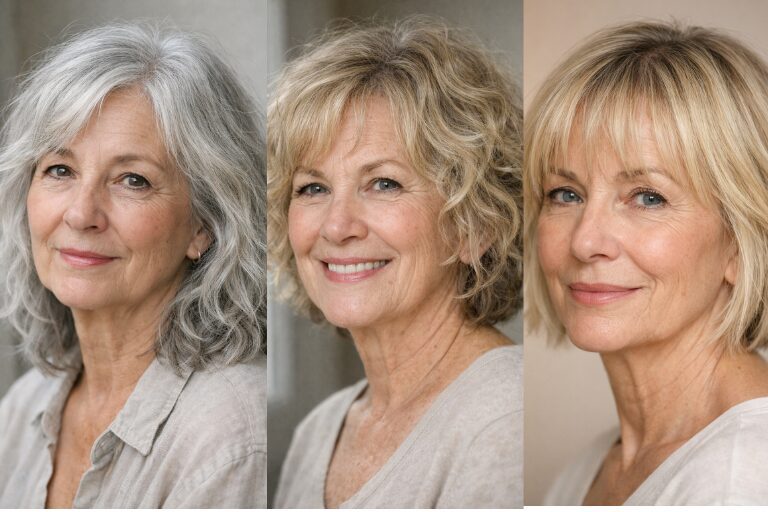
Here’s what actually helps: it’s not a miracle product, and it’s not a complicated 12-step styling routine. It’s the right haircut. The shape, the layering technique, the perimeter density — these structural decisions determine how your hair behaves every single day, with or without a full styling session. Get them right and fine hair after 60 becomes genuinely manageable. Get them wrong and no amount of volumizing mousse will save you.
These 20 hairstyles for women over 60 with fine hair are chosen specifically for their ability to create the appearance of thickness, hold their shape throughout the day, and look great whether you spend five minutes or thirty on styling. Each one comes with what to ask your stylist and how to style it at home — because a great haircut is only half the equation.
What Fine Hair After 60 Actually Needs From a Haircut
Before the styles, it helps to understand the mechanics — because once you understand why certain cuts work on fine hair, you can have a much more informed conversation with your stylist and make smarter decisions when you’re choosing between options.
Blunt or close-to-blunt ends create the illusion of thickness. When all the hair ends at the same length, the hemline looks dense and full — even when individual strands are fine. A heavily layered or razored hemline, by contrast, exposes the thinness of each individual strand at the perimeter.
Internal layers, not surface layers, are the goal. Layers that live inside the silhouette — lifting the crown and creating movement from underneath — add volume without thinning the visible perimeter. Surface layers that texture the outside of the style can make fine hair look sparse and wispy.
Shorter lengths generally work better than longer ones. Fine hair gets pulled down by its own weight at longer lengths. At shoulder length and above, fine hair holds its shape, maintains volume, and looks fuller and more deliberate. The longer it gets, the more it collapses.
A soft fringe changes the entire front profile. Bangs of almost any style — wispy, curtain, side-swept — add a visual focal point at the forehead that draws the eye upward and away from any thinness at the crown or temples. They’re one of the most effective fine hair tricks available, and they require very little styling commitment in their softer forms.
The cut needs to suit your actual styling routine. There’s no point choosing a style that requires a full round-brush blowout if you genuinely air-dry most mornings. Be honest with yourself about your routine before choosing a style, and choose accordingly.
20 Hairstyles for Women Over 60 With Fine Hair
1. A Lob With Wispy Bangs
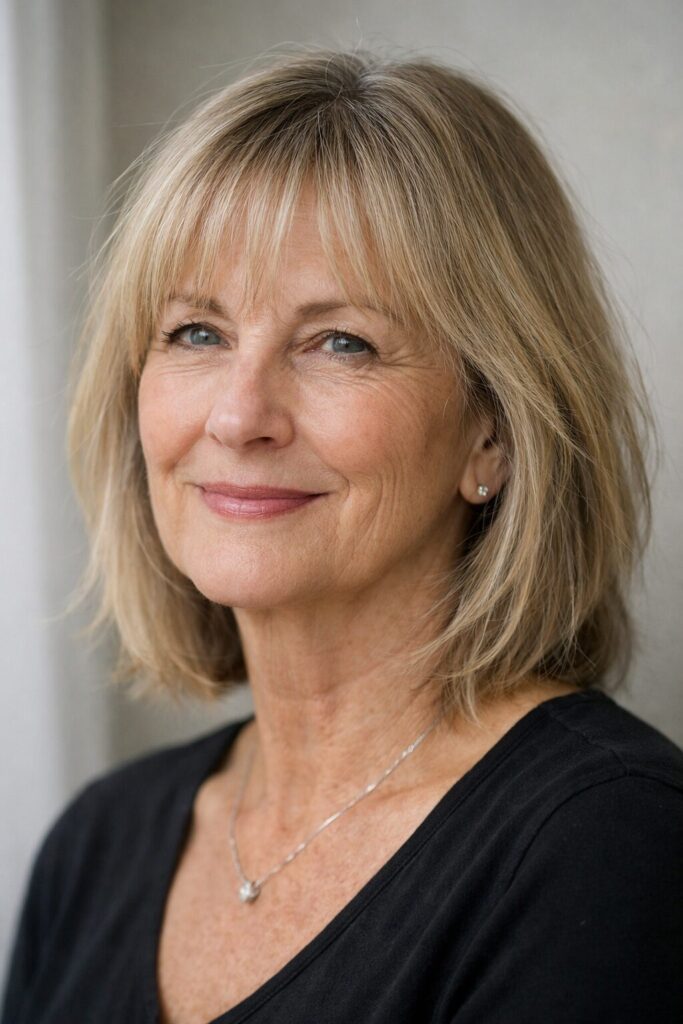
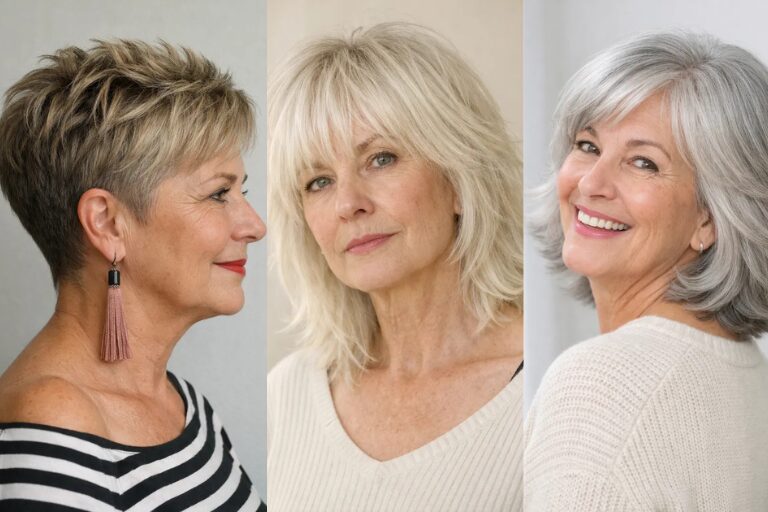
The lob — sitting at or just past the shoulder — is one of the most forgiving and universally flattering haircuts for fine hair after 60, and pairing it with wispy bangs elevates it from “nice cut” to “genuinely transformative.” The wispy bangs sit lightly on the forehead, adding a soft focal point at the front without demanding daily styling precision. The lob length keeps the hair in its densest, most volumized zone — long enough to feel luxurious, short enough to hold its shape.
The lightly textured ends through the lob prevent the style from looking too blunt or boxy while still maintaining the perimeter density that fine hair needs. It’s a careful balance — and this cut achieves it beautifully.
Ask your stylist for: Long internal layers that begin below the cheekbones, lifting the crown without thinning the perimeter. Wispy, point-cut bangs rather than blunt-cut fringe — the point-cut technique creates soft, airy edges. A light texture at the ends, not heavy razoring.
Styling tip: A quick round-brush blowout through the lengths — rolling the brush inward as you dry — gives this style its signature swing and bounce. Finish with a flexible-hold spray to keep the volume in place without stiffness.
2. Blunt Bob With a Soft Bend
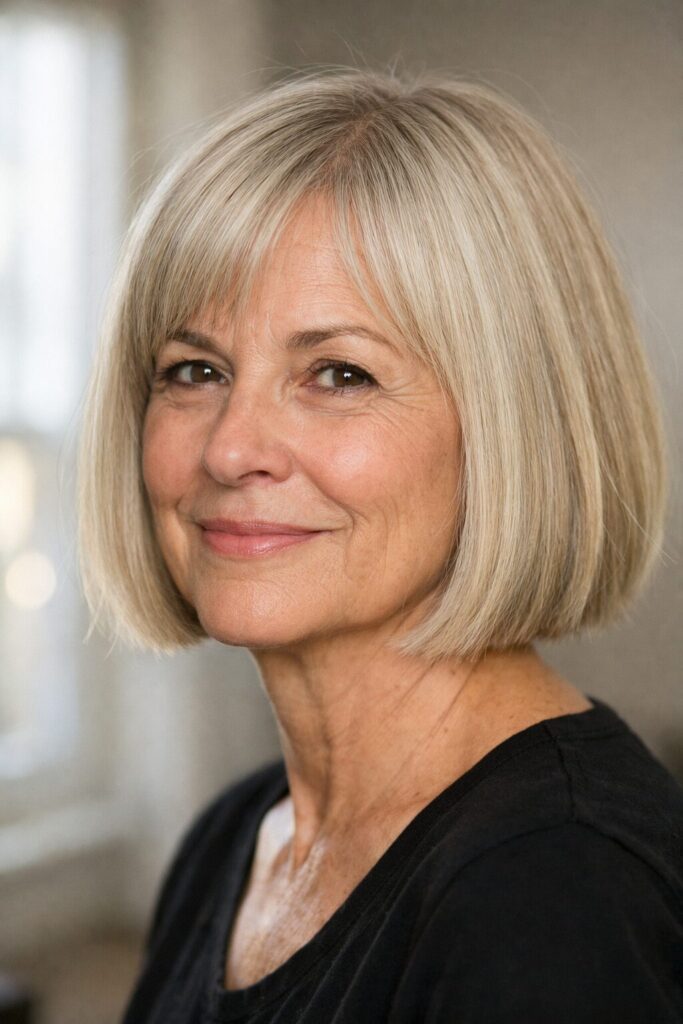
If there is one cut on this list that most consistently and reliably makes fine hair look thicker, it’s the blunt bob. The aligned hemline creates a visual density at the ends that no amount of product can replicate — when all the hair ends at the same point, the perimeter looks genuinely full. Add a soft bend at the ends rather than a rigid straight finish, and the style becomes modern and fluid rather than severe.
For fine hair, this is the structural equivalent of a cheat code. The blunt baseline does all the heavy lifting while the soft bend keeps it from looking stiff or dated.
Ask your stylist for: Minimal internal layering — just enough to prevent the style from sitting helmet-flat on the head, not enough to thin the ends. A gentle bevel underneath the hemline, which encourages the ends to curl softly inward. A clean, precise baseline rather than a soft or textured edge.
Styling tip: A flat iron or hot brush used on just the ends — rolling them under with a gentle inward curl — takes about 90 seconds and gives this style its polished, put-together finish. On days when you don’t have time, a simple blow-dry forward with a paddle brush looks surprisingly good on its own.
3. Chin-Length Shaggy Bob
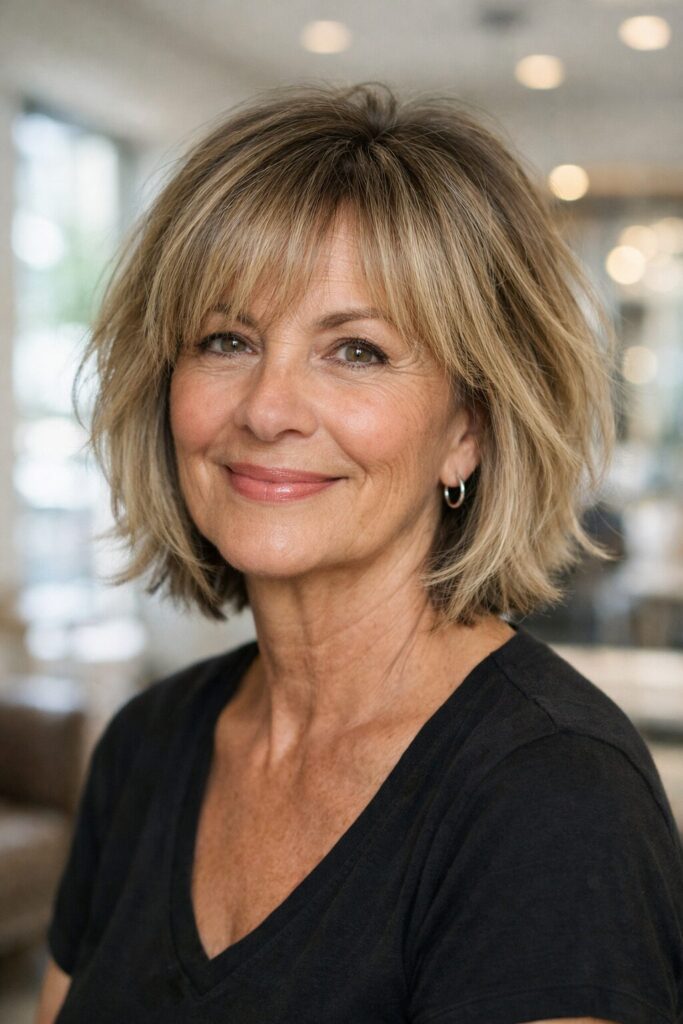
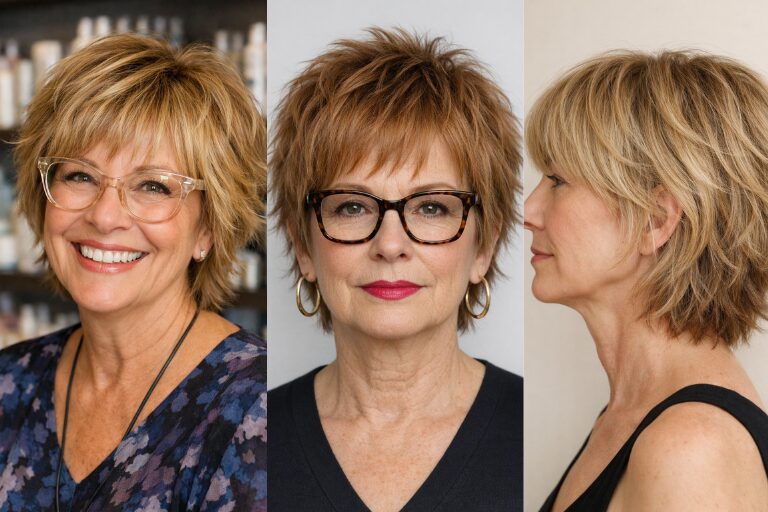
The shaggy bob sits at the chin and uses piecey, lived-in layers to create movement and texture without sacrificing the density that fine hair needs at the perimeter. The fringe — light and piecey rather than blunt and heavy — adds a soft focal point at the front that makes the whole style feel more complete and intentional.
What makes the shaggy bob particularly clever for fine hair after 60 is that the layers are shallow and concentrated around the face and crown rather than distributed throughout the entire length. This creates the movement and separation of a layered cut while keeping the hemline strong.
Ask your stylist for: Shallow layers focused around the face and crown — not throughout the entire length. Point-cut ends for that signature piecey, lived-in texture. A light fringe that blends into the layers rather than sitting as a separate, defined section.
Styling tip: A light texturizing spray scrunched into towel-dried hair and left to air dry gives this style its effortless finish. If you prefer a blowout, use a diffuser attachment for a similar organic texture. A tiny amount of lightweight pomade pinched through the ends defines the piecey texture beautifully.
4. Choppy Blonde Bob
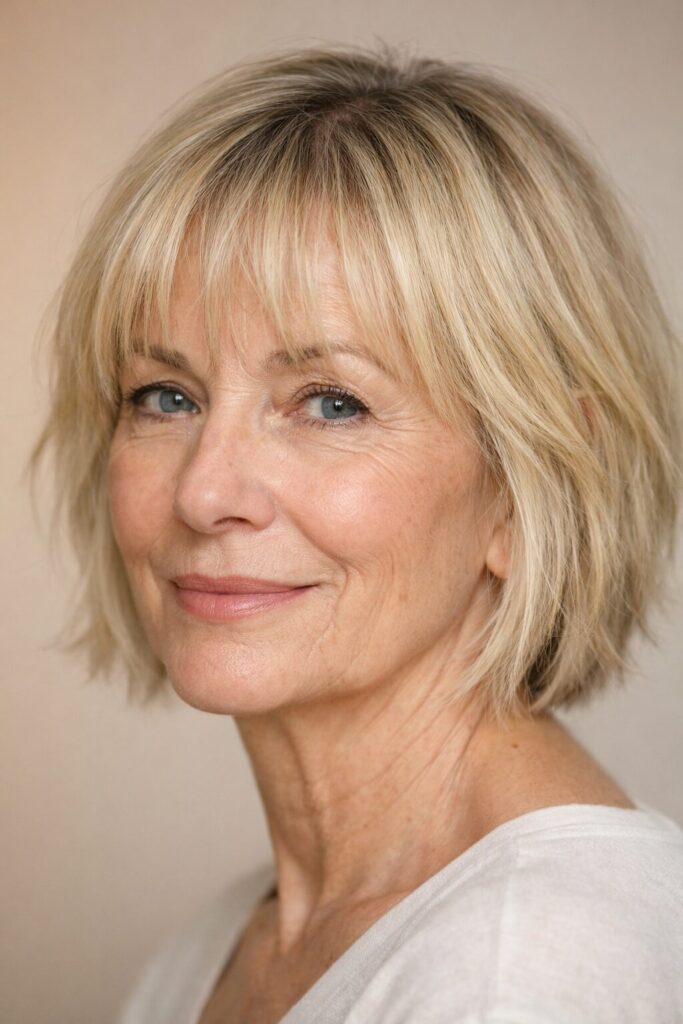
The choppy blonde bob is a masterclass in making fine hair look more abundant. The warmth of the blonde tones adds visual depth and dimension — and tonal variation in hair always reads as thickness, because the eye interprets multiple tones as multiple layers of hair. The choppy texture at the ends creates separation and movement that flat, smooth ends simply can’t achieve.
On fine hair specifically, the key is keeping the choppiness at the ends only and leaving the body of the style full and rounded. It’s a modern, confident cut that looks deliberately undone rather than accidentally messy.
Ask your stylist for: Point-cut ends that create soft choppiness — avoid heavy razoring, which removes too much weight from fine hair. Soft face-framing layers that start at the cheekbone. A rounded, full body shape with the texture concentrated only at the perimeter.
Styling tip: A small amount of mousse scrunched into damp hair before air-drying gives this style its casual, effortless texture. If you want more volume, rough-dry with your fingers first, then scrunch in a light texturizing spray on dry hair for separation.
5. Choppy Pixie Bob With Wispy Texture
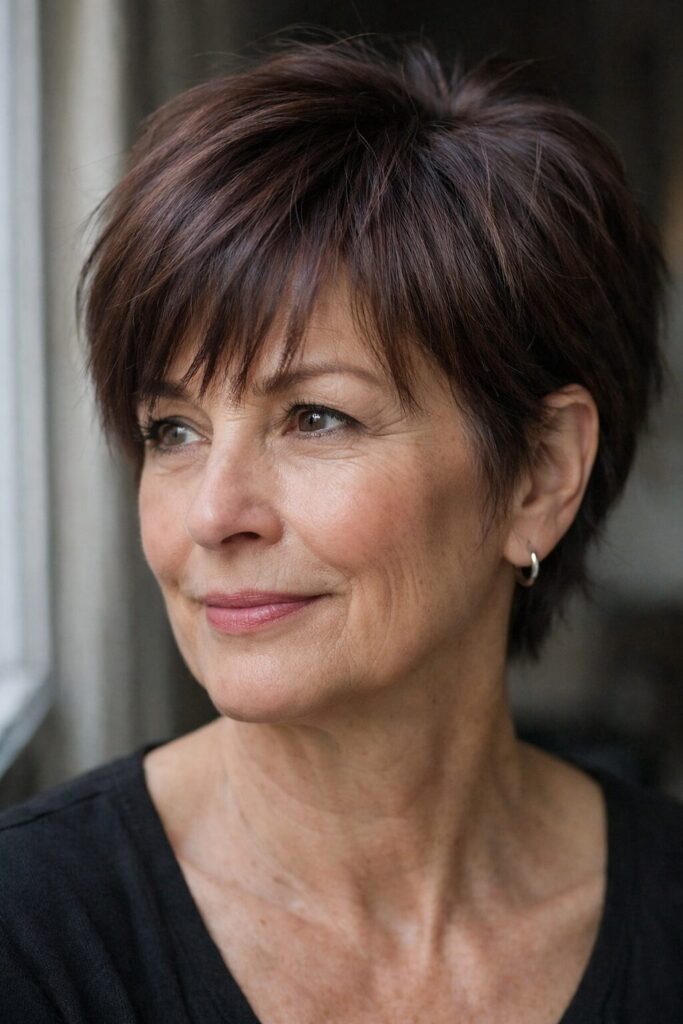
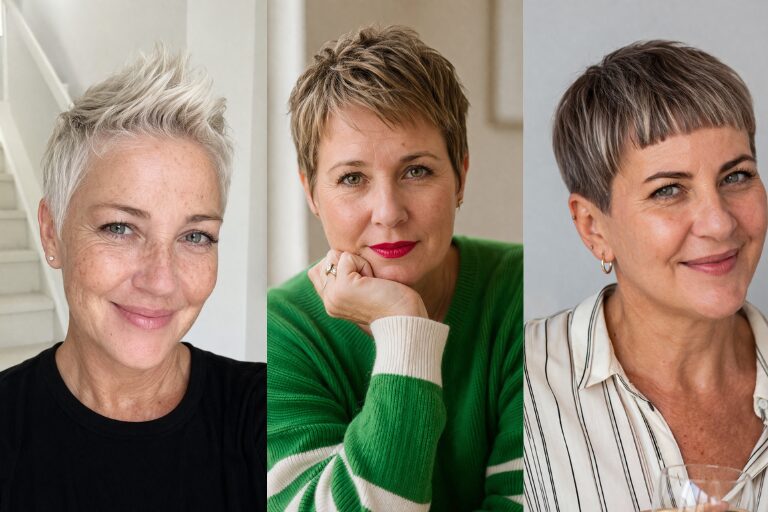
The pixie bob is longer than a traditional pixie, shorter than a traditional bob — and that sweet spot is exactly where fine hair thrives. Keeping length around the face softens the profile and prevents the style from looking too close-cropped, while the cropped, neat back keeps the overall shape from drooping or losing structure.
The wispy texture throughout gives fine hair lift without any of the spikiness that can make a short style look harsh. A slightly stacked crown means volume lives right where it’s most visible and most flattering.
Ask your stylist for: A slightly stacked crown for volume at the top. Feathered, softly textured ends throughout — not sharply cut or blunt. Length kept around the face and at the front while the back is cropped clean. Avoid heavy thinning shears, which remove weight that fine hair can’t afford to lose.
Styling tip: A pea-sized amount of lightweight styling paste worked through dry fingertips, then pressed gently through the crown and top sections, separates the pieces and builds volume simultaneously. This is a case where less product produces a better result — start with less than you think you need.
6. Classic Feathered Pixie With a Soft Side-Swept Fringe
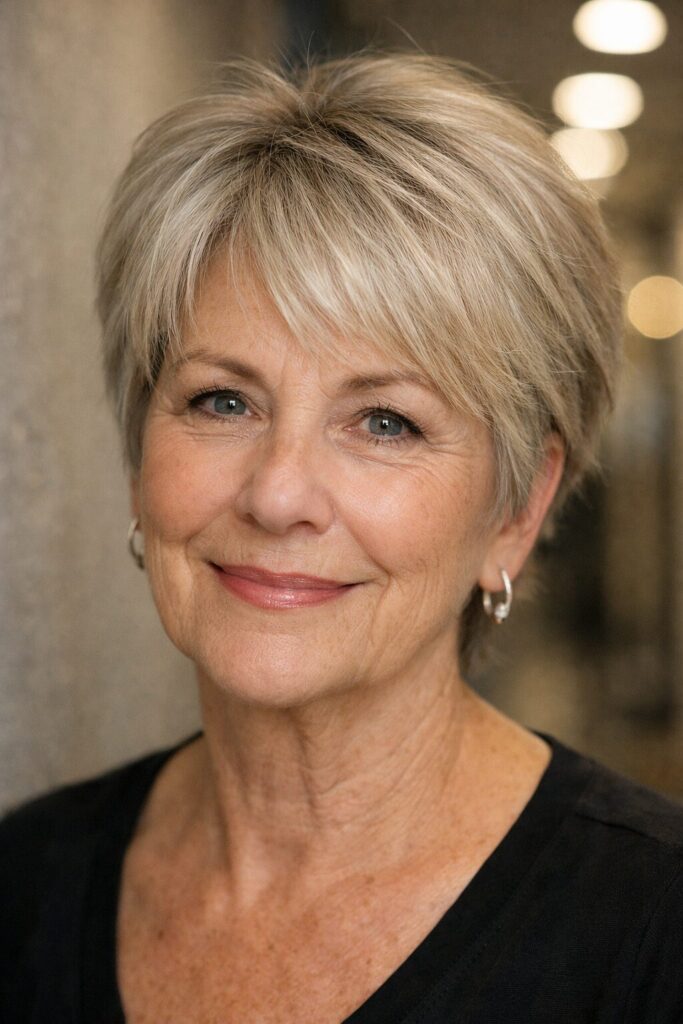
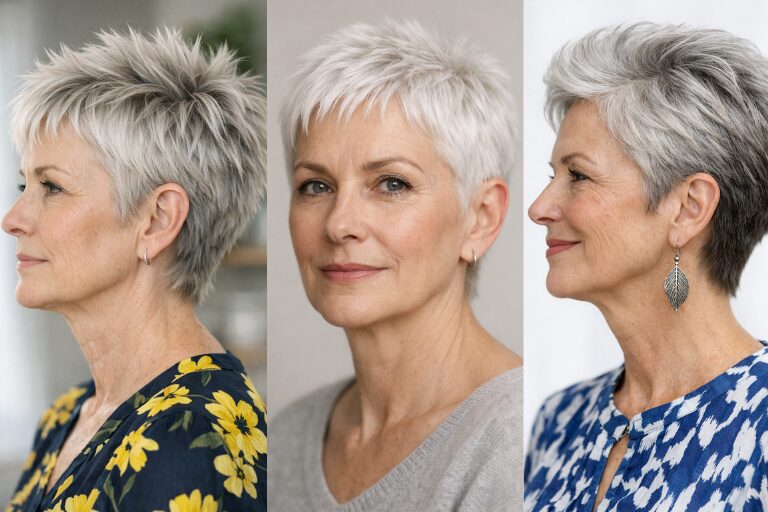
The feathered pixie has been earning its reputation as one of the most flattering short hairstyles for fine hair over 60 for decades — because it genuinely works, consistently, on a wide range of hair types and face shapes. The feathering technique lifts the crown and gives the hair that signature light, floating quality that makes fine strands look effortlessly full. The side-swept fringe softens the forehead and can be adjusted day to day — worn forward, swept to the side, or tucked behind the ear for variety.
This is a low-commitment, high-reward cut. It requires minimal daily styling and maintains its shape reliably between salon visits.
Ask your stylist for: Light internal layering at the crown with a feathering technique — not heavy razoring. A clean, tapered nape that keeps the back neat and precise. A side-swept fringe cut long enough to adjust in multiple directions.
Styling tip: Blow-dry the fringe first, directing it forward and then to the side with a small round brush or your fingers. Then rough-dry the crown section upward for lift. A light-hold finishing spray keeps everything in place without stiffness.
7. Collarbone-Length Bob
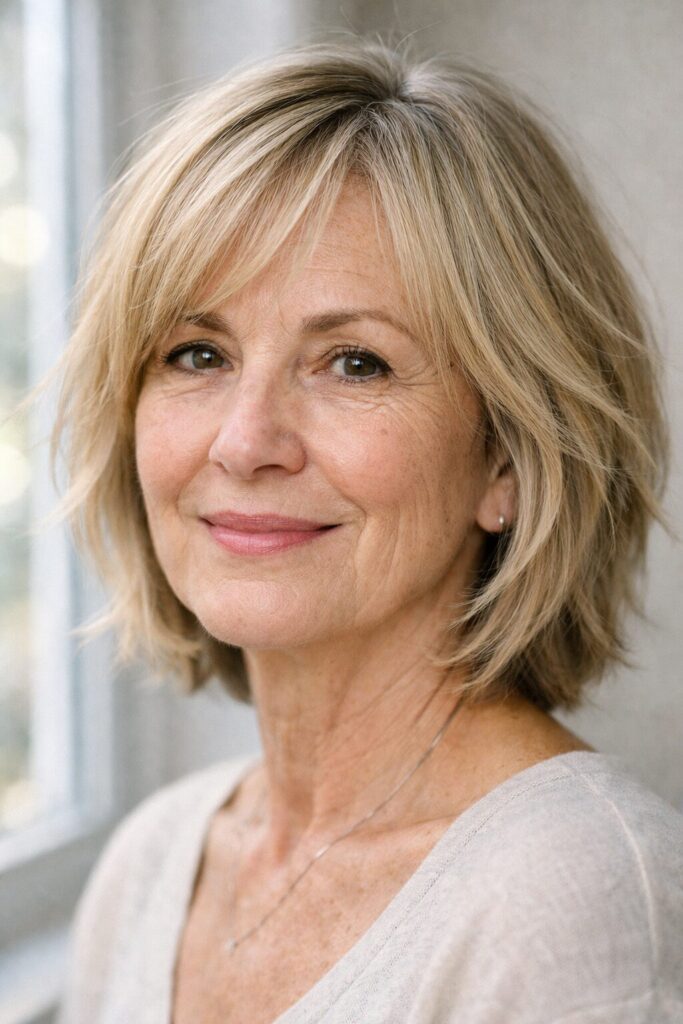
The collarbone length is a genuine sweet spot for fine hair after 60. It’s long enough that the hair feels substantial and styling options remain open — you can wear it straight, wave it, clip it up — but short enough that it holds its volume and shape without collapsing from its own weight. Below the collarbone, fine hair tends to go flat. At the collarbone, it holds.
Softly textured ends at this length prevent the style from looking blunt or boxy, and light movement at the front adds dimension. A loose wave through the lengths is the finishing touch that takes this from a simple cut to a genuinely beautiful, full-looking style.
Ask your stylist for: Long internal layers beginning below the cheekbones — well below, so the perimeter stays full. Softly textured ends that move rather than lying flat. The overall shape should be rounded and full, not angular or boxy.
Styling tip: A large-barrel curling iron used through just the mid-lengths and ends — leave the roots untouched — creates a loose, natural-looking wave that adds significant volume. Shake the waves out gently with your fingers and finish with a flexible-hold spray for bounce that lasts all day.
8. Layered Pixie Bob
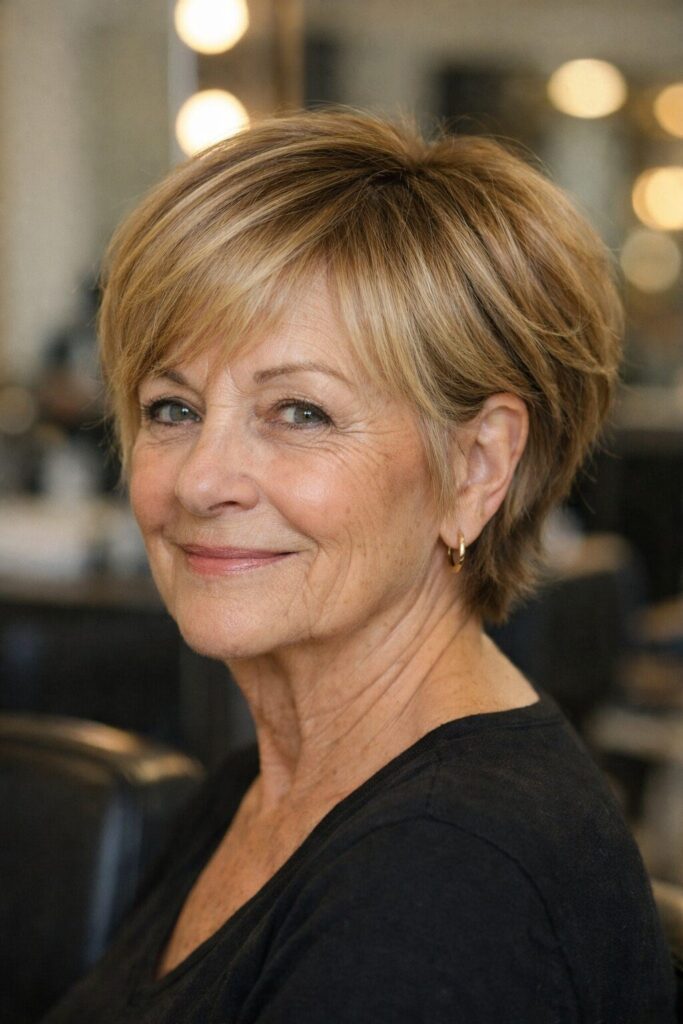
The layered pixie bob sits in a particularly useful zone for fine hair: long enough at the front and sides to feel soft and feminine, short enough overall to avoid the weight-related flattening that longer fine hair suffers. Compact layers through the crown create fullness exactly where it’s most visible, while the longer front sections can be tucked behind the ear or left to frame the face depending on the mood.
It’s a polished, put-together cut that looks intentional at every growth stage — one of the most practically useful qualities any haircut can have.
Ask your stylist for: Compact, tightly blended layers through the crown — nothing too long or too spread out. Skip heavy thinning shears entirely, which remove weight from areas where fine hair can least afford to lose it. A slightly longer front section than back for the most flattering profile.
Styling tip: A root-lifting spray applied directly to the crown before blow-drying gives this style maximum volume at the most important point. Finger-dry the crown upward as you go — no brush needed. The result looks consistently full with minimal effort.
9. Loose Natural Curls
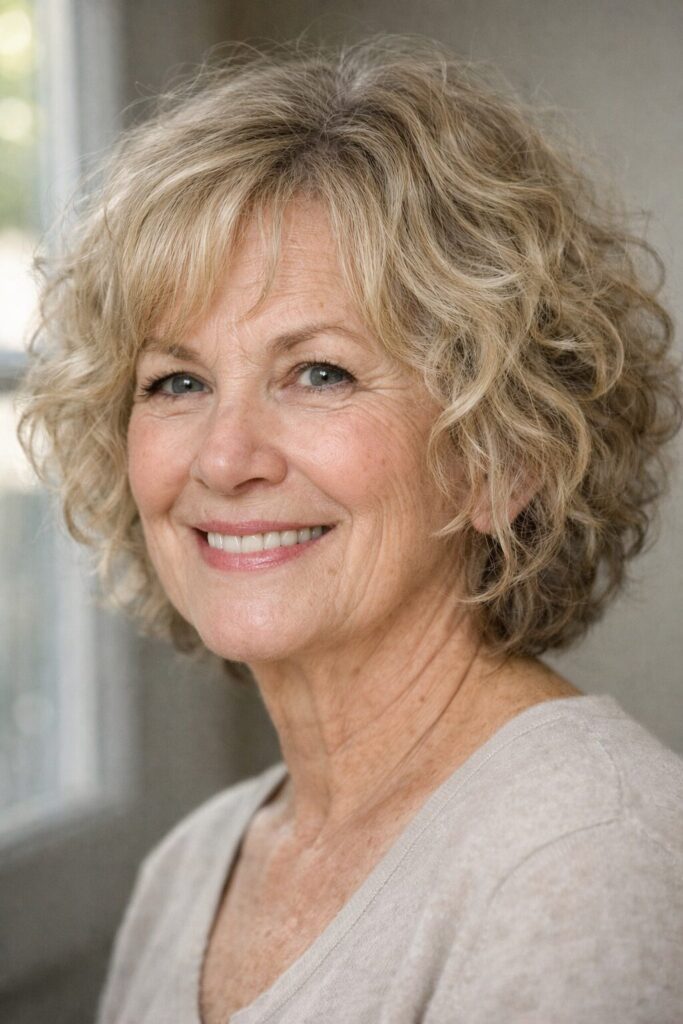
Natural curl texture is one of the most powerful volume tools available to fine-haired women — because curls and waves create bends in the hair shaft that add width, body, and dimension that straight hair simply cannot replicate. A cut designed to support rather than fight the natural curl pattern, with layers that let each curl form fully rather than weighing it down, transforms fine curly hair from something that feels unmanageable into something genuinely stunning.
The key for fine curly hair is avoiding layers that are too short — short layers can cause curl shrinkage and make the overall shape look smaller and sparser. Longer layers that support the curl pattern produce the fullest, most flattering result.
Ask your stylist for: Layers specifically designed for your curl pattern — ask for “curl-friendly layering” or request a stylist experienced with natural texture. Gentle face-framing that doesn’t remove too much hair from around the hairline. Consider requesting a dry cut, which lets your stylist see how the curls actually fall before cutting.
Styling tip: A curl-defining cream worked through soaking-wet hair, followed by diffusing on low heat with a bowl diffuser, gives fine curly hair the most defined and voluminous result. Avoid touching the curls as they dry — disrupting the curl formation creates frizz that flattens the volume.
10. Loose Silver Waves
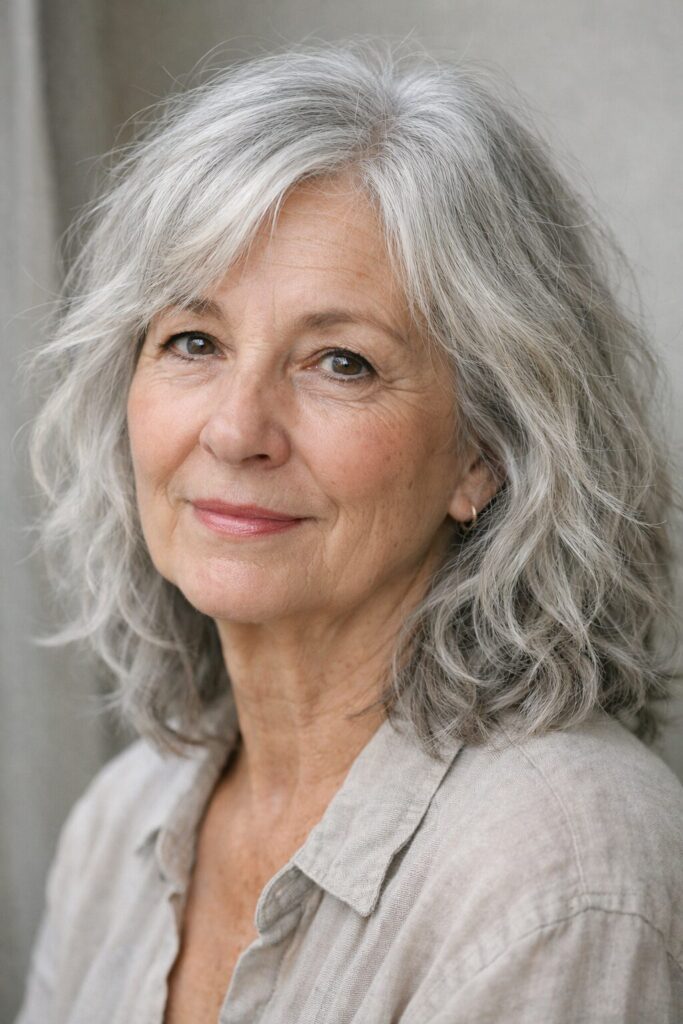
Natural silver and gray hair looks luminous in a loose wave style — the wave catches the light across the full length of the hair, showing off the gorgeous tonal variation in gray that flat, straight styles often flatten and dull. At shoulder length with gentle internal layers, loose silver waves create a style that feels both effortless and sophisticated.
This is one of those hairstyles that photographs beautifully and looks just as good in person as it does in pictures — which is not something every style can claim.
Ask your stylist for: Long internal layers past the shoulders that support wave formation. Lightly textured ends rather than a blunt hemline — just enough texture to enhance the movement of the waves. A length that sits somewhere between the collarbone and the shoulder for the most flattering silver wave effect.
Styling tip: For straight or mostly straight silver hair, a large-barrel curling iron (1.5 inches or larger) worked through the mid-lengths and ends creates a loose, natural wave. A flexible-hold spray set on low, misted from 12 inches away, holds the wave without crunch. Finger-comb gently to soften the waves before the spray fully sets.
11. Messy Brunette Bob
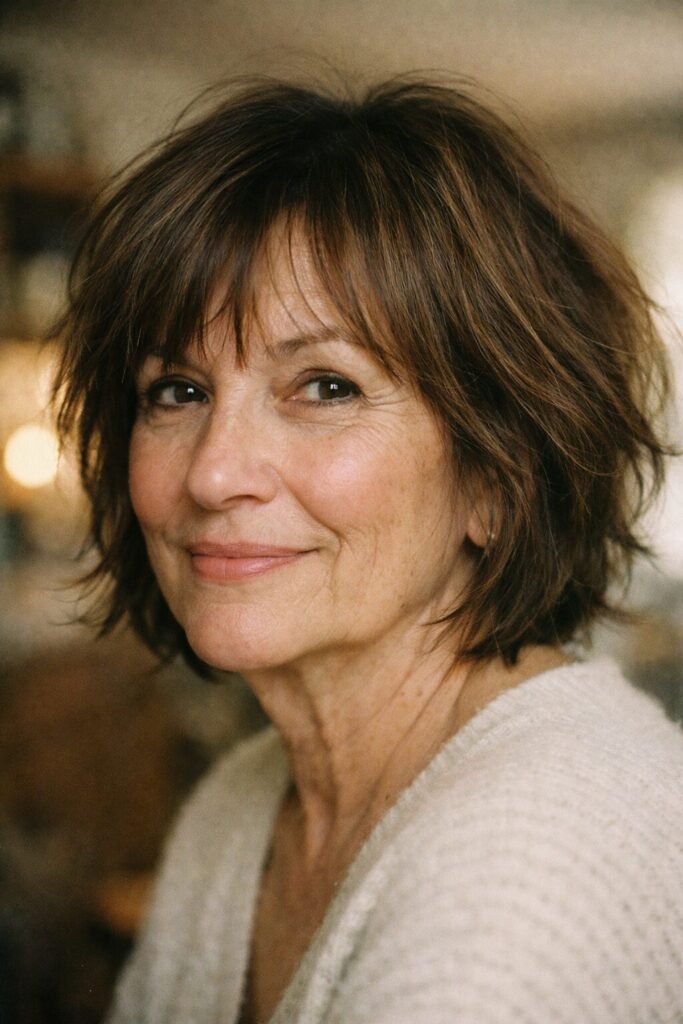
The intentionally undone quality of a messy bob is one of the best things you can do for fine hair — because it removes the expectation of perfection and replaces it with something that looks better as the day goes on. The piecey, textured layers create separation in fine hair that reads as fullness, and the light fringe adds a soft front element that anchors the whole style.
It’s a cut that looks like you styled it for five minutes when you actually spent two. That’s the goal.
Ask your stylist for: Subtle internal layers — not heavy throughout, but enough to create that lived-in separation. Piecey, point-cut ends through the lengths. A light fringe that blends into the layers rather than a separate, defined section. Avoid heavy thinning or razoring, which can make fine hair look excessively wispy.
Styling tip: A dry texture spray applied to dry hair — not wet — and scrunched through the lengths brings this style to life in under a minute. Work it in at the roots first for lift, then through the mid-lengths for separation. Don’t brush it out after applying — that would undo all the texture.
12. Piecey Fringe
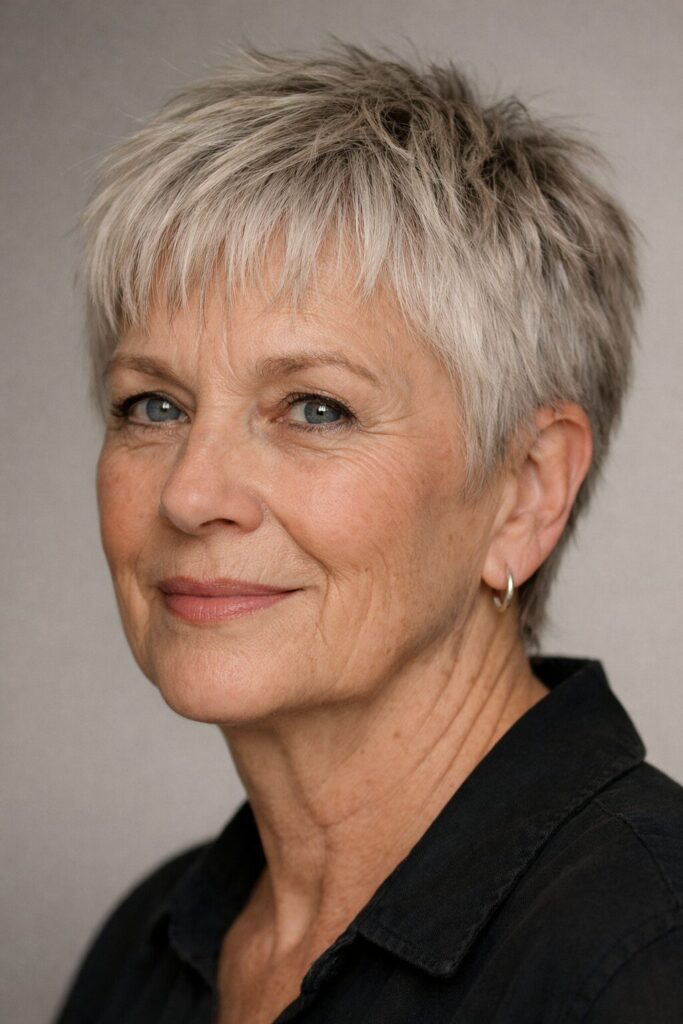
Sometimes the single most impactful change you can make to a fine hair situation is adding a fringe — and the piecey version is the most low-commitment, high-impact option available. It frames the eyes beautifully, creates an immediate focal point at the forehead, and makes the front of the hair look fuller and more deliberate without requiring the density of a full blunt bang.
The fringe pairs beautifully with a soft, easy length that can be worn straight or with a gentle wave — the fringe does the styling work, and the rest of the hair gets to stay relaxed.
Ask your stylist for: Airy, blended bangs that transition seamlessly into soft layers rather than sitting as a defined, separate section. Light pomade or texturizing paste at the ends of the bangs only creates that signature piecey separation — tell your stylist you want the fringe to look “effortlessly separated, not slicked or flat.”
Styling tip: A small round brush used on the bang section during blow-drying sets the shape and prevents separation. Once dry, pinch a few individual pieces with a tiny amount of lightweight pomade on your fingertips to create that deliberate piecey finish. Avoid applying product at the roots of the bangs, which will weigh them down.
13. Pixie Undercut
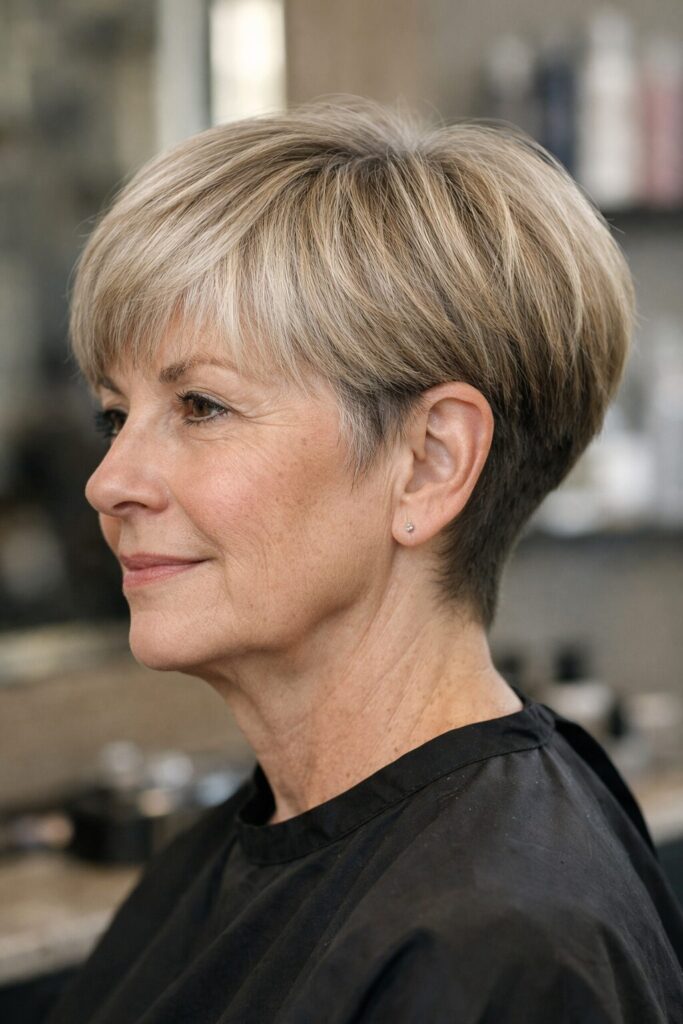
The undercut pixie removes weight from the sides and underneath, pushing all the visual volume upward toward the crown — and for fine hair, that redistribution of weight is genuinely transformative. The contrast between the close-cropped sides and the fuller, textured top creates a dynamic silhouette that makes fine hair look significantly more abundant than it actually is.
It’s a bold choice that doesn’t require as much styling courage as it might initially seem. The close sides actually make the style easier to maintain, and the textured top does all the expressive, interesting work.
Ask your stylist for: A longer, textured top section that provides the volume and visual interest. Undercut sides that are close but not severe — you want contrast, not a harsh line. Specify that the top should be kept long enough to blow-dry forward and upward for maximum crown lift.
Styling tip: A root-lifting spray at the crown before blow-drying, then finger-dry the top section upward and forward for lift. A small amount of lightweight wax or paste worked through just the top section adds texture and hold without weighing fine strands down.
14. Platinum Undercut Pixie Bob
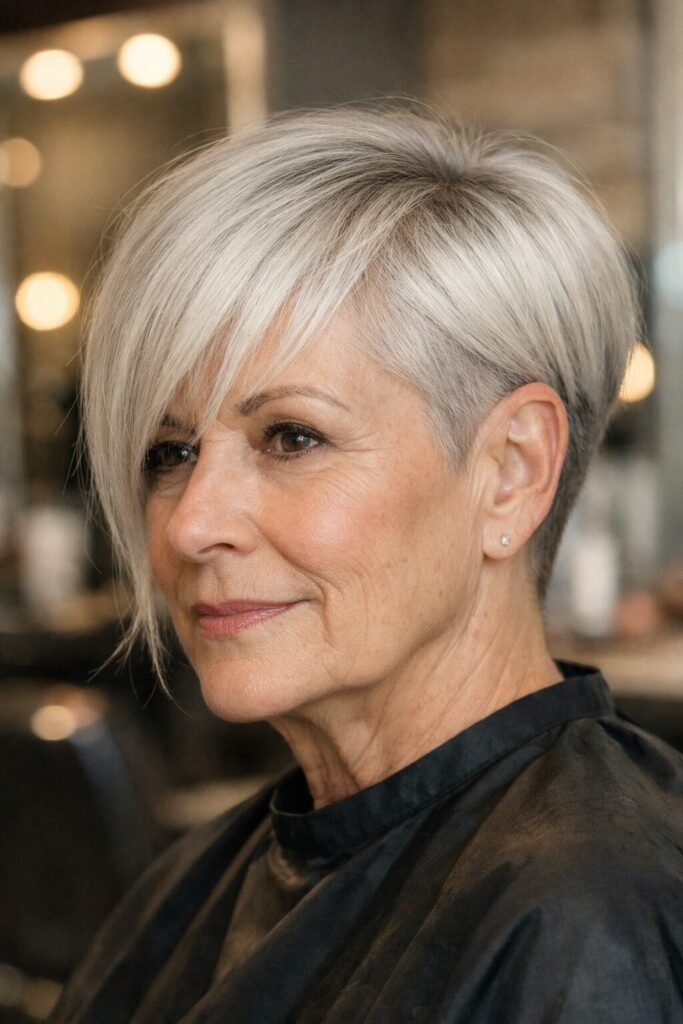
Everything that makes the pixie bob flattering for fine hair is amplified here by the addition of platinum color and an undercut. The platinum tones add high-contrast brightness that photographs with incredible richness and makes fine hair look visually fuller in person. The undercut keeps the sides controlled while the longer top section and fringe create drama and directional interest.
The long fringe is the defining feature — it creates a bold, editorial quality that gives the style genuine impact without requiring much hair density to pull off.
Ask your stylist for: A controlled, clean undercut at the sides. A longer top section with light internal layering for lift. A long, dramatic fringe that can be worn forward or swept to one side. If you’re coloring, ask your colorist about platinum toning that suits your skin’s undertone — cool platinum for cooler complexions, slightly warmer platinum for warmer skin.
Styling tip: A smoothing cream applied through the fringe while slightly damp, then blow-dried forward with a flat brush or paddle brush, gives the fringe that sleek, directional finish. A small amount of root-lifting spray at the crown before drying adds the volume contrast that makes this style look so striking.
15. Shattered Lob
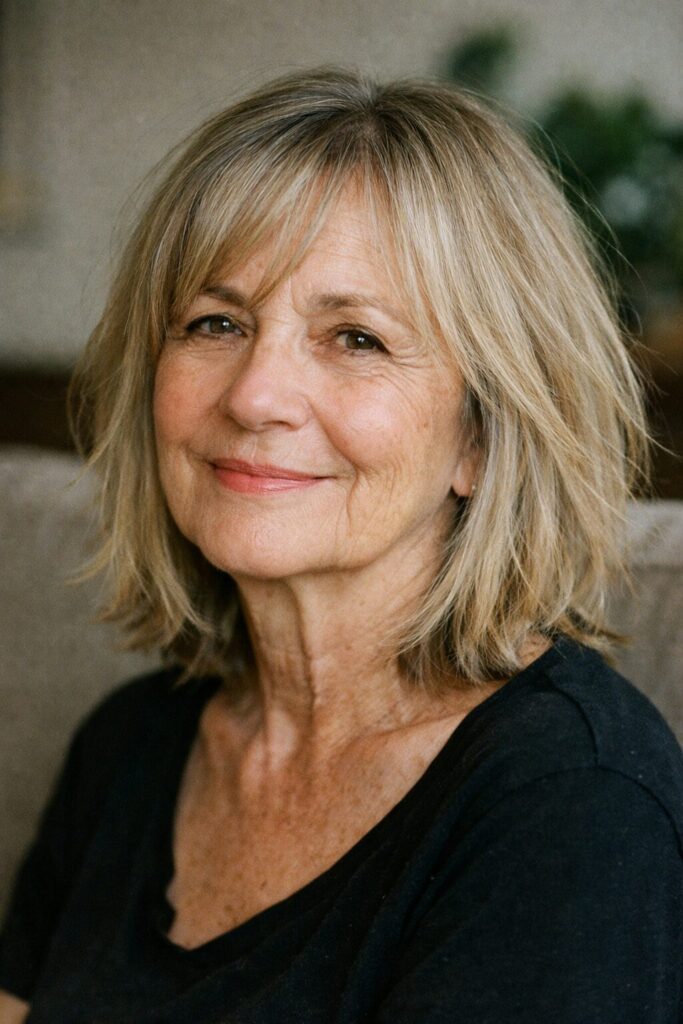
A shattered lob takes the classic lob and adds multiple light layers through the ends that create a fluid, moving quality — “shattered” refers to the light, multi-directional ends that catch the light differently as the hair moves. The result feels modern and effortlessly styled even when you’ve done very little to it.
For fine hair, the key is keeping those layers long and concentrated in the lower half of the style — short layers throughout would thin the perimeter, but long, light layers through the bottom half add movement while keeping the crown area full and dense.
Ask your stylist for: Long shattered layers focused on the bottom half of the lob only. The crown and upper sections should remain fuller and less layered. Flexible, light texture at the ends rather than heavy or blunt cuts.
Styling tip: A few loose waves added with a large-barrel iron through the mid-lengths and ends — combined with the shattered layering — creates a genuinely beautiful, magazine-worthy finish. A light flexible spray holds the movement without killing the natural flow of the layers.
16. Shoulder-Length Layers
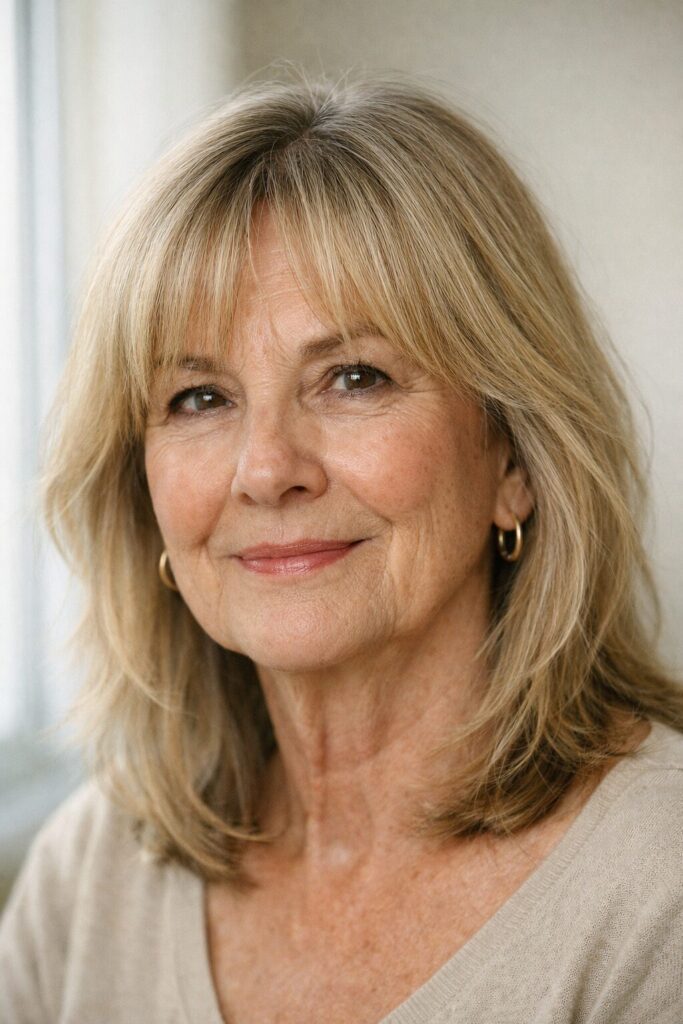
Shoulder length is the safe, reliable sweet spot for fine hair that’s not quite ready to go shorter — and with the right layering, it’s anything but boring. Face-framing layers that start at the cheekbones give the front of the style a lifted, flattering quality, and the shoulder length keeps everything in the zone where fine hair holds its shape most reliably.
This is the cut for the woman who wants options — it can be worn straight, waved, half-up, or clipped — while still having a specific, flattering shape when worn down.
Ask your stylist for: Face-framing layers starting at the cheekbone — not higher, which can over-layer the crown area. Internal layers through the top for lift. A shoulder-length hemline that’s strong enough to look full and healthy.
Styling tip: A round brush through the lengths during blow-drying — rolling it under at the ends — gives this style its full, bouncy finish. A hot brush or large-barrel curling iron used afterward adds extra volume and softness around the face for days when you want more impact.
17. Sleek Side-Part Pixie
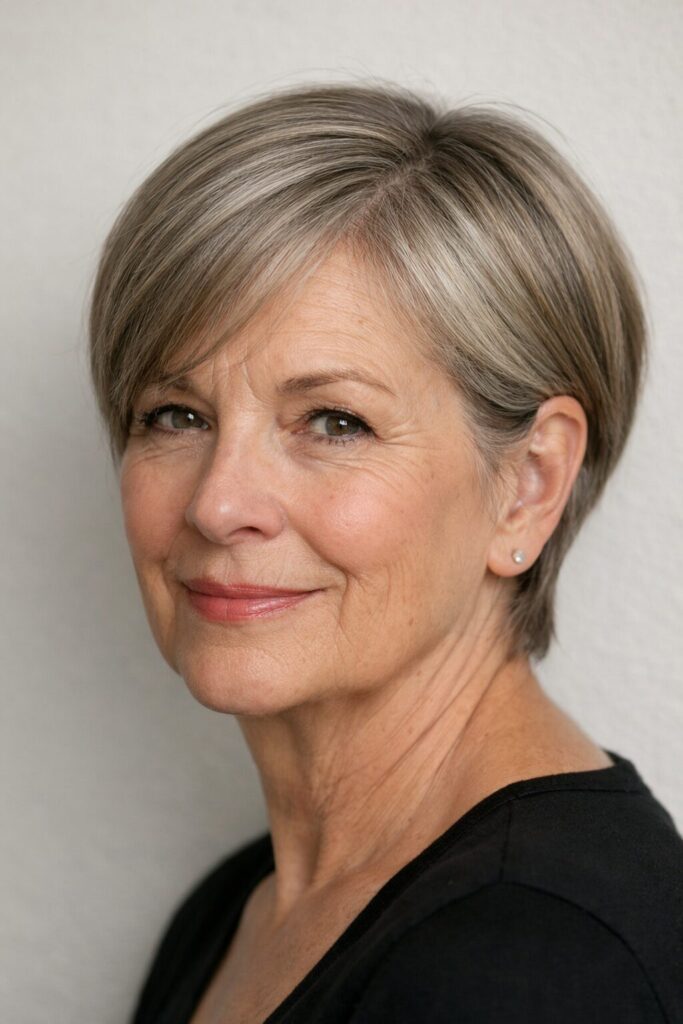
The side part is one of the simplest, most effective styling tricks for creating volume on fine hair — it breaks the symmetry, creates natural lift on the parted side, and immediately gives the silhouette a more dynamic, intentional quality. On a sleek pixie cut, it elevates the style from clean and simple to polished and purposeful.
The clean taper around the ears and nape keeps the structure precise and the overall look sophisticated rather than casual.
Ask your stylist for: A clean taper at the ears and nape — well-executed tapering is what gives this style its polished, finished quality. A longer top section that can be swept to the side cleanly. Specify a “sleek” rather than “textured” finish if you want the smoothed, intentional look this style is known for.
Styling tip: A tiny amount of lightweight serum worked through the lengths before blow-drying gives this style its smooth, polished finish. A small amount of sculpting paste through the top section, smoothed in the direction of the part, holds the side sweep cleanly. Use a fine-tooth comb to create a precise part line before applying product.
18. Soft Fringe Feathered Layers
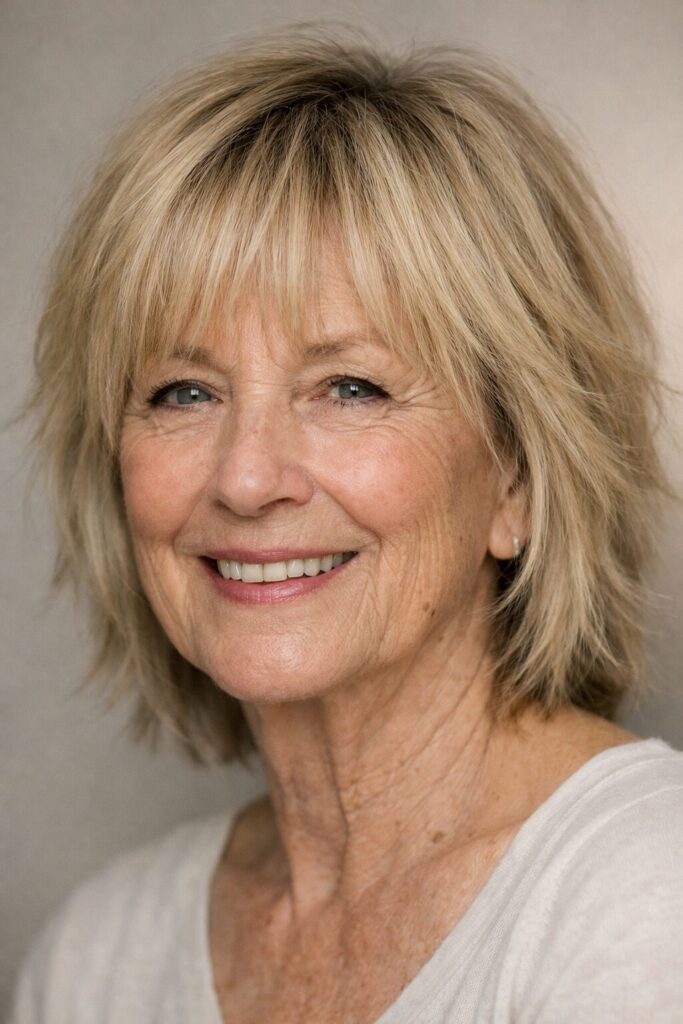
The combination of a soft fringe and feathered layers creates one of the most reliably flattering hairstyles for fine hair after 60 because each element does a specific, complementary job. The fringe keeps the front gentle and covered — softening the forehead and adding a focal point at the eyes. The feathered layers add lift at the crown and movement through the lengths without removing the perimeter density that fine hair needs to look full.
Together they create a complete, balanced style that looks put-together from every angle without requiring significant daily styling effort.
Ask your stylist for: Light feathering — emphasize the word “light.” Heavy feathering removes too much weight from fine hair and leaves the ends looking sparse. A soft fringe that blends naturally into the layers. Internal layering at the crown for lift, with a stronger, cleaner perimeter.
Styling tip: A round brush used on the fringe section while blow-drying sets the shape and prevents the bangs from separating. Dry shampoo applied at the roots and then fluffed with fingertips refreshes the volume between washes without weighing down the feathered layers.
19. Stacked Back With Gentle Graduation
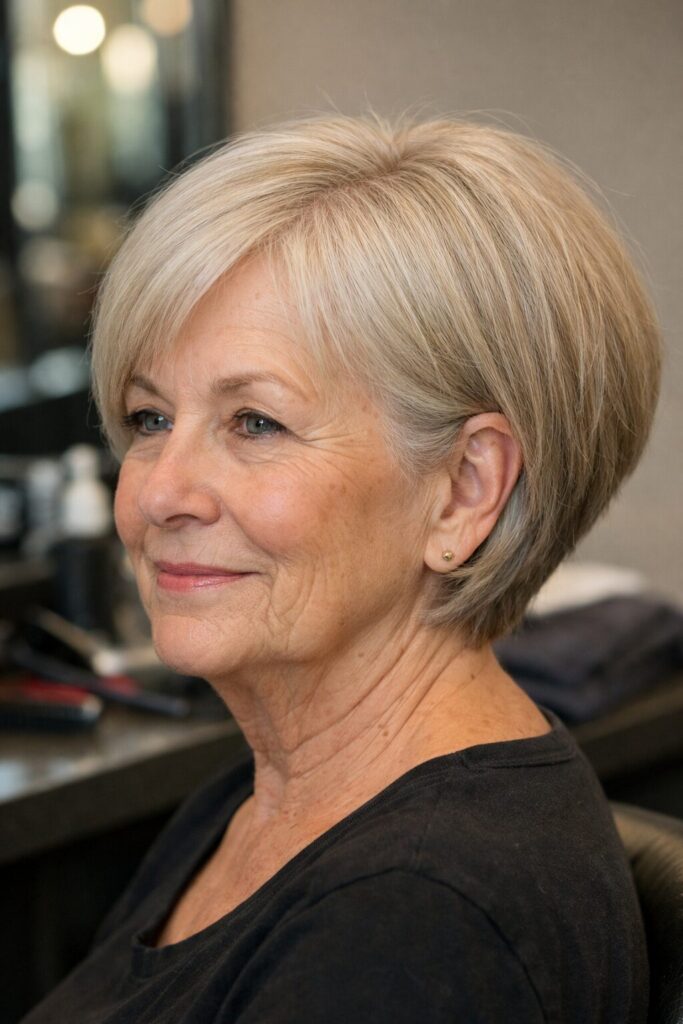
The stacked back is one of the most architecturally brilliant haircuts for fine hair because it builds volume precisely where fine hair most consistently loses it — at the back of the head, where strands fall flat against the skull. By stacking shorter layers underneath progressively longer ones, the stylist creates a rounded, lifted shape at the nape and back that gives the entire silhouette a full, three-dimensional quality.
The gentle graduation, rather than an aggressive or sharp stack, keeps the transition smooth and the overall shape flattering rather than boxy.
Ask your stylist for: A clearly defined stack at the back — ask to see the back shape in a hand mirror before leaving the salon. Gentle, smooth graduation rather than an aggressive or overly sharp stack. A tidy, clean neckline that frames the back of the neck neatly.
Styling tip: A small round brush used at the back during blow-drying — rolling it upward into the stack as you dry — is the key technique for making this style reach its full potential. Work from the lowest sections upward. A cool air blast after each section sets the volume in place before moving to the next.
20. Tapered Pixie With Softly Defined Sideburns
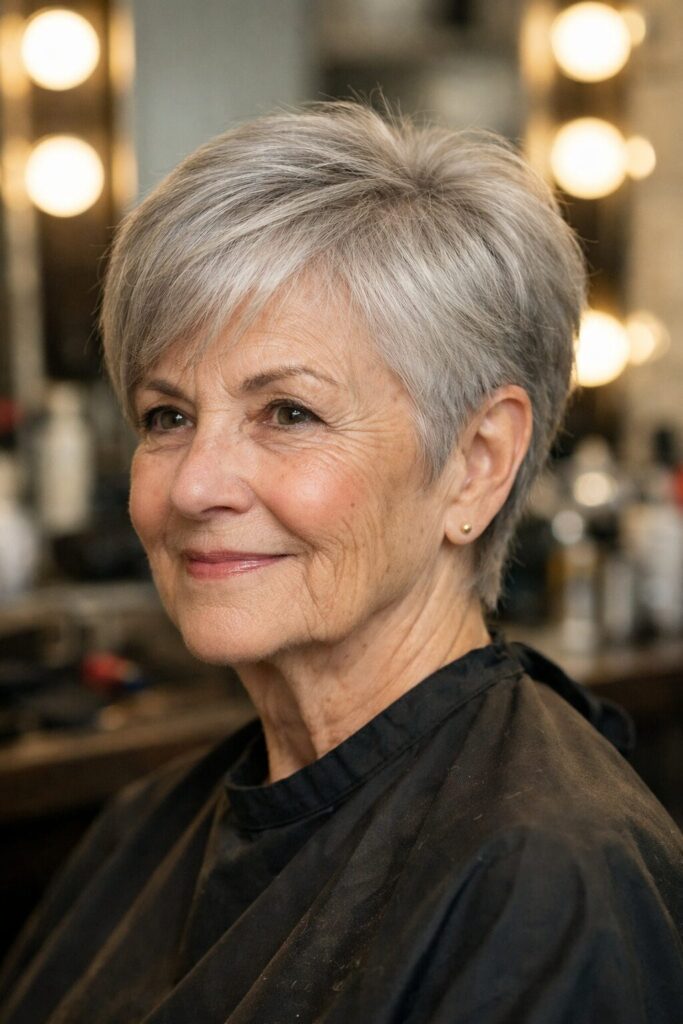
The tapered pixie with defined sideburns is for the woman who wants her short style to feel refined and deliberate rather than simply short. The tapering at the temples and sides creates a sculpted quality that gives the style genuine elegance, while the softly defined sideburns add a subtle framing detail at the jawline that’s both modern and flattering.
For fine hair, the structured outline does a brilliant job of directing attention to the face and creating a strong, confident silhouette that doesn’t depend on hair density for its impact.
Ask your stylist for: Soft texture on top — enough to create lift and separation, not so much that the crown looks sparse or over-worked. A smooth, clean taper at the temples with softly shaped sideburns rather than hard-cut lines. Specify “soft definition” rather than sharp or severe angles.
Styling tip: A light wax or texture paste worked through dry fingertips and pressed gently through the top section separates the fine strands and builds volume simultaneously. Use the very tips of your fingers rather than your whole hand to avoid over-applying product and flattening the crown.
How to Maximize Volume on Fine Hair After 60: The Complete Styling Guide
A great haircut gives you the foundation, but the right technique takes it the rest of the way. Here’s everything worth knowing about styling fine hair after 60 for maximum volume and hold.
Start every style with a volumizing base. A lightweight volumizing mousse or root-lifting spray applied to damp hair before blow-drying is the single most impactful styling step for fine hair. It gives the strands something to hold onto during drying and creates a scaffold of light volume that lasts through the day.
Blow-dry upside down for the first 60 seconds. This sounds simple — because it is — but it dramatically increases root volume on fine hair. The initial rough-dry upside down lifts the roots away from the scalp before they’ve had a chance to set flat. Once you flip upright, the roots retain some of that initial lift.
Use a round brush, not a paddle brush, for volume. A paddle brush smooths and flattens. A round brush lifts and creates movement. Even a quick 10-minute blowout with a medium round brush creates significantly more volume than the same amount of time with a paddle brush.
Cool air sets volume better than hot air. After drying each section, give it a blast of cool air from your dryer before releasing the brush. The cool air sets the shape in place — without it, the hair can fall flat as it returns to room temperature.
Dry shampoo is a styling tool, not just a refresh product. Applied to dry roots before a style is looking flat, dry shampoo absorbs oil, adds texture and grip, and lifts the roots. Used proactively rather than reactively, it extends the life of a style by hours.
Choose flexible-hold products over strong-hold ones. Maximum-hold sprays and gels can weigh fine hair down and flatten the volume you’ve worked to create. Flexible-hold sprays hold the shape while allowing natural movement — which is exactly what fine layered hair needs to look its best.
Best Products for Fine Hair Over 60
Volumizing mousse: Applied to damp roots before blow-drying. Look for lightweight formulas labeled “volumizing” rather than “defining” or “smoothing.”
Root-lifting spray: Targeted directly at the roots on damp hair. More concentrated than mousse and extremely effective on fine hair that collapses at the crown.
Dry shampoo: Both for oil absorption and as a volume tool. Use at the roots proactively, not just when hair looks greasy.
Lightweight texturizing spray: A mist through dry hair that adds separation and movement. One of the most useful finishing products for fine layered styles.
Flexible-hold finishing spray: The non-negotiable final step for any fine hair style. Holds the shape without adding weight or stiffness.
Light smoothing serum: Used sparingly on the ends only — never the roots — to add shine and prevent frizz without weighing fine strands down.
Final Thoughts
Fine hair after 60 is not a problem to be solved — it’s a texture to be understood and worked with rather than against. The right cut, built around your specific density, texture, face shape, and styling habits, genuinely changes the experience of having fine hair from something that requires constant management to something that looks beautiful with minimal effort.
Start with the shape. A blunt or close-to-blunt hemline creates the thickness illusion at the ends. Light internal layering lifts the crown. A soft fringe of some kind — however subtle — adds a front focal point that transforms the profile. Then find the right styling products and techniques to support the cut, and let the haircut do the rest of the work.
Fine hair after 60 has more potential than most people realize. The right cut is where that potential starts.
Found your next style? Save your favorites and bring them to your next appointment — the more specific you can be with your stylist, the better your result.
What haircut makes fine hair look thickest after 60?
A blunt or close-to-blunt bob or lob is consistently the most effective cut for creating the appearance of thickness. The aligned hemline creates a visual density at the ends that reads as fullness even when individual strands are fine. Light internal layering for crown lift, combined with a strong perimeter, gives you the best of both worlds — volume at the top and density at the ends.
Are layers good or bad for fine hair after 60?
Layers are good when used correctly and problematic when overdone. Light internal layers at the crown — used to create lift and movement — are genuinely beneficial for fine hair. Heavy layering throughout the lengths, especially close to the perimeter, thins the ends and makes fine hair look sparse. The phrase to use at your salon is “soft internal layering with a strong perimeter.”
What is the easiest hairstyle to maintain with fine hair over 60?
A bob, pixie, or lob with a clean shape that suits your natural texture is consistently the easiest to maintain. The shorter the style, the less daily effort required. If you genuinely prefer to air-dry, tell your stylist and ask specifically for a cut that holds its shape without heat — most good stylists can tailor the layering and perimeter to suit an air-dry lifestyle.
Should I get bangs if I have fine hair?
Bangs of almost any style are generally beneficial for fine hair because they add a focal point at the forehead that draws the eye away from any thinning at the crown or temples. The softer the bang — wispy, curtain, or side-swept — the lower the maintenance commitment. Avoid very thick, heavy blunt bangs, which require enough hairline density and consistent daily styling to look intentional rather than sparse.
How often should I trim fine hair after 60?
Every five to six weeks for shorter styles like pixies and bobs. Every six to eight weeks for lob and shoulder lengths. Fine hair shows split ends and growth more visibly than thicker hair, and a style that’s past its trim date will start to lose its shape and fullness quickly. Consistent trims are one of the most underrated tools for keeping fine hair looking its best.
What products should I avoid on fine hair?
Heavy oils and serums applied at the roots will flatten fine hair almost immediately. Rich, thick styling creams used throughout rather than just at the ends add weight that fine strands struggle to support. Alcohol-heavy sprays can dry out mature fine hair and cause breakage. And heavy-hold gels create a stiff, unnatural finish that draws attention to the thinness of fine hair rather than disguising it.